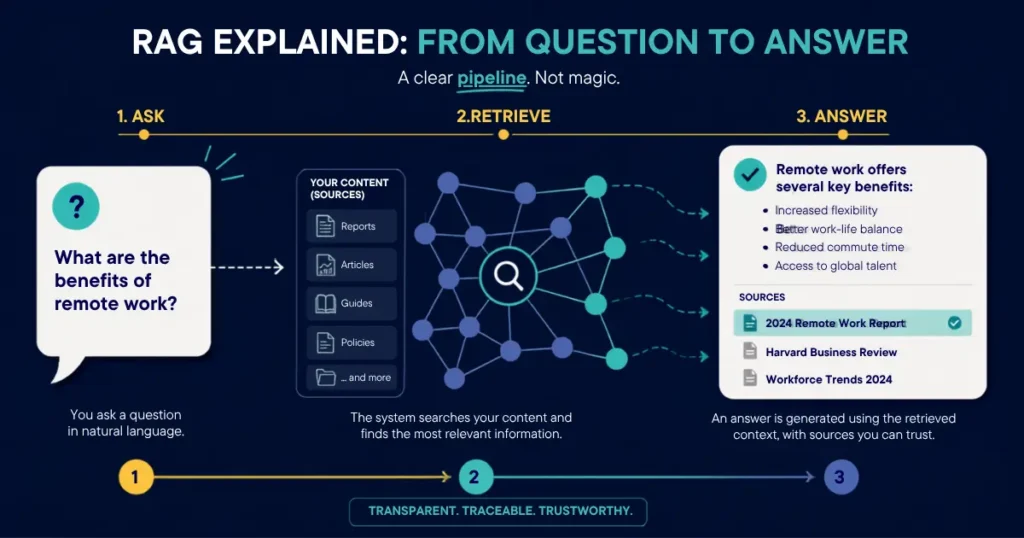
How to Measure GEO: A Practical Framework for Tracking AI Search Visibility
Quick answer:
There is no single GEO score. Measure generative engine optimization with first-party search data plus repeatable AI-search testing. Track citation rate, brand mention rate, citation prominence, answer-level influence and share of voice across a fixed prompt set on the AI platforms your audience uses.

We run a test property that ranks on page one of Google for questions about Pakistan’s 2026-27 budget. Over three months it collected 15,400 impressions across 208 queries at an average position of 8.5.
Then we asked ChatGPT and Perplexity the same question those queries represent. Neither cited it. Not once.
That gap — visible in classic search, invisible in generated answers — is the entire reason how to measure GEO is a harder problem than it looks. Ranking reports don’t describe what an AI system does with your content, and most of the metrics people quote for generative engine optimization are numbers nobody can verify.
This guide covers what changed in Google’s guidance in 2026, what Search Console will and won’t tell you, and a measurement framework you can run yourself. Every screenshot is from a property we own. Where a claim comes from Google’s documentation, it’s linked. Where something is our interpretation, it says so.
What We Found on Our Own Test Property
We maintain a separate property, NDM MarketLatch (nadeem.marketlatch.com), for testing. It is a different brand from Market Latch, and every figure and screenshot in this section comes from that property — not from client work and not from this site.
One of its better-performing sections covers Pakistan’s 2026-27 federal budget: a salary increase guide and a take-home pay calculator. Factual, timely, locally specific content — on paper, exactly the kind of thing an AI answer engine should want
What Search Console shows
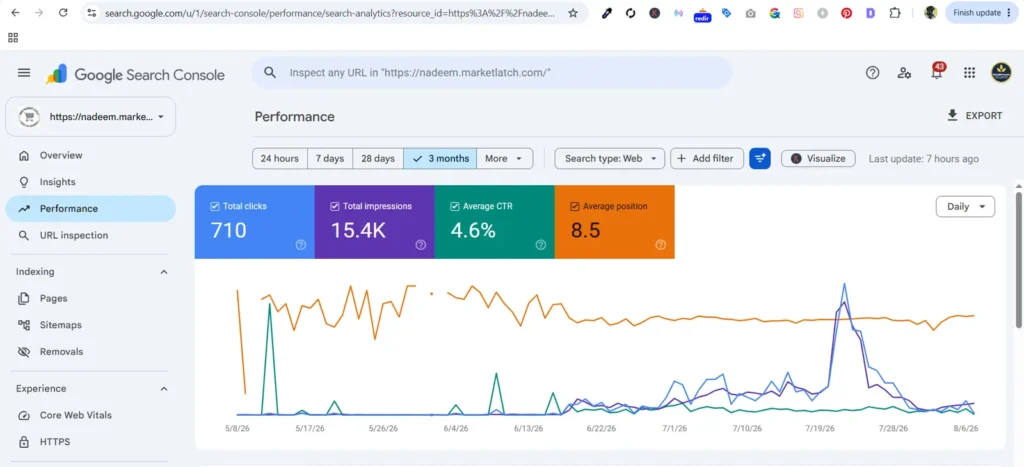
Search Console on our test property, nadeem.marketlatch.com, 8 May to 6 August 2026.
Three months: 710 clicks, 15,400 impressions, 4.6% click-through rate, average position 8.5. The spike in mid-July tracks the budget content.
The queries behind it are unambiguous. These are people asking exactly the question the content answers.
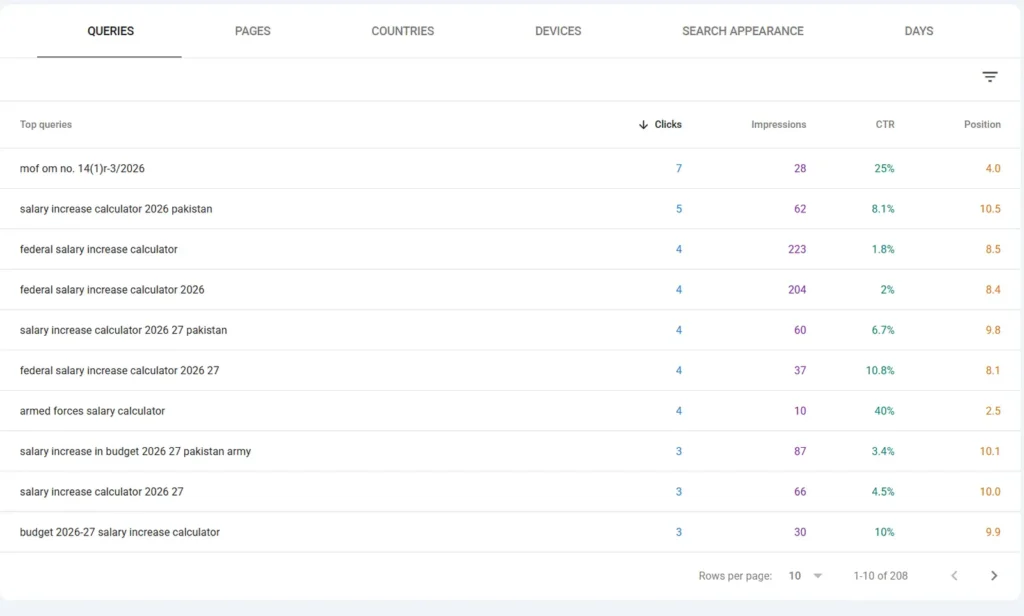
Top queries for nadeem.marketlatch.com over the same period. 208 queries in total; the top ten sit between position 2.5 and 10.5
“Armed forces salary calculator” sits at position 2.5 with a 40% click-through rate. “Federal salary increase calculator” pulls 223 impressions at position 8.5. Nine of the top ten queries are budget or salary-calculator variations.
By any traditional measure, this content works.
What the AI answers showed
On 10 August 2026 we asked both ChatGPT and Perplexity a plain-language version of the same question: “How much more will I earn after the Pakistan budget 2026-27?”
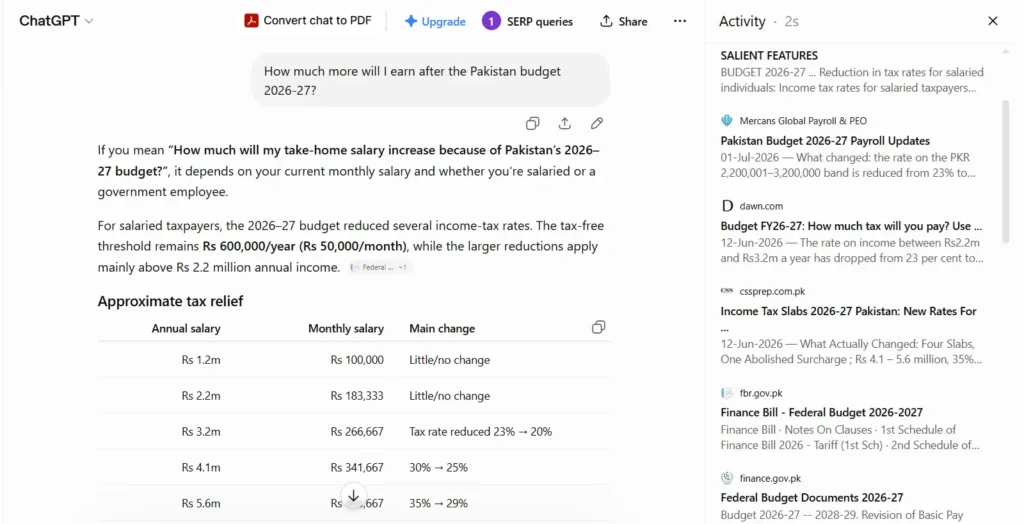
ChatGPT, 10 August 2026. Sources included dawn.com, fbr.gov.pk, finance.gov.pk, cssprep.com.pk and mytaxcalculator.com.pk. Our property was not among them
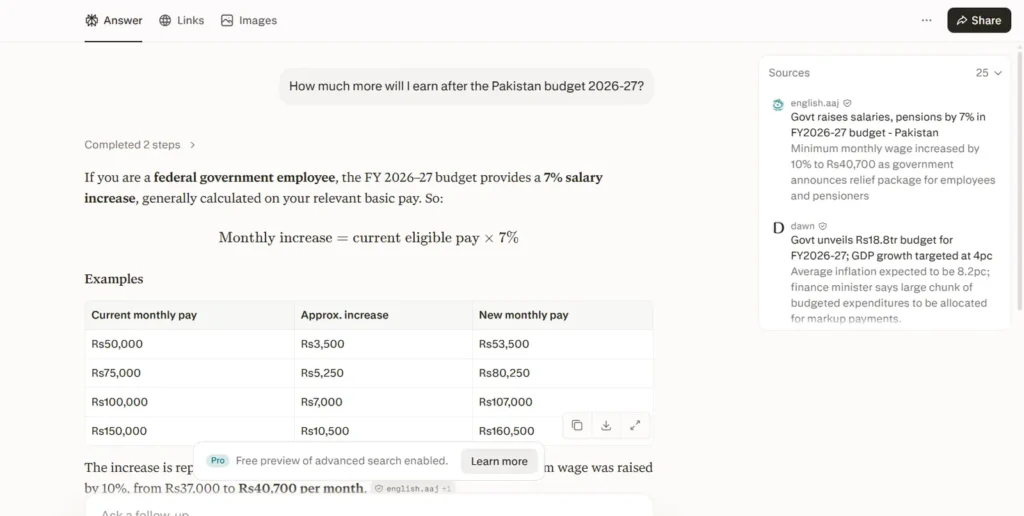
Perplexity, same prompt, same day. Twenty-five sources, led by english.aaj and dawn.com. Again, not us
We ran a third check on an unrelated topic the property also covers — a Google AI Overview for “how to run Meta ads on a small budget.” It cited a LinkedIn post, two niche marketing blogs and a YouTube channel. Not us either.
Three responses, three surfaces, zero citations, for content that ranks in the top ten organically.
What we think is happening
The following is practitioner interpretation, not documented fact. Google publishes how its AI features retrieve information, but nothing about why a specific page was or wasn’t chosen, and nothing at all about how OpenAI or Perplexity decide.
Two patterns stand out from what did get cited.
The cited sources were institutional. For a factual question about national tax policy, the systems reached for the finance ministry, the tax authority and established national newspapers. That is a sensible thing for a retrieval system to do on a high-stakes factual query, and it means a small commercial site is competing against primary sources rather than against other small sites.
Position 8.5 may simply be below the threshold. Google’s AI features are grounded in core Search ranking. Ranking somewhere on page one is not the same as being among the handful of results a system pulls into a generated answer. Our best organic positions on these queries are 8 to 10 — respectable, and possibly not close enough to the top.
There’s a third thing worth admitting. We had Rank Math’s AI Visibility module sitting installed and unconfigured on our main site the whole time, tracking nothing. That is probably true of a lot of people reading this.
What this is not
This is a spot check, not a study. Three responses on one day from one country on one property. It is not a citation rate, and we’re not calculating one from a sample this size — doing that is exactly the error this guide argues against.
What it does establish is the shape of the problem: organic ranking and AI citation are separate outcomes, and you cannot infer one from the other. The full 40-prompt run across three platforms is scheduled; we’ll publish the numbers when it’s done, including if they’re unflattering.
What Generative Engine Optimization Means in 2026
Generative engine optimization is the practice of making your content easier for AI-powered search and answer systems to find, understand, retrieve, reference and represent accurately in generated responses.
That definition is uncontroversial. What changed in 2026 is Google’s public stance on the label.
Google's position, stated plainly
In May 2026 Google published its guide to optimizing for generative AI features on Google Search. It addresses the terminology head-on: Google’s position is that its generative AI features are rooted in its core Search ranking and quality systems, and that from Google Search’s perspective, optimizing for generative AI search is optimizing for the search experience — which is to say, it is still SEO. The guide also points readers toward Google’s guidance on evaluating third-party SEO advice when considering GEO or AEO services.
That’s worth sitting with, because a great deal of GEO content sold in 2025 and 2026 was premised on the opposite claim: that AI search is a separate discipline requiring separate techniques.
Here’s the practical reading. For Google’s surfaces specifically, GEO is not a parallel discipline. Technical eligibility, genuinely useful content and clear structure are what make you eligible, and Google says so directly.
Where the GEO framing still earns its place is everything outside Google. ChatGPT, Perplexity, Claude and Copilot each run their own retrieval, their own crawlers and their own citation behaviour. Google’s documentation describes Google. So the useful version of GEO in 2026 is narrower and more honest than the version sold in 2025: the same content and technical fundamentals, applied across several systems that behave differently, measured separately because no single tool reports on all of them.
Most AI search optimization advice still treats those platforms as interchangeable. Our own spot check suggests they aren’t — ChatGPT and Perplexity answered an identically worded prompt with overlapping but different source sets.
How AI Search Finds and Uses Content
Google now documents two mechanisms by name, which means we can stop speculating about at least this part.
Google's position, stated plainly
Google describes retrieval-augmented generation — also called grounding — as the technique its AI features use to improve accuracy and freshness. The system relies on core Search ranking to retrieve relevant, current pages from the Search index, reviews the information on those pages, and generates a response with clickable links to the pages that support it
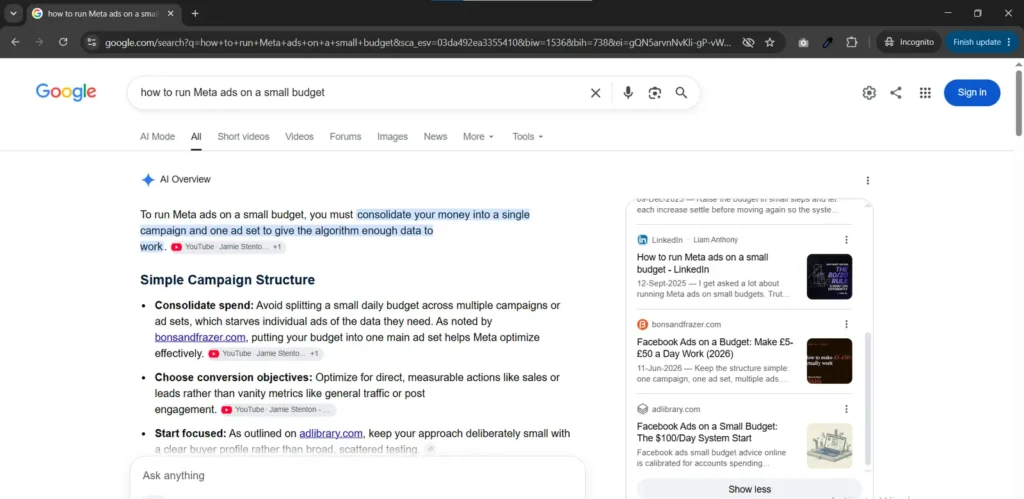
An AI Overview captured 10 August 2026. The linked sources on the right are what Search Console counts as generative AI impressions.
The consequence is unglamorous and important: if a page isn’t indexed and eligible to be shown with a snippet, it isn’t in the candidate pool. Google’s guide states that a page must meet the Search technical requirements and that the site must be included in Search generative AI features in Search Console to be eligible for display.
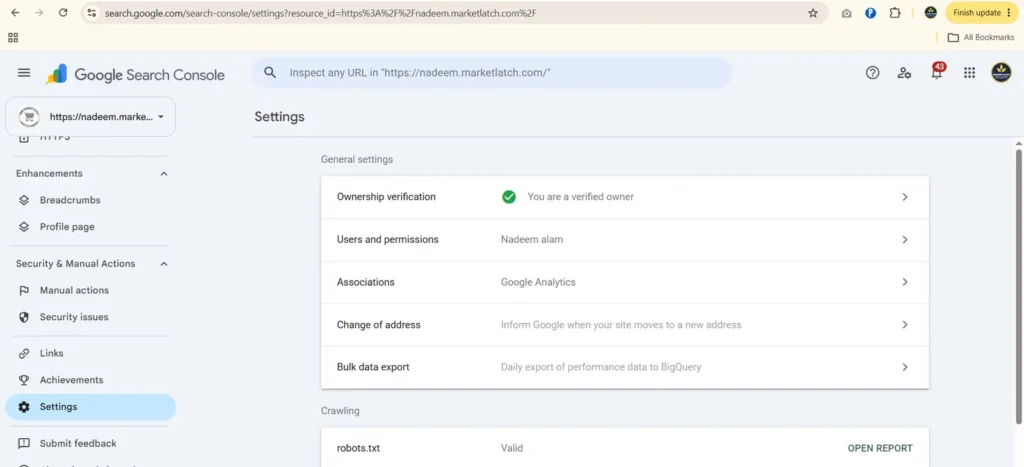
Search Console settings on our test property: ownership verified, robots.txt valid, 606 crawl requests in 90 days. Eligibility starts here, not in your content.
Query fan-out
The second documented mechanism is query fan-out: the model generates a set of concurrent related queries to gather more information than the original question alone would surface. Google’s own example is that “how to fix a lawn that’s full of weeds” might fan out into queries about herbicides, chemical-free weed removal and prevention.
This is where bad advice enters. The tempting conclusion is to build a separate page for every possible fan-out query. Google addresses that directly and says doing so primarily to manipulate rankings or AI responses violates its scaled content abuse policy, and that a high quantity of pages doesn’t make a site higher quality.
The better response to fan-out is depth in one place. A page that genuinely covers a topic — including the adjacent questions a reader would ask next — is a more useful retrieval candidate for several related queries than fourteen thin pages each targeting one variation.
For a stronger foundation, see our semantic SEO framework for organizing entities, topics, and content relationships.
GEO vs SEO: What Actually Differs
The honest comparison is narrower than most GEO-vs-SEO tables suggest, because the inputs are largely the same. The difference concentrates in the output environment and in how you measure it.
| Dimension | SEO | GEO |
| Primary environment | Ranked list of results | Generated answers, with or without visible links |
| Unit of success | A ranking position for a URL | Being retrieved, cited, or accurately represented |
| Query shape | Keywords and phrases | Full questions, comparisons, follow-ups |
| Targeting model | Keywords and intent | Topics, entities and relationships |
| Technical foundation | Crawlability, indexability, page experience | Identical — plus eligibility for generative AI features |
| Content requirement | Helpful, people-first content | Identical — Google names non-commodity content as the strongest lever |
| Click behaviour | Impression leads to a click or it doesn’t | Visibility can occur with no click at all |
| First-party data | Impressions, clicks, CTR, position, queries | Impressions only, in the generative AI report; nothing first-party outside Google |
| Measurement method | Reporting | Reporting plus your own repeatable testing |
Read the bottom two rows together and the real gap becomes obvious. For traditional search you get a query-level report — the one shown earlier in this article. For AI search you get a partial impressions report on Google’s surfaces and no vendor-neutral reporting at all on anyone else’s.
GEO vs AEO
AEO — answer engine optimization — is generally used for the narrower job of making content easy to lift as a direct answer: clear definitions, question-shaped headings, self-contained passages. GEO is used more broadly for visibility and representation inside generative experiences.
Google treats both terms as describing the same underlying work. In practice the overlap is large enough that maintaining separate strategies wastes effort. One well-structured page that answers its question early, backs claims with evidence and connects clearly to related topics serves SEO, AEO and GEO at once.
For the answer-engine side in depth — passage structure, question targeting, schema decisions and the trade-offs involved — that’s the subject of the AEO Masterclass guide. For the wider picture of how AI search systems discover and cite sites, the ChatGPT SEO pillar guide covers retrieval pipelines, crawler behaviour and entity signals across platforms.
How to Measure GEO
Eight measurements, in the order we’d build them
| Metric | What it measures |
|---|---|
| AI citation rate | How often your site is cited |
| Brand mention rate | How often your brand is named |
| Citation prominence | Where your source appears |
| Answer-level influence | Whether your information shaped the answer |
| AI search visibility | Presence across your test prompts |
| Share of voice | Your visibility vs. competitors |
| Accuracy | Whether AI describes you correctly |
| Trend | Change between repeat tests |
Why One AI Answer Is Not a GEO Metric
AI answers can change between runs, platforms, locations and time periods. Treat a single response as an observation, not a performance score. A useful GEO measurement system repeats the same prompt set on a defined schedule and compares the results over time.
Start with Search Console's generative AI performance report
On 3 June 2026 Google announced generative AI performance reports in Search Console, giving site owners a dedicated view of impressions within generative AI features on Search — including AI Overviews and AI Mode — as well as generative AI features in Discover.
Four caveats before you go looking for it:
- Not every property has it.Google’s help documentation notes the report is rolling out to a subset of website owners for testing before wider release. Our test property doesn’t have it — the Performance section shows only the standard Search results view, which is why the screenshots above are the standard report. If you can’t see it either, that alone doesn’t mean you have no AI visibility.
- It’s impressions only.The available dimensions are pages, countries, dates and devices. No query dimension, no clicks, no CTR. It tells you that you appeared, not what it was worth.
- It isn’t new data.These impressions were already inside your overall performance totals. The report separates them out; your aggregate numbers don’t change.
- Eligibility is a prerequisite.If your site is excluded from Search generative AI features you won’t accumulate impressions to report on. Discover has its own separate report.
Even with those limits, this is the only first-party AI-visibility data any platform currently gives you. Start here, and treat everything below as the layer that fills the gaps.
Metric 1: AI citation rate
The share of tested responses in which your site appears as a cited source.
Citation rate = (responses citing your site ÷ total tested responses) × 100
Test 100 prompts, get cited in 28, and your citation rate is 28% for that prompt set, on those platforms, on that date. Those qualifiers aren’t throat-clearing. Change the prompts and the number changes. It measures your test conditions, not something anyone else can reproduce.
And it needs volume. Our three-response spot check tells you something real about the shape of the problem; it does not produce a citation rate, and treating it as one would be exactly the mistake this metric invites.
Metric 2: Brand mention rate
Your brand can be named without being linked — as a recommendation, an example, or the source of a framework. Analytics will never show you this.
Brand mention rate = (responses mentioning your brand ÷ total tested responses) × 100
Track it separately from citations. The two move independently, and a rising mention rate with a flat citation rate usually means you’re being recalled from training rather than retrieved live — worth knowing, because those respond to different work.
Metric 3: Citation prominence
Record where your source appears: among the first sources supporting the answer, midway through, or only in a trailing reference list.
Treat this as internal benchmarking and nothing more. Different platforms order and display sources differently, and the same platform can return different orders for the same prompt. There is no cross-platform “position 1” in AI search, and any tool implying otherwise is selling a number it invented. Google’s guidance is blunt here: be wary of third-party tools that promise ranking success or claim to use internal Google metrics, because no third-party tool has access to Google’s internal ranking or AI systems.
Metric 4: Answer-level influence
The most useful metric here, and the one no tool measures for you.
A citation tells you a URL was shown. Influence tells you whether the answer came from your work. Read the response and check whether it uses:
- your definition or framing of a concept
- a statistic or figure you published
- your methodology or process steps
- a named framework you created
- your specific recommendation over a generic one
This is why original frameworks and named methods matter more than another restatement of common knowledge. Google’s guide makes the same point from the other direction: it contrasts commodity content — the kind of general-knowledge piece that could have originated with anyone — against non-commodity content carrying genuine expertise or first-hand experience. Commodity content has nothing distinctive for an answer to inherit.
Metric 5: Your AI search visibility test set
Everything above depends on this. A fixed prompt set is the instrument; without it you’re taking readings with a different ruler each time.
Build 60–120 prompts across six categories:
- Brand:What is [Brand]? What does [Brand] do? Is [Brand] any good?
- Category:Best [service] for [audience]. Who should I hire for [problem]?
- Educational:What is generative engine optimization? How do you measure GEO?
- Comparison:GEO vs SEO. [Brand] vs [Competitor]. Which is better for [use case]?
- Commercial:How much does [service] cost? What should I look for in a [vendor]?
- Problem-solving:My traffic dropped after AI Overviews launched — what do I do?
A shortcut for building it: open Search Console, sort queries by impressions, and rewrite your top performers as full questions. That’s how we built ours — “salary increase calculator 2026 pakistan” becomes “How much more will I earn after the Pakistan budget 2026-27?” You’re then testing the AI-search version of demand you already know exists.
Then fix your conditions and keep them fixed: same prompts, same platforms, same account state, same schedule. Monthly is enough for most sites. Log every run, including the runs where you don’t appear — those are the data.
Metric 6: AI share of voice
Competitive visibility within your own dataset.
AI share of voice = (your appearances ÷ total tracked brand appearances) × 100
Count every brand named across your tested responses, then your share of that total. Like citation rate, it’s a custom analytical metric, not an industry-standard score. Its value is entirely in consistency: run it monthly and you’ll see competitors displacing you before it shows up in traffic.
Metric 7: AI-referred traffic
Check analytics referral data for traffic arriving from AI platforms. Attribution is imperfect and inconsistent — some referrers are identifiable, some aren’t, and some sessions arrive with no referrer at all. Treat the number as a floor, not a total.
Metric 8: Leads and conversions
The one that decides whether any of the previous seven matter.
Visibility inside an answer is worth something only if it eventually produces enquiries, signups or sales. AI-referred sessions tend to arrive further along in the decision process than a broad organic visit, so raw session counts understate their value. Segment them, watch conversion rate rather than volume, and judge the programme on outcomes.
A Worked Measurement Example
The figures below are illustrative and constructed to demonstrate the arithmetic. They are not research findings or client results.
Setup: 100 prompts across 3 platforms, giving 300 responses. Your site is cited 84 times and your brand named 52 times. Counting every brand named across the set gives 600 total brand appearances.
| Metric | Calculation | Result |
| AI citation rate | 84 ÷ 300 × 100 | 28% |
| Brand mention rate | 52 ÷ 300 × 100 | 17.3% |
| AI share of voice | 84 ÷ 600 × 100 | 14% |
What makes this useful isn’t the first reading — it’s the second. Run the identical set 90 days later, after publishing or improving content, and the movement between them is your actual result.
Building a GEO Measurement Dashboard
A spreadsheet is genuinely sufficient. One row per response, these columns:
| Date | Test run date — keep runs on a fixed schedule |
| Date | Test run date — keep runs on a fixed schedule |
| Prompt | Exact wording, never paraphrased between runs |
| Category | Brand, category, educational, comparison, commercial, problem-solving |
| Platform | The specific AI surface tested |
| Brand mentioned | Yes / No |
| Cited | Yes / No |
| Cited URL | Which page was surfaced |
| Prominence | Leading source / mid / reference list only |
| Information used | Definition, statistic, framework, method, recommendation, none |
| Competitors named | Every other brand in the response |
| Accuracy | Whether the answer described you correctly |
| Notes | Anything unusual |
The last two columns earn their keep faster than people expect. Being described inaccurately in an answer is worse than not appearing at all, and you’ll only catch it by reading the responses rather than counting them.
How to Audit Your GEO Performance
This is how to measure GEO in practice rather than in principle: a repeatable workflow, roughly a day to set up and two hours per run.
- List the questions your buyers actually ask — from sales calls, support tickets and your own Search Console query report.
- Convert them into a fixed prompt set across the six categories above.
- Choose the platforms your audience genuinely uses. Three is plenty.
- Confirm technical eligibility first: indexed, snippet-eligible, not excluded from Search generative AI features.
- Run the full set and record every response, including the misses.
- Calculate baseline citation rate, brand mention rate and share of voice.
- Note which competitors appear, and on which questions specifically.
- Check whether your unique information is being used, or only your URL shown.
- Identify the questions where you should be cited and aren’t — that gap list is your content brief.
- Improve those source pages: sharper direct answers, better evidence, original analysis, clearer internal links.
- Wait a defined interval. Sixty to ninety days is realistic; anything shorter measures noise.
- Re-run the identical set, compare, then connect the movement to traffic and conversions.
Step 11 is the one people skip. Retesting a week after publishing and concluding GEO “doesn’t work” is the most common self-inflicted failure in this discipline.
If you’d rather work from a prepared implementation sequence than build the workflow yourself, the AI SEO Implementation Checklist 2026 sets out the technical and content tasks in dependency order, which helps most with steps 4 and 10.
GEO Checklist 2026
Technical eligibility
- Page is crawlable, indexed and eligible to be shown with a snippet
- Site is included in Search generative AI features in Search Console
- Canonical URL is correct and duplicate content minimised
- Main content is in server-rendered HTML, not dependent on blocked JavaScript
- Page experience is sound across devices
- Site is verified in Search Console so the generative AI report appears when it reaches your property
Content quality
- The main question is answered clearly and early
- The page offers something beyond common knowledge — first-hand experience, original analysis, or a method you developed
- Claims that matter are supported and sourced
- Images and video support the text where they genuinely help
- The page would satisfy a reader even if no AI system ever saw it
Credibility
- The author is named, with relevant and verifiable expertise
- Business information is accurate and consistent across the web
- Methodology is transparent, including its limitations
- Publication and update dates are accurate
Measurement
- A fixed prompt set exists and is documented
- Baseline citation rate, mention rate and share of voice are recorded
- A retest interval is scheduled and honoured
- AI-referred traffic is segmented in analytics
- Visibility is connected to leads, not tracked in isolation
GEO Tools Worth Using
First-party data. Search Console — the generative AI performance report where available, plus the standard performance report for the traditional-search picture. Your analytics platform for referral segmentation. Free, accurate, and the only data that’s genuinely yours.
Your own testing. A spreadsheet and a scheduled two hours. Unglamorous, but it’s the only method that captures answer-level influence, and it costs nothing.
Commercial monitoring. Several SEO platforms now offer AI-visibility tracking that automates prompt runs and citation logging. If you’re already running Rank Math on WordPress, it includes an AI Visibility module — check whether it’s configured before paying for a separate tool. Ours sat installed and tracking nothing for months, which is a mistake worth not repeating. Evaluate any commercial option on what it actually measures; if a vendor claims access to internal Google ranking data or an official AI ranking position, that claim is false, and Google says so in its own guidance.
Technical checks. Whatever crawler you already use, plus URL Inspection for indexation and the Rich Results Test for structured data. No AI-specific tooling required.
What Google Says You Can Ignore
This section may save more time than everything above it. Google’s 2026 guide includes a mythbusting list aimed at practices circulating in GEO advice. For Google Search specifically:
- txt and similar files.Google states you don’t need to create machine-readable files, AI text files or Markdown versions to appear in Google Search or its generative AI capabilities, because Search doesn’t use them. Maintaining one for other systems is fine — Google says it will neither help nor harm visibility there, because Search ignores it.
- Chunking content.No requirement to break pages into small pieces for AI comprehension. Google says its systems handle multiple topics on a page and surface the relevant part, and that there’s no ideal page length.
- Rewriting for AI systems.No special writing style needed. Google’s systems handle synonyms and general meaning, so chasing every long-tail phrasing variation is wasted effort.
- Manufactured mentions.Seeking inauthentic mentions across the web is less effective than it appears, since core ranking systems focus on high-quality content while other systems block spam.
- Structured data as a GEO lever.Structured data isn’t required for generative AI search and there’s no special schema to add. Keep using it — it earns rich results eligibility in regular Search — but not as an AI tactic. For the WordPress-specific framework for deciding what schema to keep, add, fix, or skip, see our Schema Markup for WordPress guide.
One boundary worth stating clearly: this list describes Google. Other AI platforms make their own choices, and llms.txt in particular is treated differently by different systems.
Internal Linking and Topic Clusters for GEO
Internal linking does two jobs here. It moves readers to the next useful resource, and it demonstrates how ideas on your site relate — which helps any retrieval system understand which page is authoritative on a subject.
The structure that works is unremarkable: a pillar page introducing the subject, supporting articles covering individual concepts in depth, and links running in both directions with descriptive anchor text.
Two rules keep it honest. Every internal link should answer “why would the reader want this page right here?” — if it doesn’t, remove it. And every supporting article needs a distinct job. Publishing three articles that all broadly explain GEO means they compete with each other for the same query, and a retrieval system has no reason to prefer any one of them. That’s the most common structural mistake we see on otherwise well-run sites.
For readers who want full implementation depth — retrieval mechanics, entity and knowledge graph work, schema decisions, auditing and WordPress-level execution — the Generative Engine Optimization Book covers ground this article can only summarise.
If you want this visibility framework implemented as part of a broader AI-search strategy, see our GEO & AEO Services.
Can AI-Generated Content Appear in Google Search?
Yes. Google’s position, set out in its guidance on AI-generated content, is that the question isn’t whether AI was involved but whether the result meets the standards of the Search Essentials and its spam policies.
The line that matters is scaled content abuse: producing large volumes of pages primarily to manipulate rankings, without adding value. That’s a violation regardless of whether a human or a model wrote it.
A workflow that stays on the right side of it: research, drafting assistance, then human verification of every factual claim, original analysis only you could contribute, expert review, editing and fact-checking before publication. The AI accelerates the parts that don’t require judgement. It doesn’t supply the judgement.
Common GEO Mistakes
- Testing once and drawing conclusions.AI responses vary by platform, phrasing, timing and context. One run is an observation.
- Assuming organic rankings carry over.Our test property ranks top ten and was cited zero times in three checks. They’re separate outcomes.
- Chasing citations while ignoring conversions.A 40% citation rate that produces no enquiries is a vanity metric.
- Buying tools that claim internal Google metrics.No third-party tool has that access.
- Publishing volume in response to fan-out.This is the exact pattern the scaled content abuse policy targets.
- Skipping the technical gate.Unindexed or ineligible pages cannot be retrieved, however good the writing.
- Leaving your tools unconfigured.Installed is not the same as tracking.
- Not reading the responses.Counting citations while missing that an AI is describing your service inaccurately is an expensive oversight.
Where This Goes Next
The measurement gap is closing slowly on the Google side and hasn’t started closing anywhere else. Search Console’s report will likely gain dimensions over time — Google has said it’s working with site owners on which insights would help. Whether other platforms ever offer publisher-facing reporting is an open question, and we wouldn’t build a plan on the assumption that they will.
Which leaves the position that has held up throughout this shift: be the clearest, most credible, most useful source on the questions your audience actually asks, make sure the technical foundation lets systems reach you, and measure consistently enough to know whether it’s working.
Our own next step is the full 40-prompt run across three platforms on the test property. We’ll publish what it shows.
Frequently Asked Questions
How do you measure GEO?
The short version of how to measure GEO: combine first-party data with your own testing. Use Search Console’s generative AI performance report for impressions in Google’s AI features where it’s available on your property, then run a fixed prompt set across the AI platforms your audience uses and track citation rate, brand mention rate, citation prominence, answer-level influence and share of voice. Repeat the identical test on a schedule — the comparison between runs is the measurement, not any single run.
What is an AI citation?
A reference to your website as a source supporting a generated answer, usually shown as a clickable link. It differs from a brand mention, where you’re named without being linked. Track them separately, because they respond to different work.
Does ranking on page one mean AI will cite me?
No. On our own test property, content ranking between positions 2.5 and 10.5 for budget-calculator queries was not cited by ChatGPT, Perplexity or a Google AI Overview when we asked equivalent questions. Google’s AI features are grounded in core Search ranking, but ranking somewhere on page one is not the same as being among the sources pulled into a generated answer.
Is GEO a Google ranking factor?
No. Google’s guidance is that its generative AI features run on its core Search ranking and quality systems, and that optimizing for generative AI search is still SEO. There’s no separate GEO signal to optimise.
Is GEO replacing SEO?
No. For Google’s surfaces the two aren’t separable — technical eligibility and helpful content make you eligible in both. The GEO framing is most useful for platforms outside Google, which run their own retrieval, and for the measurement problem traditional reporting doesn’t cover.
Does E-E-A-T matter for GEO?
Experience, expertise, authoritativeness and trust are useful ways to assess content quality, and Google’s people-first content guidance uses them as a self-assessment framework. E-E-A-T is not itself a ranking factor — Google’s systems use a range of signals associated with helpful, reliable content, with trust weighted most heavily. Adding an author bio does not make a page rank.
Do I need an llms.txt file?
Not for Google. Google states plainly that Search doesn’t use llms.txt or similar files and that maintaining one neither helps nor harms visibility there. Other AI systems handle these files differently, so if you maintain one, do it for those systems.
What should a GEO checklist include in 2026?
Technical eligibility first — indexed, snippet-eligible, included in Search generative AI features. Then content that answers its question directly and adds something beyond common knowledge. Then credibility signals: named author, accurate business information, transparent methodology, honest dates. Then a measurement routine with a fixed prompt set and a scheduled retest.
Why can't I see the generative AI report in Search Console?
Three likely reasons: the report is still rolling out and hasn’t reached your property; your site hasn’t received enough impressions in generative AI features; or your site has been excluded from Search generative AI features. Check the exclusion setting first, since that’s the one you control. Our own test property doesn’t have the report yet either.
About the author

Nadeem Alam is the founder of Market Latch, a digital marketing agency working with clients across the USA, UK, Canada, Australia, the UAE and Pakistan. He is a digital growth strategist and WordPress specialist with around 5 years in search, covering technical, on-page, off-page and local SEO, generative engine optimization and answer engine optimization, WooCommerce and Elementor development, and Google and Meta Ads.
He is the author of the Generative Engine Optimization Book, the AEO Masterclass guide and the AI SEO Implementation Checklist 2026, and holds certifications from Google Digital Garage, Semrush Academy, Coursera and uConnect. He runs nadeem.marketlatch.com as a working test property, which is where the measurements in this article come from.
Published 10 August 2026. Google’s guidance on generative AI search is being revised regularly; the documentation referenced here was current as of 10 August 2026. Measurements were taken on 10 August 2026 from Pakistan and reflect that date, region and account state.