Introduction
There is no shortage of SEO information. There is a severe shortage of SEO sequence. Almost everyone running a website knows they should improve page speed, fix their schema, publish better content and earn more reviews.
What they do not know is which of those to start on Monday morning, which is pointless until something else is finished, and which can safely wait eight weeks. That gap between knowing and doing is where most SEO budgets quietly disappear.
This SEO implementation checklist closes it with 144 specific actions, in the order they should actually be performed.
Why This Checklist Matters
Search changed shape between 2023 and 2026, and most published checklists did not change with it. They still assume ten blue links, when a query today might be answered by an AI Overview that never earns a click, or resolved inside ChatGPT Search from three cited sources.
Meanwhile the fundamentals became more decisive, not less. Language models lean on structured, well-marked-up pages because they are cheaper to parse and safer to quote.
One technical decision now affects five ranking surfaces at once. That is why a single sequenced SEO implementation checklist beats a stack of specialist guides you read separately.
The Problem
Consider how implementation usually fails. An audit lands as a 60-page PDF with 200 findings and no order of operations. A team meets, agrees everything is important, and assigns nothing.
Two weeks later somebody compresses images, somebody else rewrites a title tag, and the migration issue suppressing forty pages from the index remains untouched because it was on page 41.
No sequence, no ownership, no definition of done. These are not knowledge problems — they are project management problems wearing an SEO costume.
The Solution
This SEO implementation checklist treats search optimization as what it is: a build with dependencies. Every row is a single completable instruction, tagged with the discipline it serves, given a priority, and placed where it will not be undone by later work.
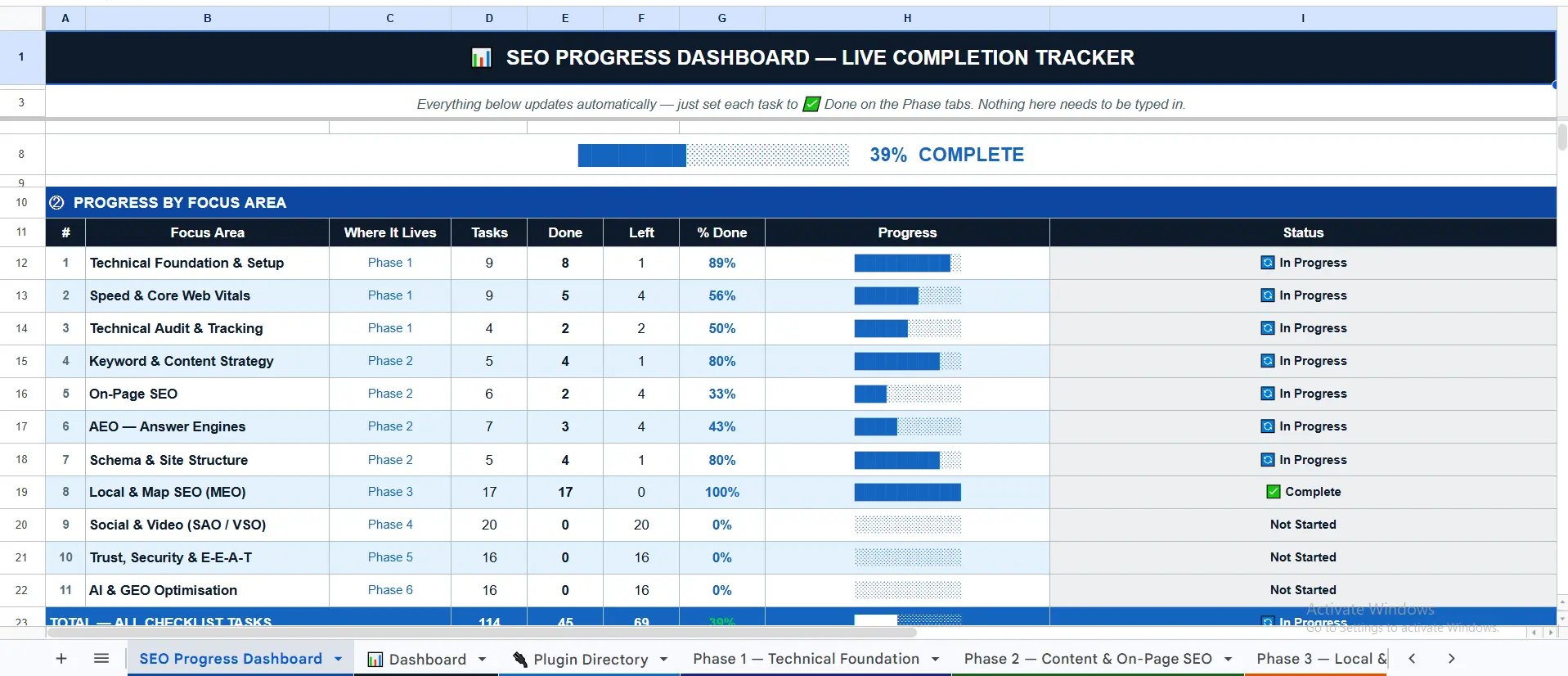
Because each task carries a live status field feeding an automatic dashboard, the honest answer to “where are we?” takes three seconds instead of a two-hour review.
That is what turns a technical SEO checklist into a working SEO project checklist your team can actually run.
What Makes This SEO Implementation Checklist Different
Most checklists you can download in ten seconds are lead magnets — forty vague bullets designed to make you book a call. This one is the deliverable, not the bait.
It is sequenced rather than listed, across six dependency-aware phases with real timelines. It covers ten optimization disciplines rather than one, with every task tagged so you can filter for what matters to you.
It names the exact configuration path wherever a tool is involved, and separates quick wins from multi-week projects so nobody plans a sprint around something that takes two months.
Who This SEO Implementation Checklist Is For
SEO agencies standardising client delivery so every account manager runs the same sequence. Freelancers scoping engagements and proving progress without building a deck each month. Founders working the phases solo.
WordPress developers converting vague client requests into a defined SEO task checklist — or handing the technical phase to our WordPress Development team instead.
Marketing teams, bloggers, SaaS companies, local businesses, ecommerce stores and enterprise teams needing one baseline across a large estate.
Key Benefits
You stop researching and start shipping, because the decision of what to do next is already made. You avoid rework, because dependent tasks are ordered correctly.
You reduce tool spend, because the SEO implementation checklist separates the tools that are required from the ones that are optional. And you build visibility on the surfaces that are growing — AI answers, maps, video — rather than only the one that is shrinking.
What You’ll Learn
The SEO implementation checklist teaches a repeatable method, not just a set of fixes. How to establish a technical baseline that will not need revisiting. How to map keywords to intent before writing a word, and how to mine Search Console positions 11–20 for the fastest gains available to you.
How to structure a page so it can be lifted into a featured snippet or an AI answer. How to configure schema so it validates and actually produces rich results. And how to check whether a language model is citing you at all.
What’s Inside the SEO Implementation Checklist
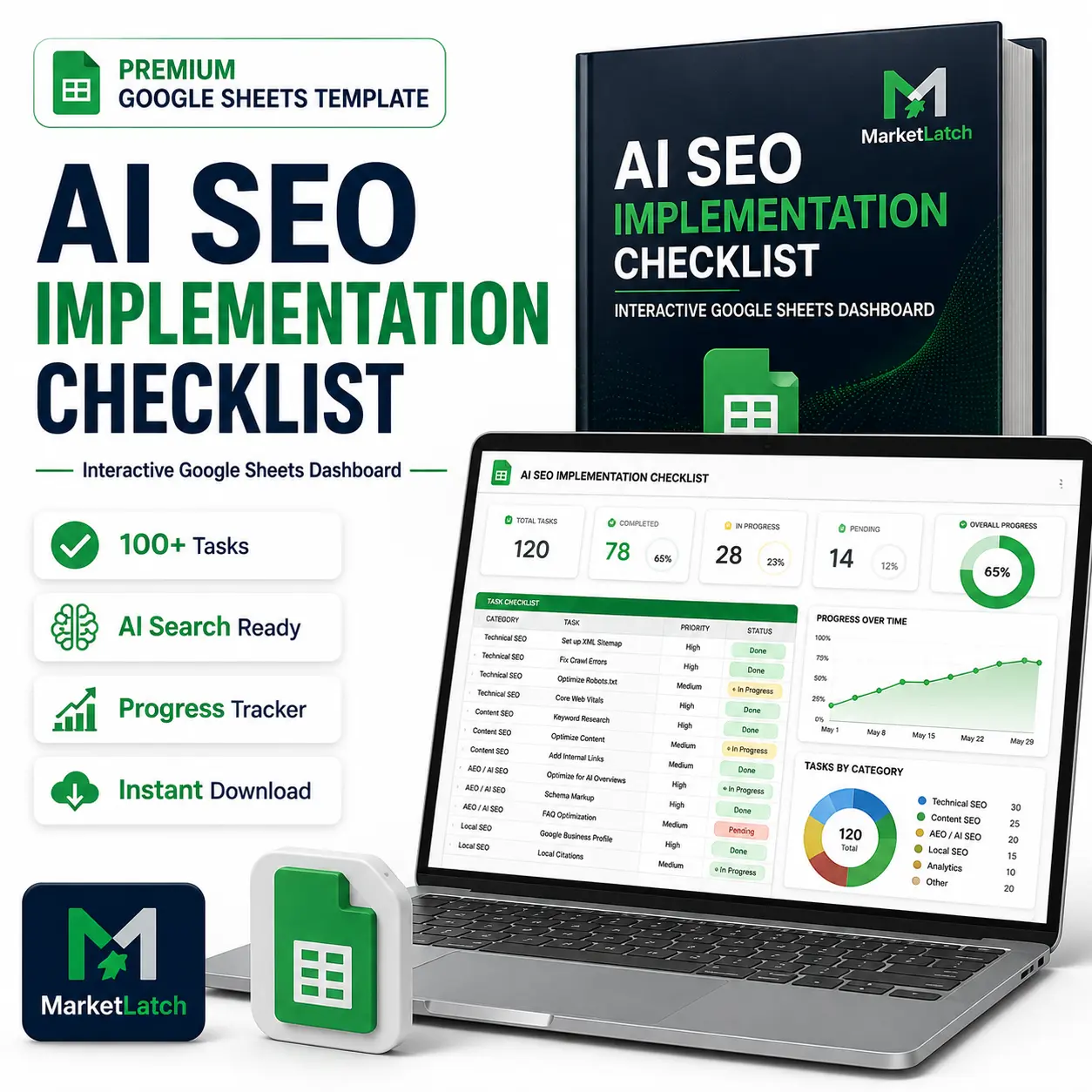
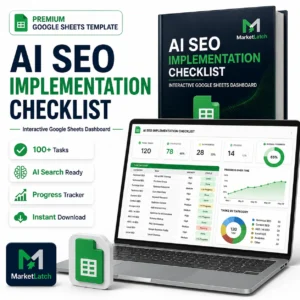
The complete 144-point website SEO checklist, a Website Overview onboarding sheet, and a master dashboard summarizing completion by phase.
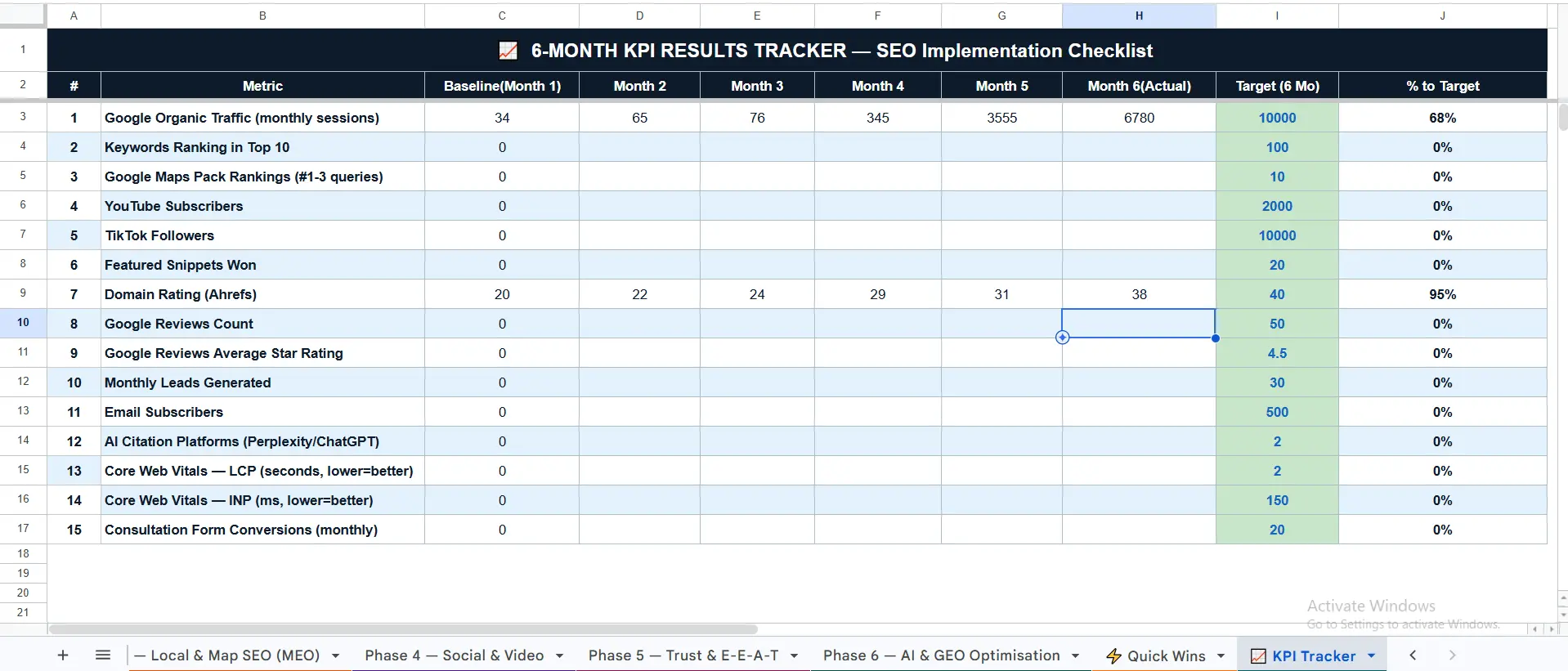
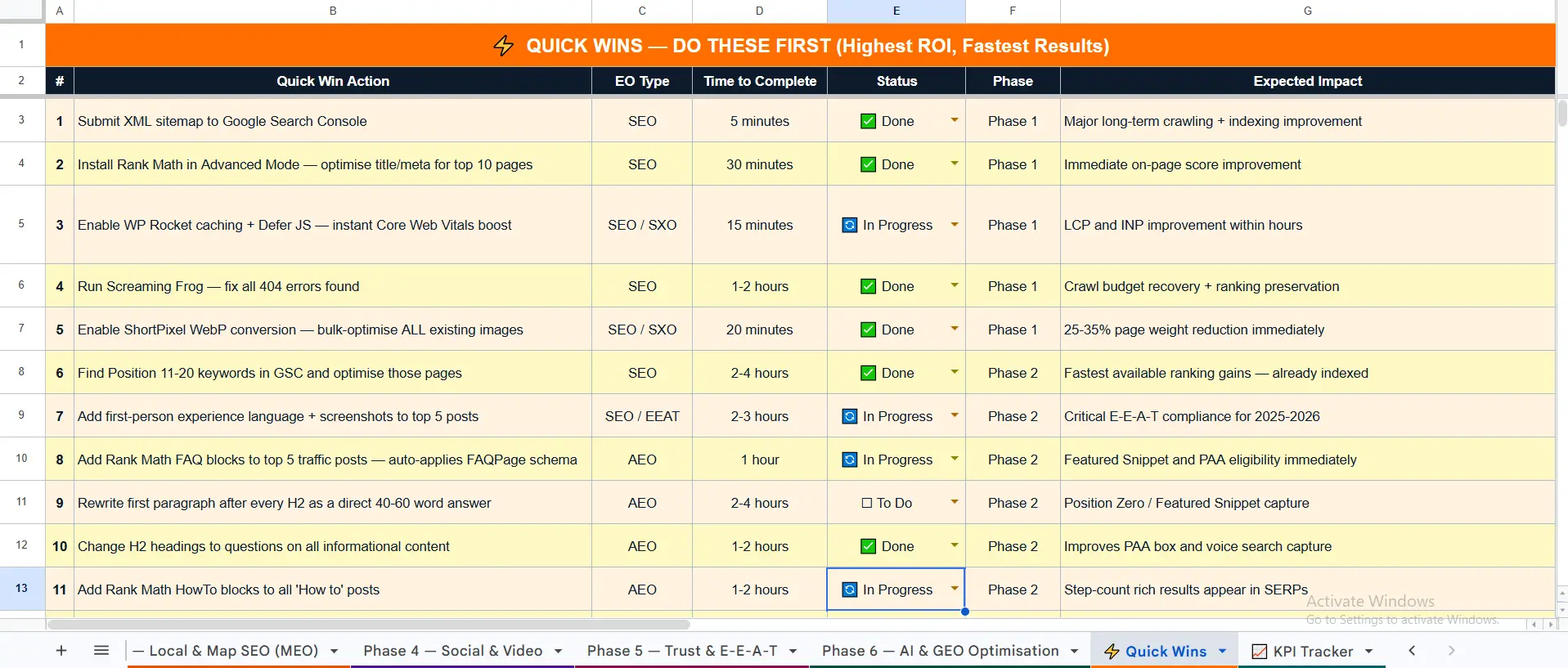
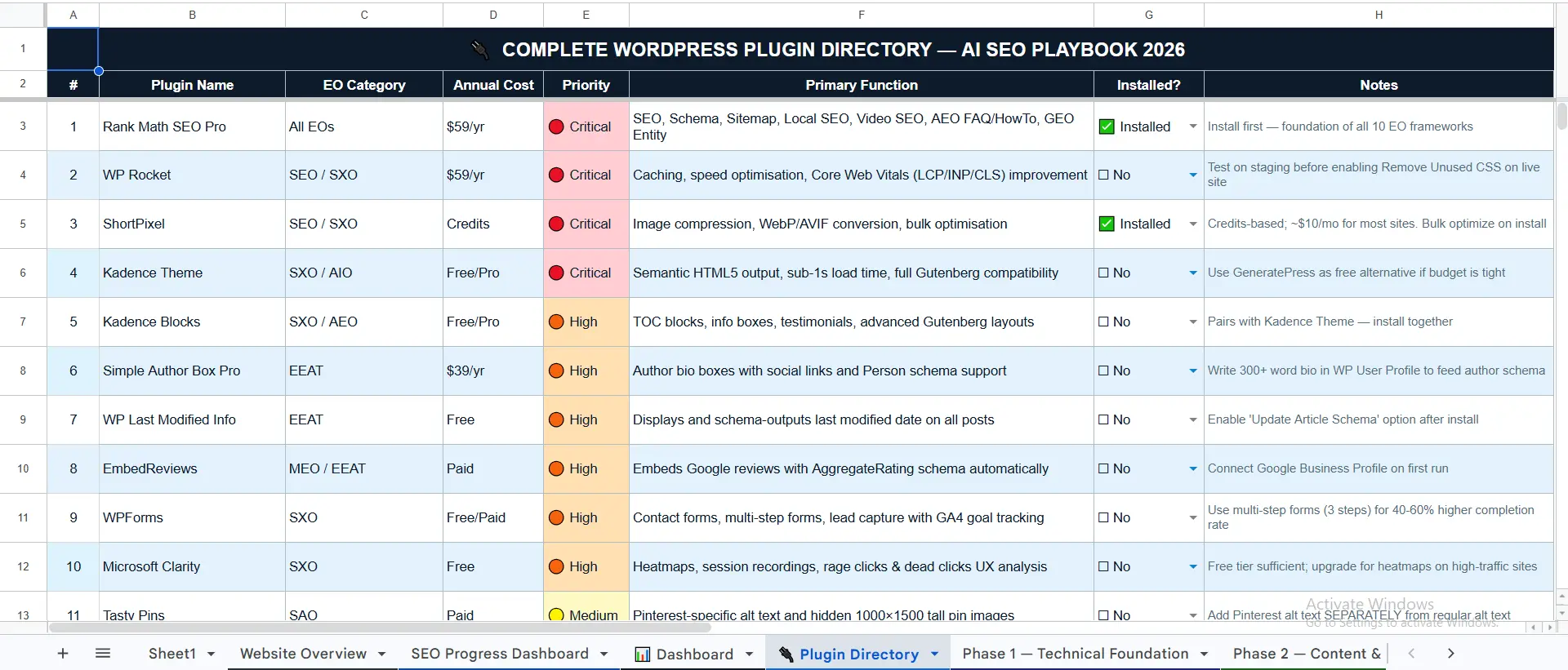
An SEO Progress Dashboard with auto-calculating percentages and visual progress bars. A 20-tool plugin directory with annual costs and priority ratings. A 30-item quick wins sheet with time estimates, and a 12-metric six-month KPI tracker.
Free updates for the 2026 edition are included with every copy of the SEO implementation checklist.
Checklist Sections
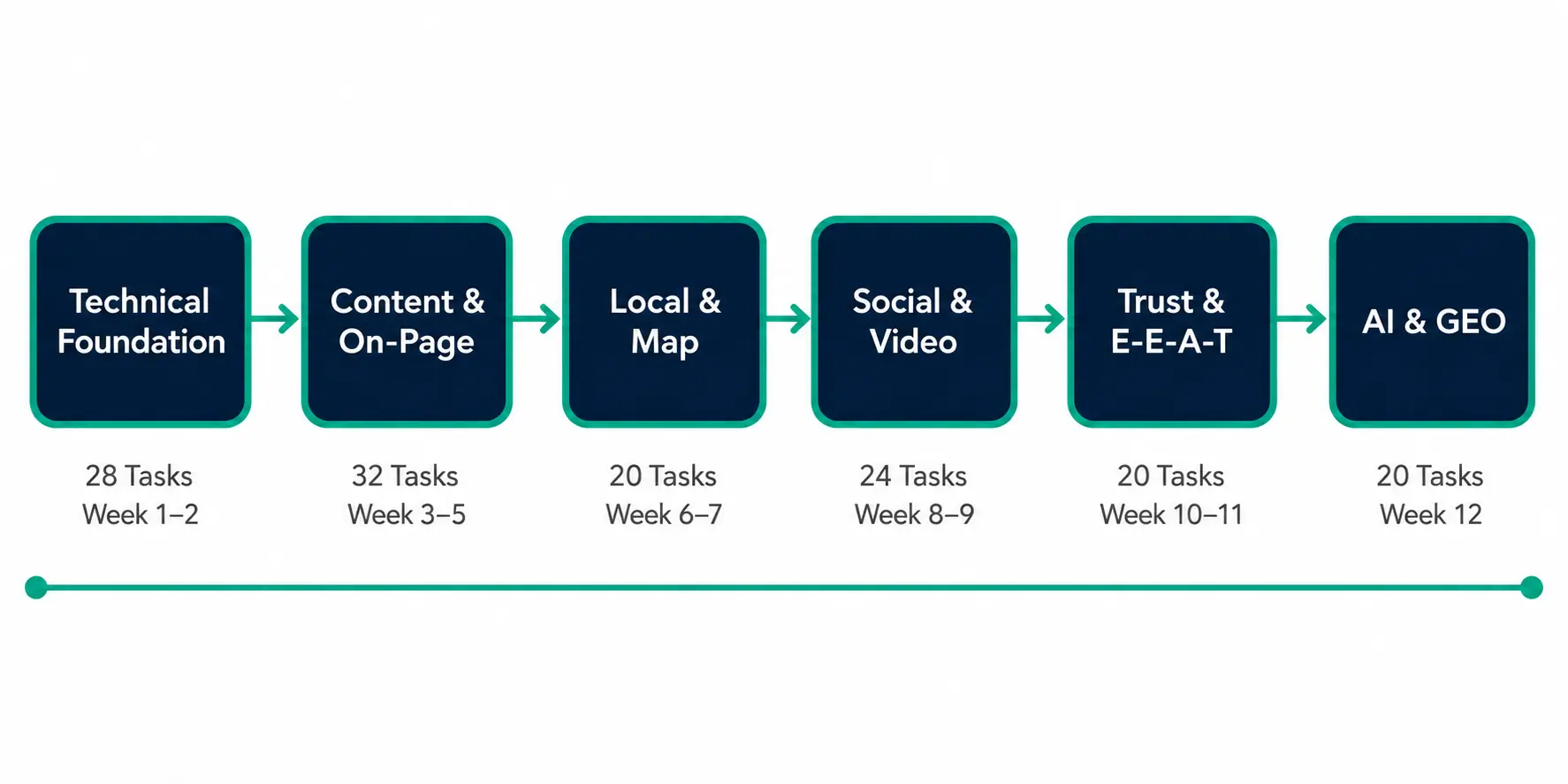
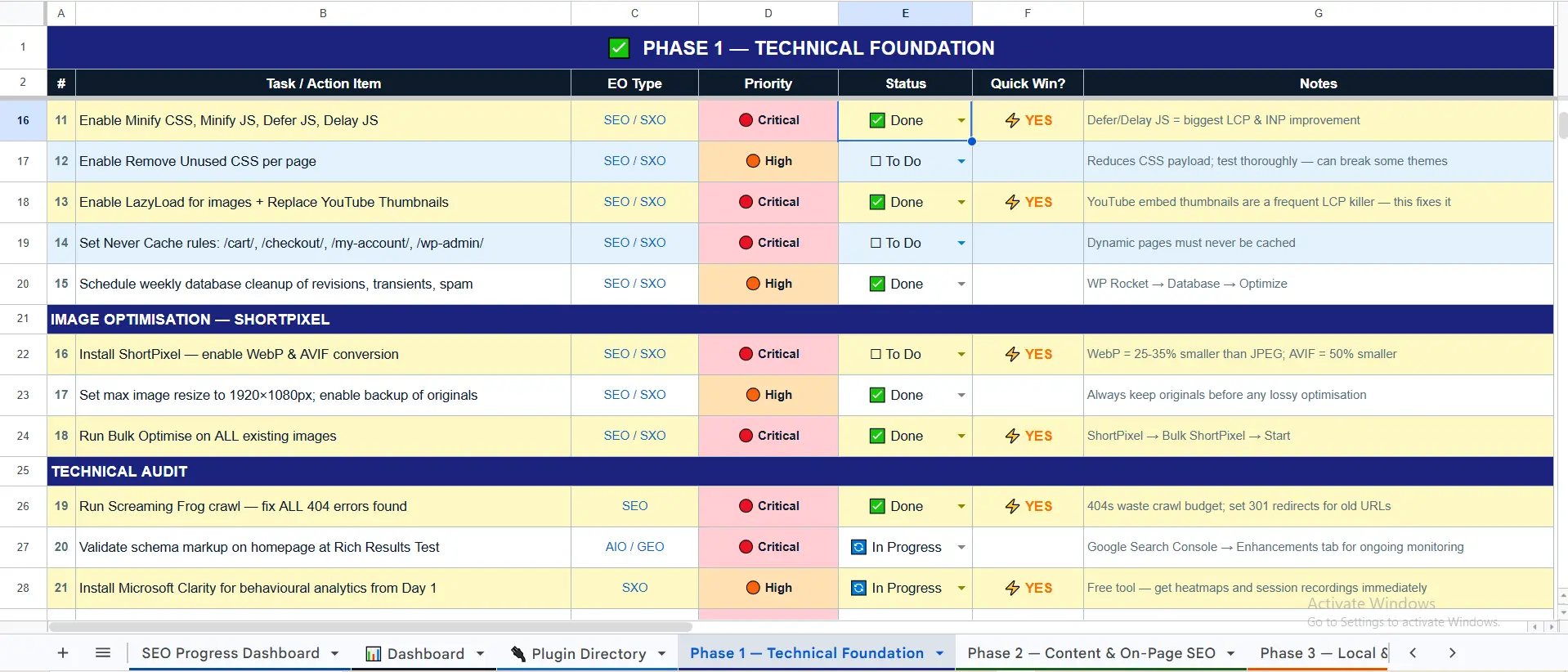
Phase 1 — Technical Foundation (22 tasks, Week 1). Hosting, SSL and CDN configuration, SEO plugin setup in advanced mode, Search Console connection, archive handling to prevent duplicate content, and sitemap submission to Google and Bing.
Speed work covers caching, JavaScript deferral and lazy loading against Core Web Vitals thresholds. The phase closes with a crawl, resolving 404s and index coverage gaps. Nothing later performs reliably until this is finished.
Phase 2 — Content & On-Page SEO (23 tasks, Weeks 2–6). Competitor gap analysis, intent classification and cluster construction, then the on-page SEO checklist itself: title construction, meta description framing, single H1 with logical heading hierarchy, entity coverage and internal linking depth.
The AEO layer restructures content for extraction — question-formatted H2s, direct 40–60 word answers — before mapping schema coverage by content type.
Phase 3 — Local & Map SEO (17 tasks, Weeks 2–3). Claiming and verification, exact legal naming, full category selection, individual service listings, seeded Q&A and a review process with a velocity target rather than a one-off push — the sequence behind our GBP Optimization work. Then LocalBusiness structured data, NAP consistency and location pages that are genuinely distinct.
Phase 4 — Social & Video Search (20 tasks, Month 2). YouTube keyword research, title formulas, VideoObject schema, descriptions with timestamps, captions and video sitemap submission. Then the searchable profile fields and caption structures on TikTok, LinkedIn, Instagram and Pinterest — each runs its own search engine, and most sites ignore all four.
Phase 5 — Trust & E-E-A-T (16 tasks, Months 2–3). Author bio boxes, a credential-bearing profile, Person schema with job title and knowledge areas, and correct index settings on author archives. Then the About page, a Contact page with physical address, the legal policy set, last-modified dates and review display with rating markup.
Phase 6 — AI & GEO Optimisation (16 tasks, Month 3). The reason this AI SEO implementation checklist exists in 2026. Entity infrastructure via sameAs markup, an llms.txt file, and a Wikidata entity linked back into your schema.
Then cornerstone content built in the structure models prefer to quote, fact density standards, a quarterly freshness cycle, and citation monitoring across ChatGPT, Perplexity, Gemini, Copilot and Google AI Overviews — the layer covered in depth in our AEO Masterclass Edition.
Why Choose Market Latch
Market Latch is a digital growth practice built around one strategist — founder Nadeem Alam — who has spent roughly fifteen years implementing search strategy for clients across the US, UK, Canada, Australia, the UAE and Pakistan.
Mostly hands-on work rather than advisory, which is why this SEO implementation checklist reads like a build sheet rather than a theory paper. The sequencing is not an editorial preference; it reflects which mistakes cost the most to undo.
If you would rather have it implemented for you, explore our SEO Services or GEO & AEO Services.
Professional Use Cases
A founder launching a WordPress site works Phase 1 in week one, so it goes live with correct indexing and speed configuration rather than retrofitting both after traffic arrives.
An agency onboarding a competitive local client runs Phase 3 of the SEO implementation checklist immediately while the developer works Phase 1 in parallel, using the dashboard as the monthly reporting artefact.
A blogger hit by a core update works the Phase 5 trust block and the Phase 2 AEO layer, then measures recovery against a documented baseline. A store owner uses the Phase 1 audit to find crawl waste as part of an E-commerce Marketing push.
Every week you spend deciding what to do next is a week of compounding rankings you did not start. This SEO workflow checklist has already made those decisions for you. Get the checklist today and finish your first five quick wins before the weekend. Not ready to buy? Start with a Free SEO Audit.
Quick Reference
What is it? A downloadable SEO implementation checklist of 144 sequenced tasks across six phases, with a live progress tracker, plugin directory, quick wins sheet and KPI tracker.
How long does it take? Six to twelve weeks to work the full SEO implementation checklist. The 30 quick wins are achievable in your first week.
Do I need WordPress? No — the tasks are platform-agnostic. And it is a one-time purchase with permanent access, not a subscription.
FAQs
1. What exactly is the SEO Implementation Checklist?
The SEO implementation checklist is a complete implementation document of 144 individual tasks, arranged in the order they should be carried out on a live site. Every task includes the action, the discipline it belongs to, a priority level, a status field and a note naming the exact setting to use.
Tasks are grouped into six phases — technical, content and on-page, local and map, social and video, trust and E-E-A-T, and AI and generative search — alongside a plugin directory, quick wins sheet, KPI tracker and two auto-calculating dashboards.
2. How is this different from a free SEO checklist?
Free checklists are lead magnets. Their purpose is to make you aware of a gap and then book a call, which is why they are broad rather than complete — forty vague bullets, no sequence, no settings, no tracking.
This SEO implementation checklist is the deliverable itself: tasks sequenced by dependency, carrying priorities and status so they can be assigned and reported, naming actual settings, feeding an automatic dashboard. It also covers the AI search work most checklists written before 2025 ignore entirely.
3. Does this work if my site isn’t on WordPress?
Yes. Canonical tags, sitemaps, heading hierarchy, schema, Core Web Vitals, internal linking and entity signals work identically on Shopify, Webflow, Wix, Squarespace or a custom build.
Only the implementation detail is WordPress-specific, since the notes name Rank Math menu paths as the most common stack. Roughly eighty per cent transfers without modification; the plugin directory is the section that will not apply.
4. How long does the full SEO action plan take?
Six to twelve weeks, with per-phase timelines built into the SEO implementation checklist. Technical foundation is a focused week. Content and on-page runs weeks two to six because it involves writing rather than configuration. Local runs in parallel during weeks two and three.
Social and video occupy month two, trust spans months two and three, and AI optimisation sits in month three because it depends on content built earlier. Those assume meaningful weekly time, not full-time work.
5. What are the quick wins inside the SEO Implementation Checklist?
Thirty tasks pulled from all six phases that take between five minutes and a few hours and produce disproportionate results. Submitting a sitemap takes five minutes and permanently improves crawling. Enabling caching takes fifteen and moves Core Web Vitals within hours.
Optimising pages already in positions 11–20 is the fastest gain available. They sit on their own sheet because momentum is what stops a project stalling at week three.
6. Does it cover getting cited by ChatGPT and AI Overviews?
Yes, as a full phase rather than a bolted-on section. Phase 6 covers the entity infrastructure that makes a brand legible to a language model — sameAs markup, llms.txt, a Wikidata entity.
Then the content characteristics that correlate with citation: cornerstone guides, original data assets, fact density and a quarterly freshness cycle. It closes with monitoring: querying the answer engines directly and recording whether your domain appears as a cited source.
7. Will this guarantee first-page rankings?
No, and any product claiming otherwise is misrepresenting how search works. Rankings depend on your competition, domain history, industry and content quality.
What this SEO audit checklist does is remove the preventable causes of underperformance — broken indexing, invalid schema, slow pages, thin trust signals, unmapped intent, content answer engines cannot extract. The KPI tracker exists so you measure improvement against your own recorded baseline rather than against a promise.
8. Can I use it with clients and across my team?
Yes to both. The licence covers your organisation rather than a single seat, and permits unlimited use across sites you own or manage, including client sites.
Upload the tracker to a shared Drive, add an owner column and assign by name — because the dashboard calculates from the status column, everyone updating their own rows produces an accurate project view without anyone compiling a report. It does not permit reselling the file as your own product.
9. What support is available after purchase?
Reach Market Latch directly at info@marketlatch.com or through the contact form — the same direct line used for client engagements, not a ticket queue.
Support covers questions about the SEO implementation checklist itself: what a task means, which phase something belongs to, or how to adapt an item to a different CMS. More reading on implementation is on the Blog.
Get the AI SEO Implementation Checklist today




Reviews
There are no reviews yet.