Introduction
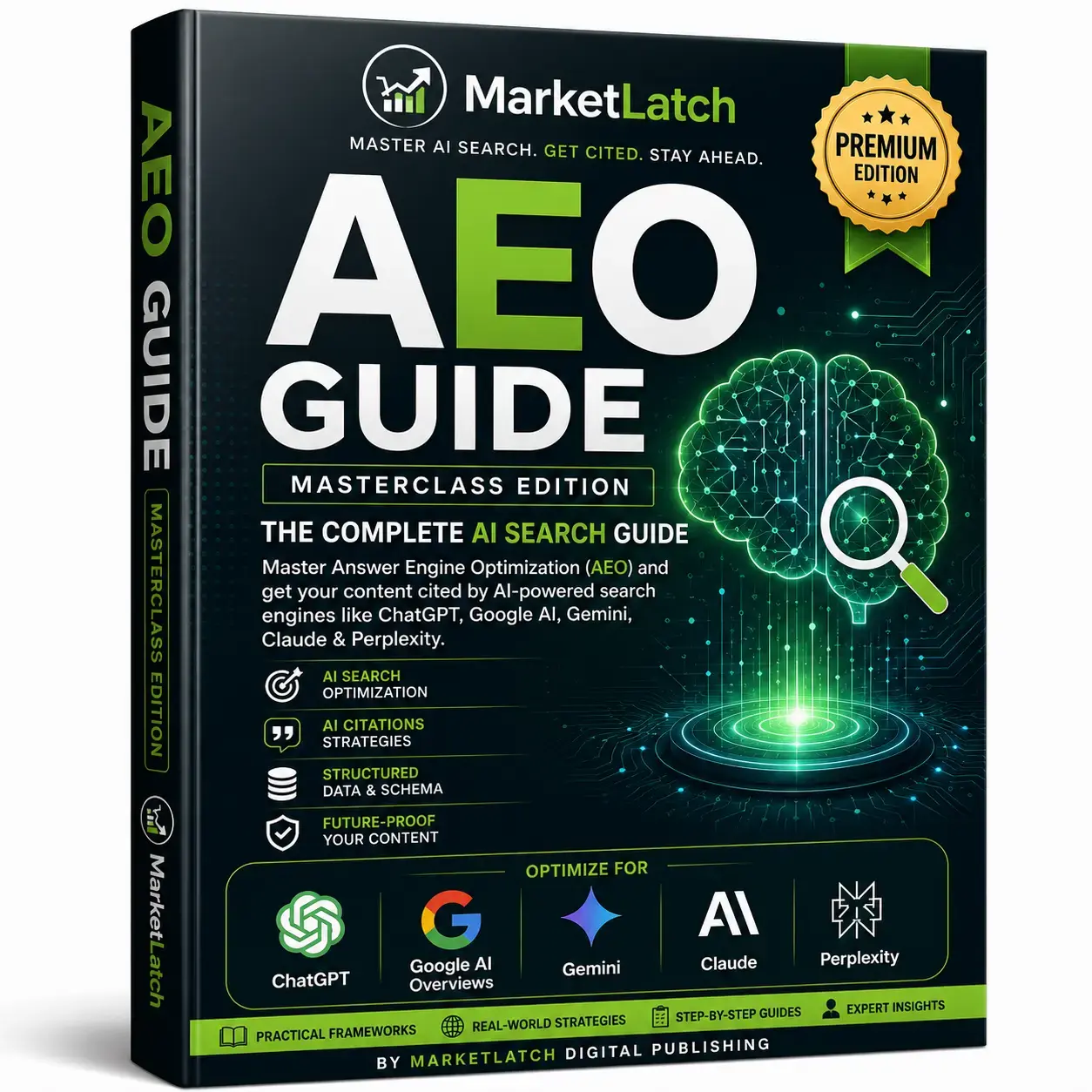
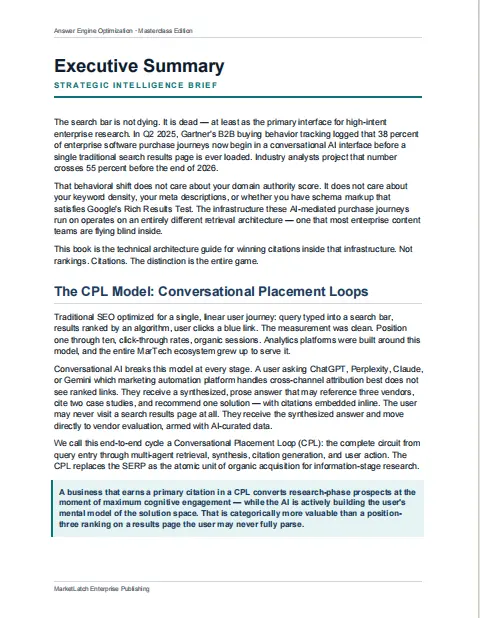
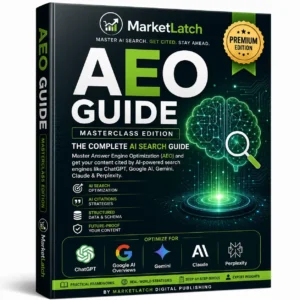
The search bar isn’t dying — it’s already dead as the primary interface for high-intent research. Enterprise buyers, SaaS evaluators, and technical decision-makers increasingly ask ChatGPT, Perplexity, Gemini, or Copilot a question and act on the synthesized answer they get back, never touching a traditional results page. The AEO Guide (Answer Engine Optimization: Masterclass Edition) is the technical playbook for making sure your business is the one those systems name — not the one they quietly use and forget to credit.
Why This Guide Matters
Every ranking factor you’ve spent a decade optimizing — keyword density, meta descriptions, backlinks, even a clean Rich Results Test — touches only a fraction of how conversational AI actually decides what to cite. The AEO Guide exists because “post more content” and “add more schema” are not strategies; they’re activity. This book gives you the actual retrieval mechanics underneath AI search, so every hour you invest moves a number that matters.
The Problem
Most content teams are flying blind against a system they cannot observe. Conversational AI interfaces frequently pass no referral data, so your analytics shows nothing while your competitor gets named in the exact answer a prospect used to make a shortlisting decision. The failure mode is worse than not ranking — it’s being retrieved, read, and used to inform an answer, without ever being named. That’s traffic and trust transferred to someone else, silently.
The Solution
Answer Engine Optimization treats citation — not ranking — as the unit of success. The AEO Guide walks you through the complete Conversational Placement Loop: how a query gets decomposed, routed through retrieval and reranking, synthesized into an answer, and either attributed to you or not. Once you can see each of those six stages as a distinct, fixable competitive arena, “AI visibility” stops being a vague aspiration and becomes an engineering checklist.
What Makes This Guide Different
This isn’t a repackaged “AI is changing SEO” listicle. It’s a masterclass-depth technical resource with production-ready code — schema JSON-LD you can paste into functions.php today, a validated robots.txt configuration for GPTBot, ClaudeBot, and PerplexityBot, and a KPI framework (AI Share of Voice, Citation Depth Score, Content Freshness Index, Entity Mention Velocity) built specifically because click-through rate and rank position don’t measure anything that happens inside a synthesized answer.
Who This Guide Is For
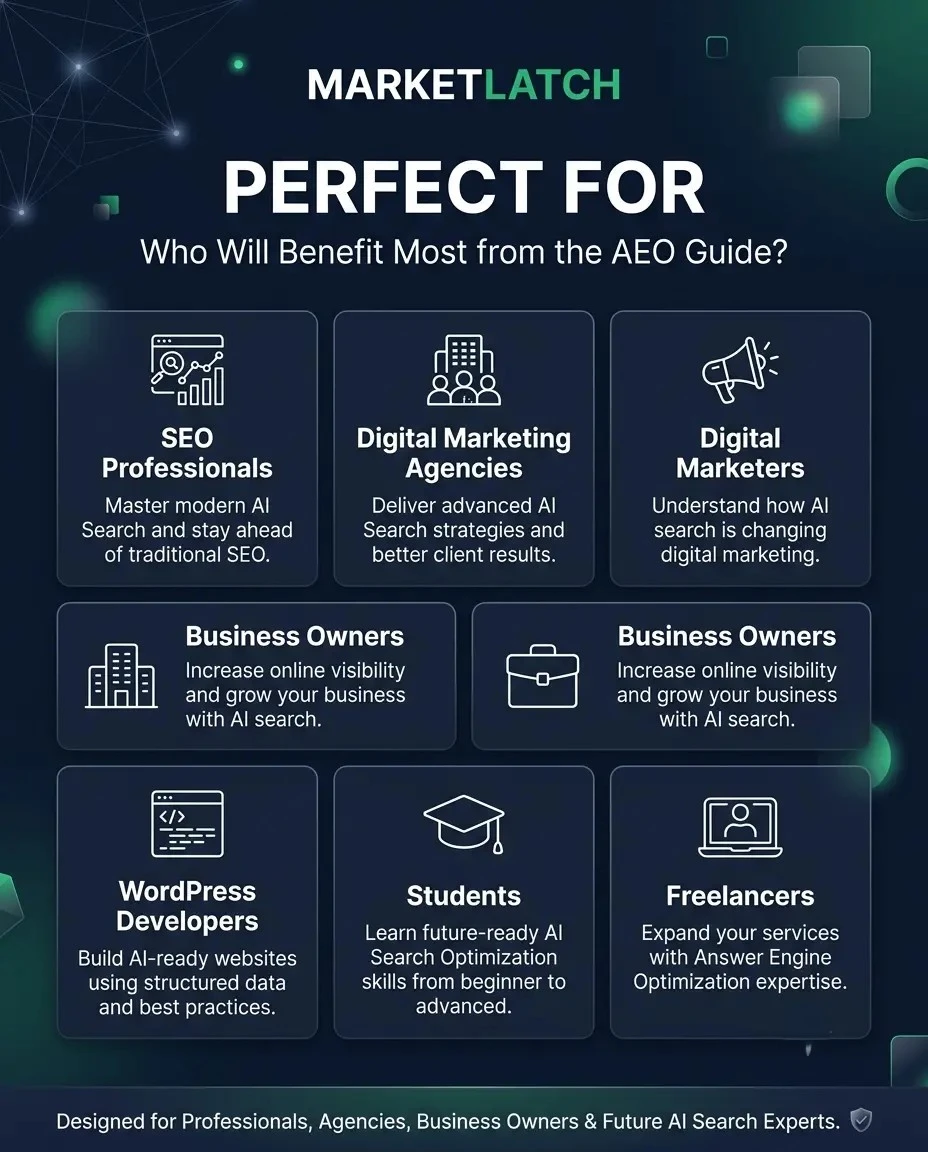
Technical content directors, SaaS founders who handle their own growth, in-house and agency SEO leads adding AI visibility to their service line, and WordPress developers who need to implement AEO— or who can hand it to our WordPress Development team rather than just discuss it in a strategy.
Key Benefits
You’ll stop guessing at “AI SEO” tactics and start working from an actual retrieval architecture. You’ll know precisely why a competitor gets cited on a query where your content was clearly retrieved and reranked well — and how to fix it. You’ll walk away with copy-paste schema code, not just theory.
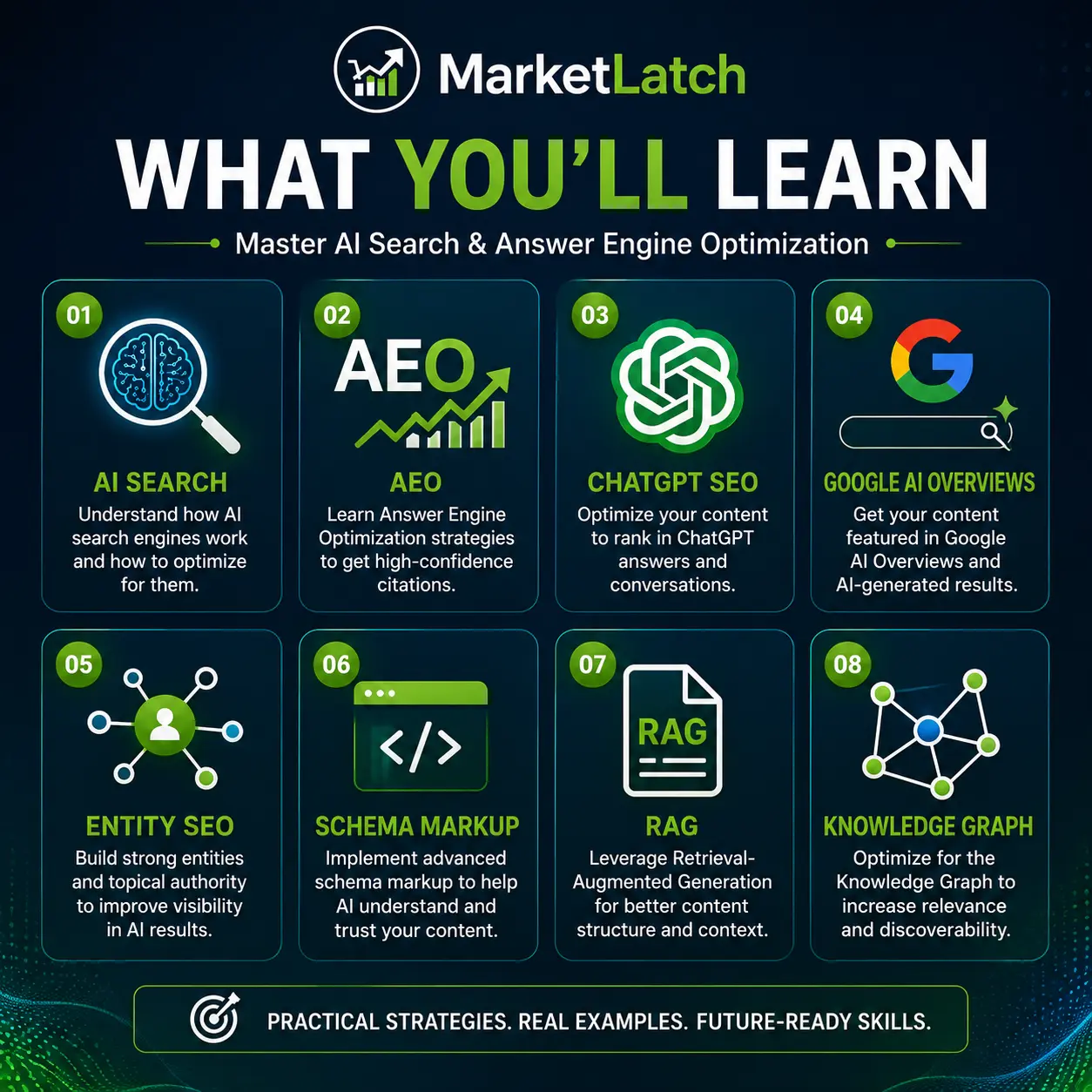
What You’ll Learn
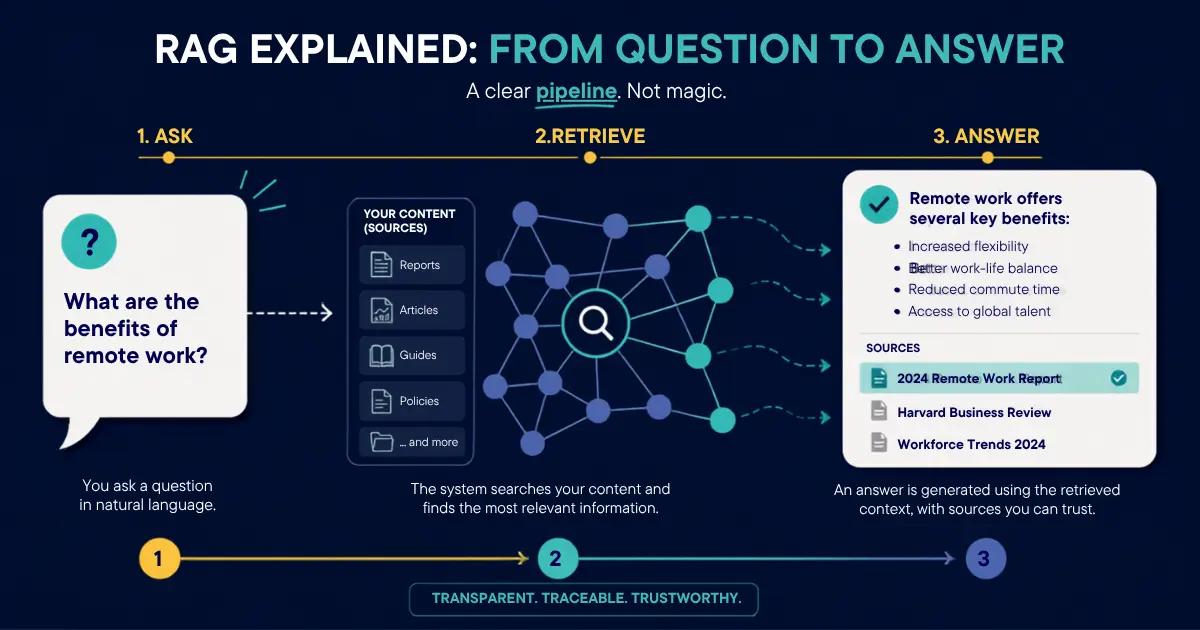
The complete RAG pipeline (query encoding, hybrid retrieval, cross-encoder reranking, and generation) and exactly which levers you control at each stage. Entity disambiguation — the single most common reason well-written content gets used without attribution. The 512-to-1024-token chunking standard and how to structure headings so AI systems split your content on your terms, not theirs.
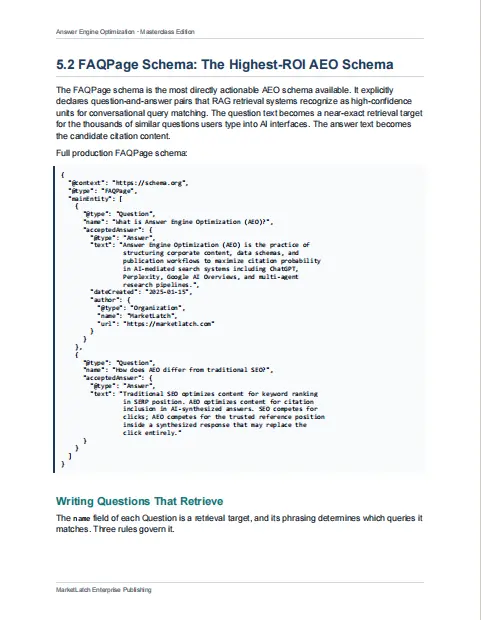
FAQPage and HowTo schema written to the exact specification that gets cited (40–120 word answers, one question per object, entity named in the question). The full WordPress functions.php injection framework for Organization, Article, and FAQPage schema. The six-KPI measurement system for reporting AI visibility to people who don’t have time to read this book.
What’s Included
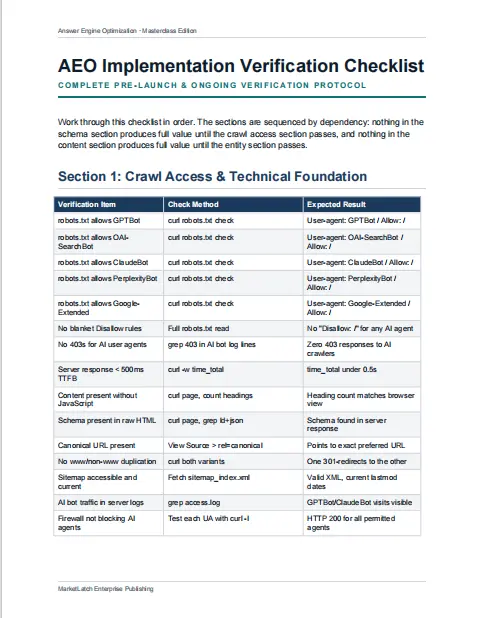
The complete 125-page AEO Masterclass Edition PDF across ten chapters, the AEO Implementation Verification Checklist (7 sections, pre-launch through ongoing quarterly audit), production-ready JSON-LD schema code blocks, and the 12-month enterprise AEO roadmap with quarter-by-quarter deliverables and target KPI movement.
Topics Covered
The AI Search Revolution and the four-phase shift from document retrieval to synthesis. The Conversational Placement Loop framework and its six-stage diagnostic protocol. Multi-agent retrieval architecture and the citation engine. Entity optimization and off-domain citation strategy. Schema markup — FAQPage, HowTo, Organization, Article, and @graph patterns.
AI-friendly content architecture and chunking strategy. WordPress AEO implementation, including headless REST configurations. AI visibility KPIs. Enterprise governance and team structure. The agentic shift and Generative Experience Optimization (GXO).and how local-intent queries interact with GBP Optimization. Read more on our Blog
Why Choose Market Latch
Market Latch is a digital growth agency built around one strategist — founder Nadeem Alam — who implements GEO, AEO, SEO, WordPress, and paid media directly rather than routing you through account managers relaying someone else’s work. The AEO Guide is the documented version of the same framework Market Latch runs for its own GEO & AEO Services clients: not repackaged theory, but the operating manual. If you’d rather have this implemented for you, explore our SEO Services
Professional Use Cases
A content director restructuring fifteen exhaustive pillar pages into scoped, citable clusters ahead of a Q3 content audit. A SaaS founder implementing FAQPage schema across a documentation site before a fundraising round that leans on organic visibility. An agency productizing “AEO audits” as a new service line using the book’s own diagnostic checklist as the audit template. An online store owner applying this framework to product pages as part of an E-commerce Marketing push.
AI search isn’t a future trend you can plan for later — it’s already deciding, right now, whether your business gets named or gets used and forgotten Get the AEO Guide today and start building the entity clarity, schema architecture, and content structure that earns citations instead of hoping for rankings.Not ready to buy? Start with a Free SEO Audit.
Quick Reference
Is this the same as SEO? No — SEO optimizes for ranking; AEO optimizes for citation inside an AI-generated answer. See the full FAQ section below for the complete breakdown.
Do I need a developer to implement the WordPress sections? Helpful but not required — every code block is documented step-by-step for a comfortable non-developer.
Is this current for 2026 AI systems? Yes — the Masterclass Edition explicitly covers ChatGPT, Perplexity, Google AI Overviews, Claude, and Microsoft Copilot as they operate today.
AI search isn’t a future trend you can plan for later — it’s already deciding, right now, whether your business gets named or gets used and forgotten Get the AEO Guide today and start building the entity clarity, schema architecture, and content structure that earns citations instead of hoping for rankings.
FAQs
1. What is the AEO Guide?
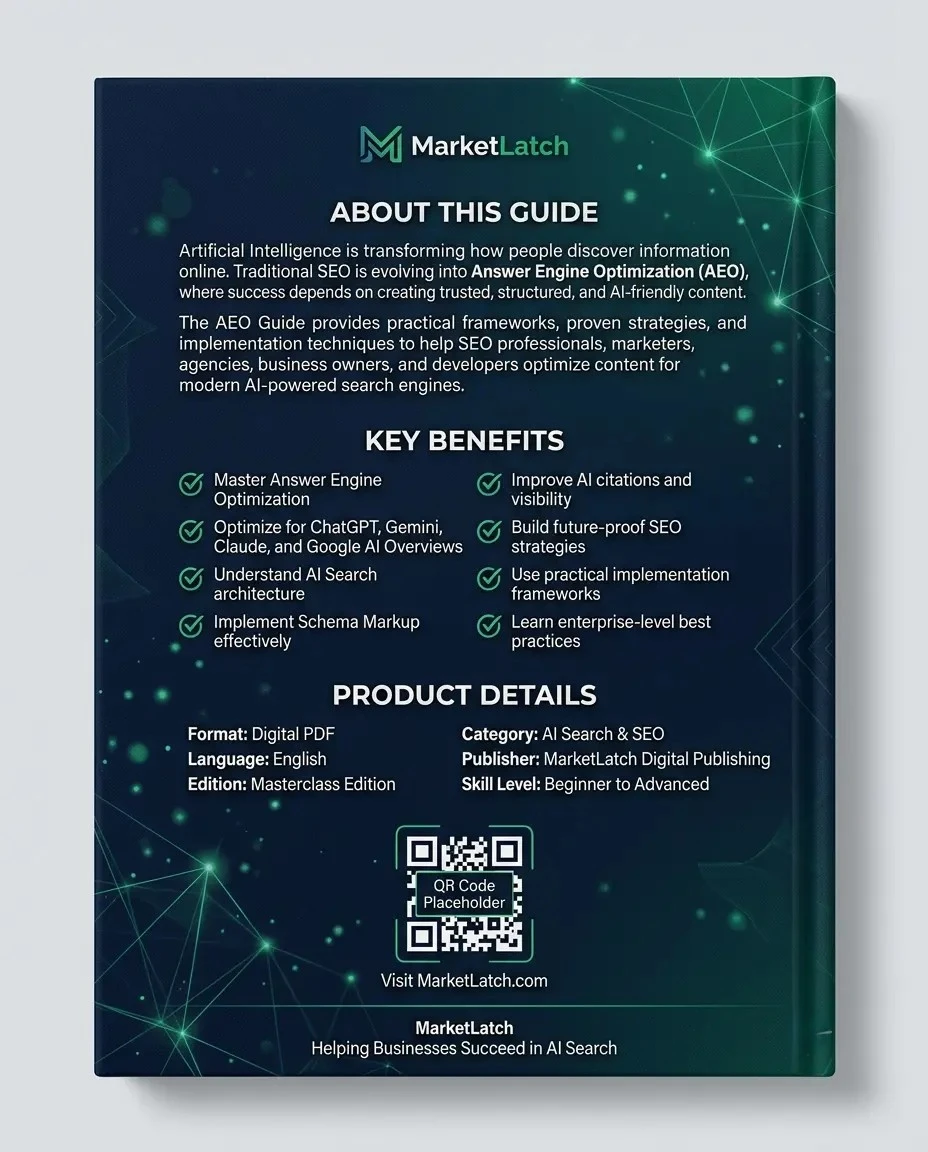
The AEO Guide is Market Latch’s 125-page Answer Engine Optimization: Masterclass Edition — a technical playbook for structuring content, schema, and WordPress infrastructure so AI systems like ChatGPT, Perplexity, and Google AI Overviews retrieve, synthesize, and cite your content with an attributed source link. It covers ten chapters, from retrieval architecture through enterprise governance, plus a full implementation verification checklist. It’s built for content directors, SaaS founders, technical SEOs, and agencies who need to move past “AI trends” content into working implementation.
2. How is AEO different from traditional SEO?
Traditional SEO optimizes content to rank in a list of ten links, measured by position and click-through rate. Answer Engine Optimization optimizes content to be retrieved, reranked, and cited by name inside a synthesized AI answer — a user may never see or click a ranked link at all. AEO builds on SEO fundamentals like crawlability and content quality, but adds entity disambiguation, schema engineering, and chunk-level content structure that traditional SEO tools were never built to measure.
3.Who is this guide for?
Technical content directors running an existing content program, SaaS founders handling their own growth without a dedicated content team, in-house or agency SEO leads adding AI visibility to their service offering, and WordPress developers implementing schema and crawler access at the code level. The book includes a “start here” reading path for each of these roles, so CMOs, technical SEOs, and hands-on founders each know exactly which chapters to prioritize first.
4. Do I need coding experience to use this guide?
No — but it helps for the deepest technical sections. Chapter 7’s WordPress implementation includes complete, documented `functions.php` code blocks for schema injection, and every step assumes you can copy code into a child theme file, not that you can write it from scratch. Non-technical readers get full value from the strategy, entity, and content-structure chapters; technical readers or their developers get production-ready code for the implementation chapters.
5. What AI platforms does this guide cover?
The Masterclass Edition covers the retrieval and citation mechanics behind ChatGPT (including ChatGPT Search), Perplexity, Google AI Overviews and AI Mode, Claude, and Microsoft Copilot. Rather than listing platform-specific tricks that expire with the next model update, it teaches the underlying RAG retrieval, cross-encoder reranking, and entity resolution mechanics that all of these systems share — so the guide stays useful as individual platforms change their interfaces.
6. Does this guide include schema markup code?
Yes. Chapter 5 provides production JSON-LD schema for FAQPage, HowTo, Organization, Person, Article, and `@graph` entity network patterns, written to the exact specification AI retrieval systems reward: one question per Question object, 40–120-word self-contained answers, and schema that matches the visible page content exactly. Chapter 7 then shows you how to inject that schema into WordPress via `functions.php` action hooks, layered by priority.
7. What is the Conversational Placement Loop (CPL)?
The Conversational Placement Loop is the book’s core strategic framework — the complete circuit a user’s question travels through, from query formulation, through multi-agent retrieval and reranking, to citation and the resulting reinforcement of your brand’s entity-topic association. Unlike a SERP, which is a one-shot linear event, a CPL is a loop with memory: one conversation frequently generates four to nine retrieval events, and consistent citation strengthens future citation probability.
8. Will this guide help with WordPress specifically?
Yes — Chapter 7 is written as the operational WordPress playbook, covering `functions.php` schema injection frameworks, headless and REST API configuration for multi-agent crawlers, Gutenberg content-block formatting for AI parsing, and a complete crawler-access verification protocol. Every code block in the chapter is documented against a live WordPress installation, which matters directly to Market Latch’s own audience of WordPress-based content teams and agencies.
9. How long is the AEO Guide and how is it structured?
The AEO Guide runs 125 pages across ten chapters, an AEO Implementation Verification Checklist, and an About the Author section. Chapters progress from strategic foundations (the AI Search Revolution, the CPL framework) through technical architecture (retrieval, entity optimization, schema) into implementation (WordPress, measurement) and finally enterprise operating model and future-facing strategy — with a role-based reading path so different readers can prioritize different chapters first.
10. What measurable results can I expect from applying this guide?
The book provides a six-KPI framework — AI Share of Voice, Citation Depth Score, Citation Conversion Rate, Content Freshness Index, Entity Mention Velocity, and a RAG Retrieval Proxy conversion metric — rather than vague visibility promises. Results depend entirely on your starting technical foundation and content volume, but the book is explicit that crawl frequency and citation conversion typically move within two to four weeks of entity and schema fixes, while AI Share of Voice moves over six to twelve weeks.
11. Is AEO a passing trend or a durable skill?
The book argues AEO is durable because its core requirements — entity clarity, original and specific claims, structural legibility, and machine-readable facts — improve the underlying quality of your information rather than exploiting a scoring function that a model update can close overnight. Chapter 10 explicitly separates what’s mechanically determined (retrieval displacing parametric recall, verification layers strengthening) from what’s genuinely uncertain, so you’re not building a strategy on a guess.
12. Can an agency use this guide to build a service offering?
Yes. Chapter 9’s governance framework, team structure, and 12-month roadmap are explicitly designed to be operationalized at agency or enterprise scale, and the Verification Checklist can be used directly as an audit deliverable for client-facing AEO engagements. This is the same operating framework Market Latch uses internally for its own GEO & AEO client work
13. How is this guide different from a blog post about “AI SEO tips”?
Most “AI SEO” content lists surface-level tactics without the retrieval mechanics behind them. This guide explains why those tactics work at the level of hybrid dense-plus-sparse retrieval, cross-encoder reranking, and attribution confidence — so you can diagnose new problems yourself instead of waiting for the next listicle. It also includes verification protocols, KPI definitions, and production code, not just recommendations.
14. What format does the AEO Guide come in?
The AEO Guide is delivered as a downloadable PDF, formatted for both on-screen reading and reference use during implementation, with tables, code blocks, best-practice call-outs, and warning boxes preserved from the source Masterclass Edition.
15. How do I get support if I have questions after purchase?
Reach Market Latch directly at info@marketlatch.com, or through the contact form at marketlatch.com/contact — the same direct line used for Market Latch’s client engagements, not a ticket queue.
Get the AEO Guide today
Reviews
There are no reviews yet.