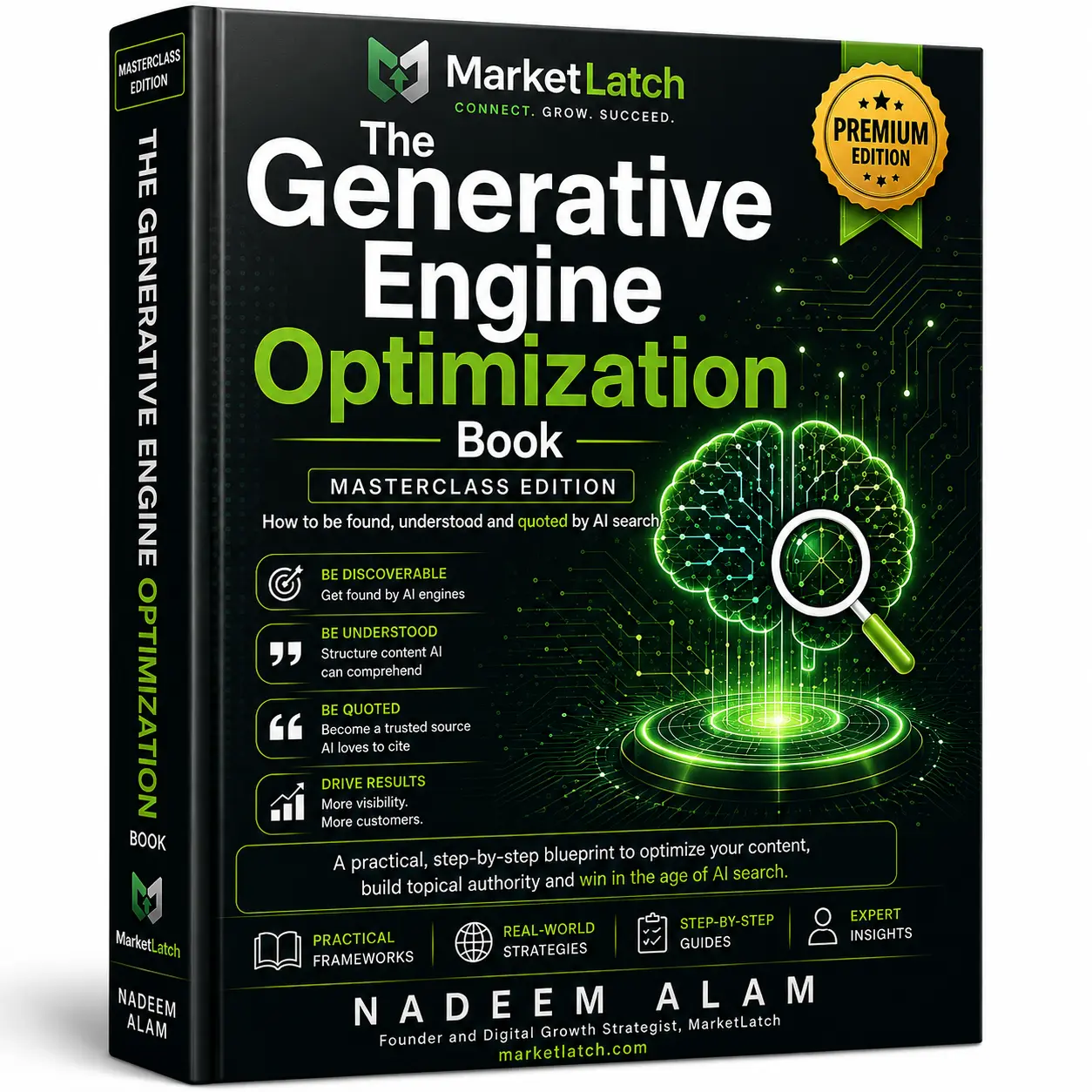
The Generative Engine Optimization Book for People Who Have Been Told to “Just Write Better Content”
A Generative Engine Optimization book should answer one question before anything else: why did your traffic quietly stop growing while your rankings stayed the same?
Here is the honest answer. Somebody asked ChatGPT the exact question your best article answers. They got a clear, correct, seven-sentence reply. Your name was not in it. There was no link to click. Nothing broke, nothing was penalised, and no report you own will ever show you what happened.
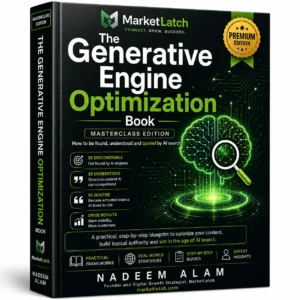
The GEO Blueprint — Masterclass Edition is a 176-page, 19-chapter field manual for fixing that. It is written for people who have never seen a vector, never touched JSON-LD, and do not have a developer on call.
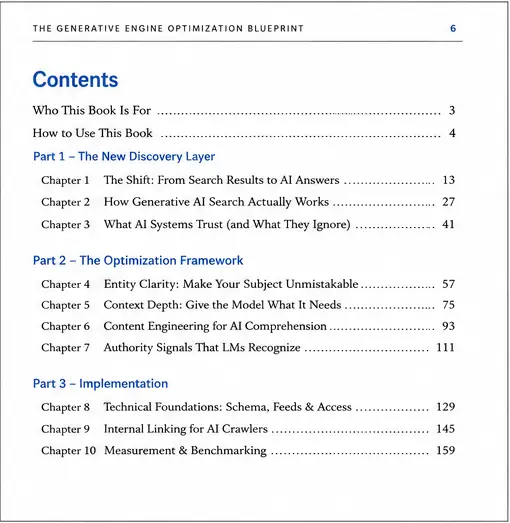
Table of Contents
Part 1 — The New Reality
- The Zero-Click Reality
- Inside a Synthetic Answer Engine
- Counting the Cost: Your Invisibility Tax
Part 2 — How AI Actually Understands Content
4. From Words to Numbers
5. How AI Decides What Is Close Enough
6. Entities, Not Keywords
7. Building Your Entity Graph
Part 3 — Making Your Content Machine-Readable
8. Structured Data: Your Machine-Readable Introduction
9. Schema for Research, Case Studies and the API Layer
10. The PDEC Method
11. Tables, FAQs and Dates
Part 4 — Measuring What’s Working
12. The LLM Footprint Audit
13. Competitors, Attribution and Your Dashboard
Part 5 — Full Technical Implementation
14. The Technical Foundation
15. Site-Wide Identity in WordPress
16. Authors, Blocks and Page-Level Signals
17. The API Layer and Internal Linking
18. Maintenance, Site Types and Proving Value
Part 6 — Looking Ahead
19. What Comes Next
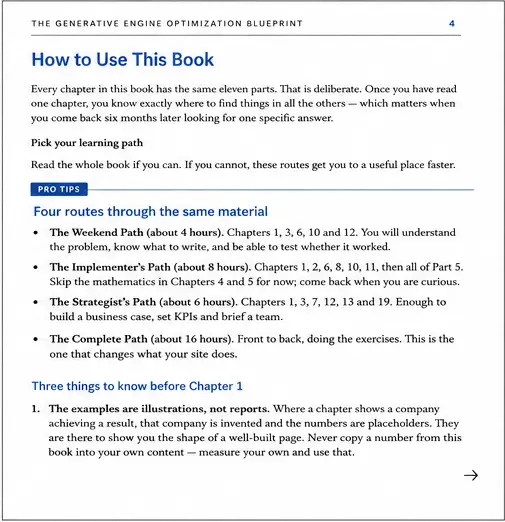
Every chapter follows the same structure — explanation, step-by-step exercise, and checklist — so once you’ve read one, you know exactly where to find anything six months later.
What This Generative Engine Optimization Book Actually Covers
Most writing on this topic gives you a philosophy and leaves you at the keyboard. A Generative Engine Optimization book earns its price by giving you the mechanism first, then the button to press.
You will learn how AI search systems break your page into chunks, turn those chunks into numbers, and score them for relevance — explained without a single equation. Then you will learn exactly what to change so your chunks win.
Part 1 — The Ground Has Moved
Chapters 1 to 3 explain the zero-click shift, how a synthetic answer engine assembles a reply, and how to calculate your own “invisibility tax” from Search Console data you already have. No borrowed statistics. Your numbers.
Part 2 — How AI Search Actually Works
Chapters 4 to 7 cover embeddings, retrieval, similarity scoring and the shift from keywords to entities. This is the LLM optimization foundation every later chapter depends on, and it is written for a complete beginner.
Part 3 — The Technical Blueprint
Chapters 8 to 11 give you structured data, the PDEC claim method, data tables, FAQs and temporal anchoring. PDEC — Proprietary, Data, Evidence, Consequence — is the four-part paragraph structure that turns ordinary prose into something an AI will quote and attribute.
Part 4 — Finding Out Where You Stand
Chapters 12 and 13 are a complete four-layer audit protocol: presence, accuracy, competitive displacement and claim attribution. You end this section holding a scored spreadsheet and a prioritized backlog.
Part 5 — Building It On WordPress
Chapters 14 to 18 are the implementation half. Crawler access, robots.txt, organization schema, author entities, block patterns, the REST API layer, hub-and-spoke linking, and a monthly maintenance routine. Every snippet is copy-paste ready.
Part 6 — The Road Ahead
Chapter 19 covers the four durable principles that survive any platform change — the answer to “what if all of this is different next year?”
Why This Generative Engine Optimization Book Is Different
It refuses to invent statistics. You will not find a single unattributed “73% of searches are now zero-click” claim. Every company in every case study is explicitly labelled as invented, and the book tells you outright never to cite a number from its pages. Instead, Chapter 3 shows you how to derive your own figures from your own data.
It tells you what is uncertain. Chapter 17’s REST API section is labelled speculative, because no platform has committed to consuming custom REST fields. Most competing material on AI search optimization presents everything with equal confidence. This one separates documented fact from reasoned inference from illustration, in a dedicated back-matter section.
It was rebuilt for beginners, not diluted for them. The first edition of this material was written for enterprise SEO directors and opened by stating that nothing in it was introductory. That was the wrong audience. The businesses hurt most by the shift to AI search are sole traders, local firms, bloggers and small agencies — the ones with no budget to hire someone to explain it. This edition keeps every framework and adds the steps.
It is a design object, not a text dump. 32 custom diagrams, drawn for teaching rather than decoration. Every chapter carries the same eleven sections in the same order, so you always know where the checklist is.
What You Get Inside
| Format | Professionally typeset DOCX, 176 pages |
| Chapters | 19, across 6 parts |
| Diagrams | 32 custom educational visuals |
| Case studies | 16 worked scenarios (clearly labelled illustrative) |
| Checklists | One per chapter, plus a 7-stage master checklist |
| Reference | 36-term glossary, acronym table, tools directory |
| Code | Copy-paste PHP, JSON-LD and robots.txt |
| Level | Complete beginner to advanced practitioner |
No other Generative Engine Optimization book on the market ships with a typeset print-ready interior and a full diagram set at this price.
Every Chapter Follows the Same Eleven-Part Structure
Consistency is what makes a Generative Engine Optimization book finishable. No chapter skips a section, and no section appears where you did not expect it.
Why This Matters — the real-world problem, in one page
Explanation — one concept at a time, in plain English
Visual Diagram — with a title and a short reading
Beginner Corner — an everyday analogy
Real-World Case Study — problem, solution, result
Step-by-Step Implementation — the longest section, deliberately
Avoid These Mistakes — 5 to 10 items, each with the reason
Pro Tips — what practitioners actually do
Recommended Tools — chapter-specific, with why
Chapter Checklist — tick boxes
Key Takeaways — 5 to 10 bullets
Scattered throughout: Quick Wins, Did You Know, Try It Yourself, Self Audits, Mini Challenges and Warning boxes.
Who This Generative Engine Optimization Book Is For
- Complete beginners. This is the Generative Engine Optimization book to start with if you have never read one. Chapters 4 and 5 explain how machines read meaning, starting from zero. No prior AI knowledge is assumed anywhere in the book.
- Bloggers and content creators. Your writing is being read by machines and summarized without attribution. Chapters 10 and 11 fix that at the paragraph level.
- Small business owners. Chapter 1 is a 30-minute audit you can run today. Chapters 14 to 16 are the entire fix, and none of it requires a developer.
- Freelancers and consultants. The four-layer audit in Chapters 12 and 13 is a saleable deliverable. Question set, scoring matrix, error register, prioritized backlog.
- WordPress and Woo Commerce users. Part 5 is five chapters of settings, snippets and plugin decisions written specifically for WordPress. Store owners: Chapter 18 explains why every specification published as an image is invisible data.
- SEO professionals. You know technical SEO. This maps what you already do onto a retrieval system instead of a ranking system, and shows you where the two diverge.
- Agencies. A repeatable service line: audit, implement, maintain, report. Chapter 18 covers what you can honestly claim and what you cannot.
- SaaS founders and enterprise teams. Chapter 19’s working-group model assigns six functions without hiring anyone.
The Skills You Walk Away With
By the last page of this Generative Engine Optimization book you will be able to do all of the following without help:
Running a rigorous multi-platform visibility audit, logged out and scored
Calculating your own invisibility tax from Search Console
Writing paragraphs structured to be quoted and attributed
Publishing organization and person schema that actually validates
Finding and eliminating conflicting structured data
Configuring crawler access for GPTBot, ClaudeBot, PerplexityBot and Google-Extended
Building hub-and-spoke clusters that demonstrate topical depth
Reading a competitor’s structure to build your own backlog
Reporting results without claiming attribution that does not exist
Where This Fits in the Future of SEO
The future of SEO is not the end of SEO. It is the same discipline pointed at a different consumer. For twenty years you optimized for a system that ranked pages. Now you are also optimizing for a system that retrieves passages, resolves entities and decides what to quote.
Traditional signals still matter, which is why no serious Generative Engine Optimization book tells you to abandon them. Crawlability, speed, structure and authority all carry over. What changes is that being findable is no longer enough — you also need to be quotable, attributable and unambiguous. This Generative Engine Optimization book covers the second half without pretending the first half stopped mattering.
If you want the shorter, free version of this argument first, read our guide to ChatGPT SEO and the seven drivers that get you cited. It is the natural companion to Chapters 1, 10 and 12.
Built on Documented Standards, Not Guesswork
The technical half of this Generative Engine Optimization book rests on published specifications you can verify yourself. The vocabulary comes from Schema.org. The implementation guidance follows Google Search Central’s structured data documentation. Crawler user agents are taken from OpenAI’s published bot documentation and its equivalents. Chapter 19’s fourth principle points at the W3C Verifiable Credentials data model, and Chapter 7’s entity work uses Wikidata as its primary identifier source.
Where a claim is inference rather than documentation, this Generative Engine Optimization book says so on the page rather than in a footnote.
Frequently Asked Questions
What is a Generative Engine Optimization book and why do I need one?
A Generative Engine Optimization book is a guide to making your website visible inside AI-generated answers rather than only in search results. You need one if people are asking ChatGPT, Claude, Gemini, Copilot or Perplexity the questions your business answers — and getting a reply that does not mention you.
Do I need technical skills to use this book?
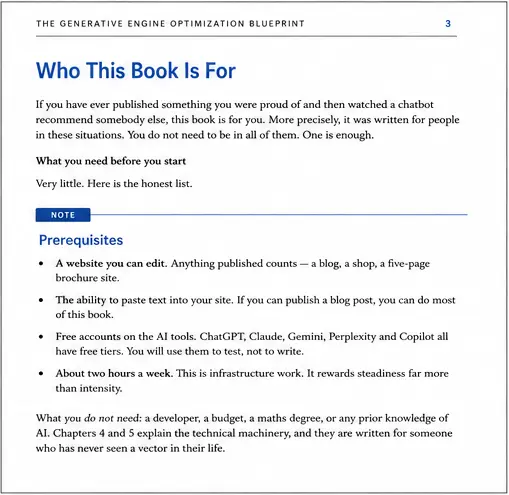
No. Chapters 1 to 13 require no code at all. Part 5 includes PHP and JSON-LD, but every snippet is copy-paste with placeholders explained line by line. Chapter 14 shows you where to paste them safely.
Is this only useful for WordPress users?
Part 5 is WordPress-specific and is five of the nineteen chapters. The other fourteen apply to any platform. Shopify, Webflow, Squarespace and custom-build users get the full framework — only the buttons differ.
How is this different from a normal SEO book?
A traditional SEO book optimizes for ranking a page. A Generative Engine Optimization book optimizes for retrieval, entity resolution and citation. Different mechanism, overlapping tactics — and this one explains exactly where they overlap and where they diverge.
Does this replace my current SEO work?
No, and any Generative Engine Optimization book that claims otherwise is selling you something. It sits alongside your existing work. Every technical SEO fundamental still applies. This adds the layer that makes your content quotable by machines.
How long before I see results?
Realistically, six to twelve weeks for accuracy corrections on live-retrieval platforms, and three to six months for genuine presence gains. Chapter 18 explains why, and what you can honestly claim in the meantime.
What format is the book delivered in?
A professionally typeset DOCX, 176 pages, downloadable immediately after purchase. It opens in Word, Google Docs, Pages and LibreOffice, and prints cleanly.
Are the case studies real companies?
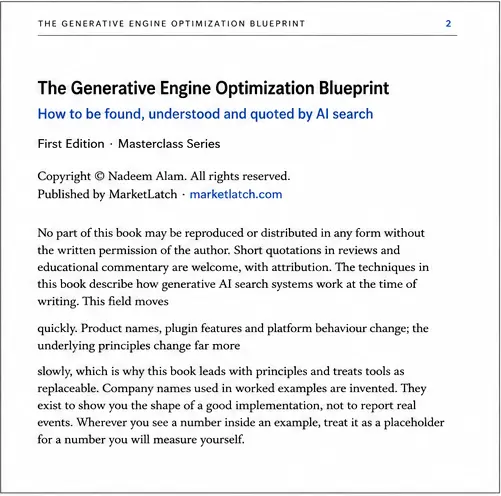
No, and the book says so repeatedly. Every named company is invented to illustrate a pattern clearly. The patterns are drawn from practice; the businesses and their numbers are not. You are told plainly never to cite a figure from the book as a statistic.
Ready to Find Out Whether AI Search Knows You Exist?
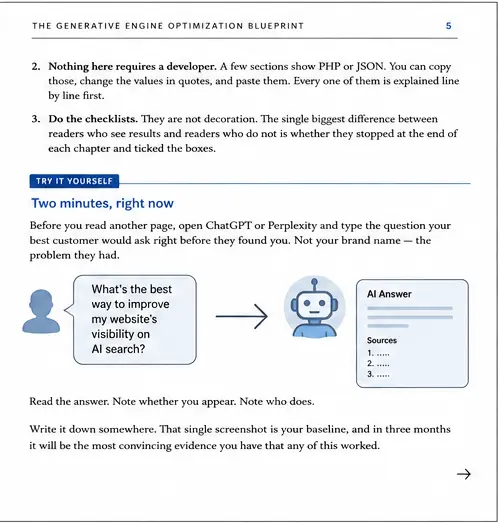
Open ChatGPT right now. Type the question your best customer would ask before they found you — not your brand name, the problem they had. Read the answer. Note whether you appear.
If you did not, this Generative Engine Optimization book is the fix, and Chapter 1 starts in the next thirty minutes.
Buy the GEO Blueprint — instant download
Want the whole set? The AI Search Authority Bundle pairs this with the AEO Masterclass Edition and the AI SEO Implementation Checklist 2026.
Prefer it done for you? Our GEO & AEO services implement this framework directly, and our technical SEO services cover the foundation it sits on. Not sure where you stand? Start with a free SEO audit.
Browse the rest of the Market Latch digital library.


Reviews
There are no reviews yet.