What Is Semantic SEO?
Semantic SEO is the practice of optimizing content around meaning, entities, relationships, context, and search intent rather than relying primarily on exact keyword repetition. The goal is to make the subject, concepts, relationships, and purpose of a page clear to both users and search systems.
Semantic SEO vs Traditional Keyword Optimization
Traditional keyword optimization focuses primarily on matching a page to specific search terms. Semantic SEO expands that approach by addressing the concepts, entities, attributes, questions, and relationships associated with the searcher’s underlying intent. Instead of asking only whether a keyword appears on the page, semantic optimization asks whether the page clearly explains the topic and its related concepts.
Semantic SEO vs Entity SEO
Semantic SEO and entity SEO overlap, but they are not identical. Entity SEO focuses on clearly identifying people, organizations, products, places, and other distinct things. Semantic SEO uses those entities together with their attributes, relationships, context, and associated concepts to build a clearer representation of the topic.
How Semantic SEO Builds Topical Coverage
Topical coverage means addressing the important concepts and questions that naturally belong to a subject. A strong Semantic SEO page does not repeat the primary keyword across multiple paragraphs. It explains the main concept, related entities, attributes, use cases, comparisons, problems, and questions that help satisfy the underlying search intent.
Semantic SEO and Internal Linking
Internal links strengthen semantic relationships between pages when the destination is genuinely relevant to the surrounding content. Use descriptive anchor text that explains the relationship between the current topic and the destination page rather than relying on generic phrases such as “click here” or “learn more.”
Semantic SEO and Structured Data
Structured data can help describe what a page represents, but it does not replace clear content. Use Schema.org markup when it accurately represents visible information on the page. For WordPress sites, first check what WooCommerce, Rank Math, the theme, or other plugins already generate before adding additional JSON-LD. For a practical guide, see our structured data for WordPress.
Semantic SEO for AI Search
AI-powered search systems need content that can be retrieved, interpreted, and connected to a user’s question. Make important information available as text, use descriptive headings, explain entities and relationships clearly, support important claims with evidence, and make each major section understandable without requiring the reader to infer missing context. For a broader implementation approach, see our Semantic SEO and AI search guide.
Semantic SEO Implementation Checklist
- Identify the primary entity and topic
- Define the primary search intent
- Map related entities and concepts
- Cover the major questions users have about the topic
- Explain important relationships between concepts
- Use descriptive H2 and H3 headings
- Add relevant internal links
- Use descriptive anchor text
- Validate structured data
- Remove duplicate or conflicting schema
- Make sure the content is crawlable and indexable
- Review competing pages for important content gaps
- Measure organic search performance and update the content when evidence shows a gap
The Six-Layer Machine-Readable Content Architecture Framework
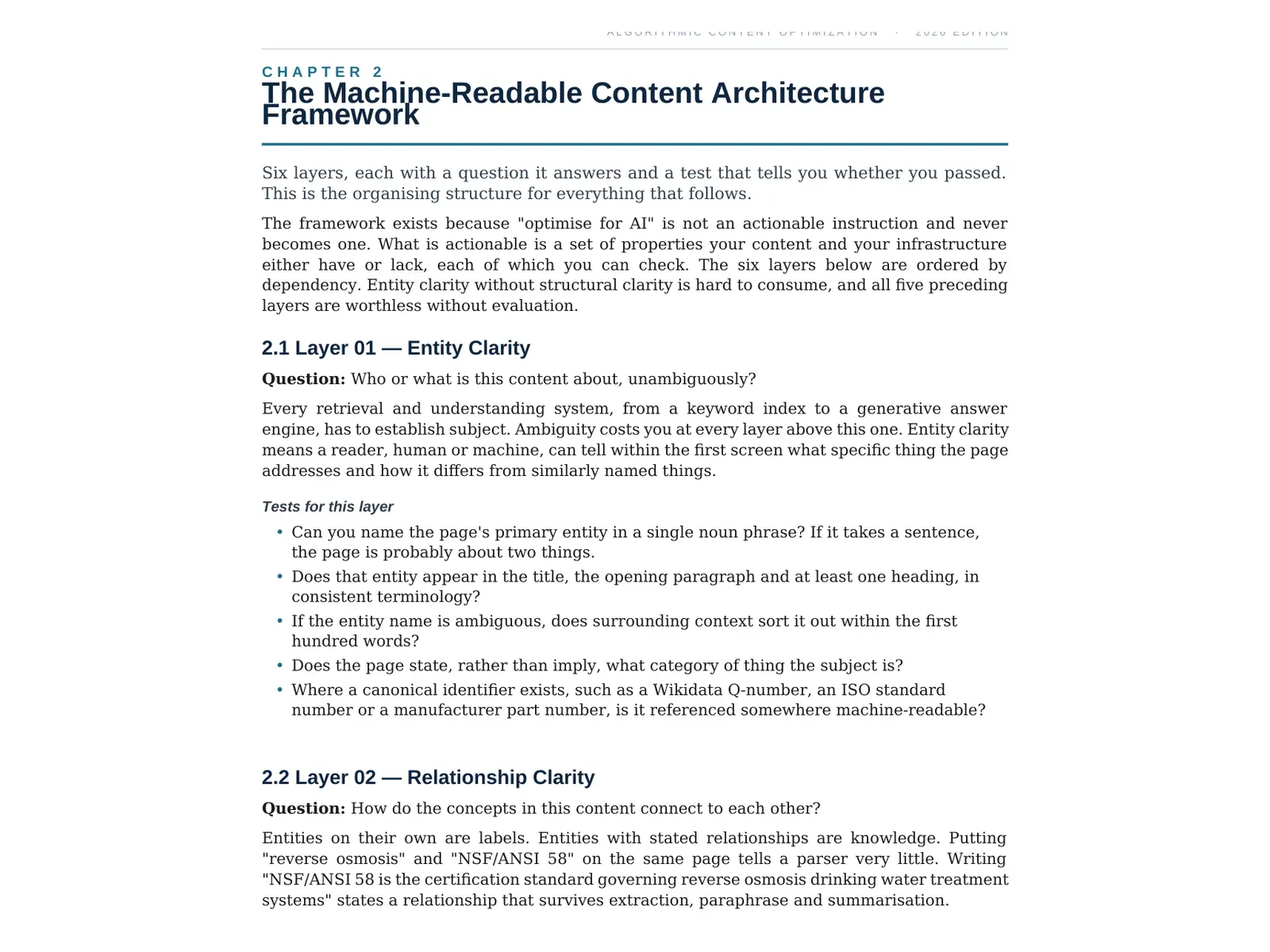
This framework is the organizing structure of the book. It is presented as the author’s model, not as a recognized industry standard — no platform certifies it and no vendor operates it. Its value is that “optimize for AI” is not an actionable instruction and never becomes one, whereas a set of properties your content either has or lacks can be checked.
The six layers are ordered by dependency, and every technique in the book maps to one of them. Between them they turn Semantic SEO from a philosophy into a checklist you can score.
| Layer | The question it answers | Why it matters |
|---|---|---|
| 01 — Entity Clarity | Who or what is this about, unambiguously? | Ambiguity here costs you at every layer above it. |
| 02 — Relationship Clarity | How do the concepts connect? | Entities alone are labels; stated relationships are knowledge. |
| 03 — Structural Clarity | Can a machine identify sections, lists and metadata? | Cheapest layer to fix, most commonly neglected. |
| 04 — Evidence | Are the claims sourced and verifiable? | Decides whether an expert reader trusts you. |
| 05 — Accessibility | Can the systems you care about retrieve it? | Blocked or JavaScript-only content retrieves nothing. |
| 06 — Evaluation | Did any of it measurably work? | Without it, the other five are a belief system. |
Each layer comes with its own tests, and the book supplies a 0–3 scoring method — absent, partial, solid, exemplary. The lowest-scoring layer is almost always where the next hour of work belongs, rather than the layer you find most interesting. In practice most sites score reasonably on layers 01 and 03, poorly on 02 and 04, unpredictably on 05, and at zero on 06.
How to Optimize Content for AI Search
If you have been looking for a straight answer on how to optimize content for AI search, this book’s position will be either refreshing or annoying, depending on what you were hoping for.
Start with the documented floor. In its own guidance on AI features and your website, Google states there are no additional requirements and no special optimizations necessary to appear in AI Overviews or AI Mode; that you do not need to create new machine-readable files, AI text files, markup or Markdown, because Google Search does not use them; and that no special schema.org structured data is required. Its stated fundamentals are ordinary and familiar — allow crawling, make content findable through internal links, provide a good page experience, make important content available as text, and keep structured data consistent with what visitors can see.
A fair reaction to that list is disappointment, and that reaction is the point. The gap between what Google documents and what the AI-SEO market sells is where most wasted implementation budget goes.
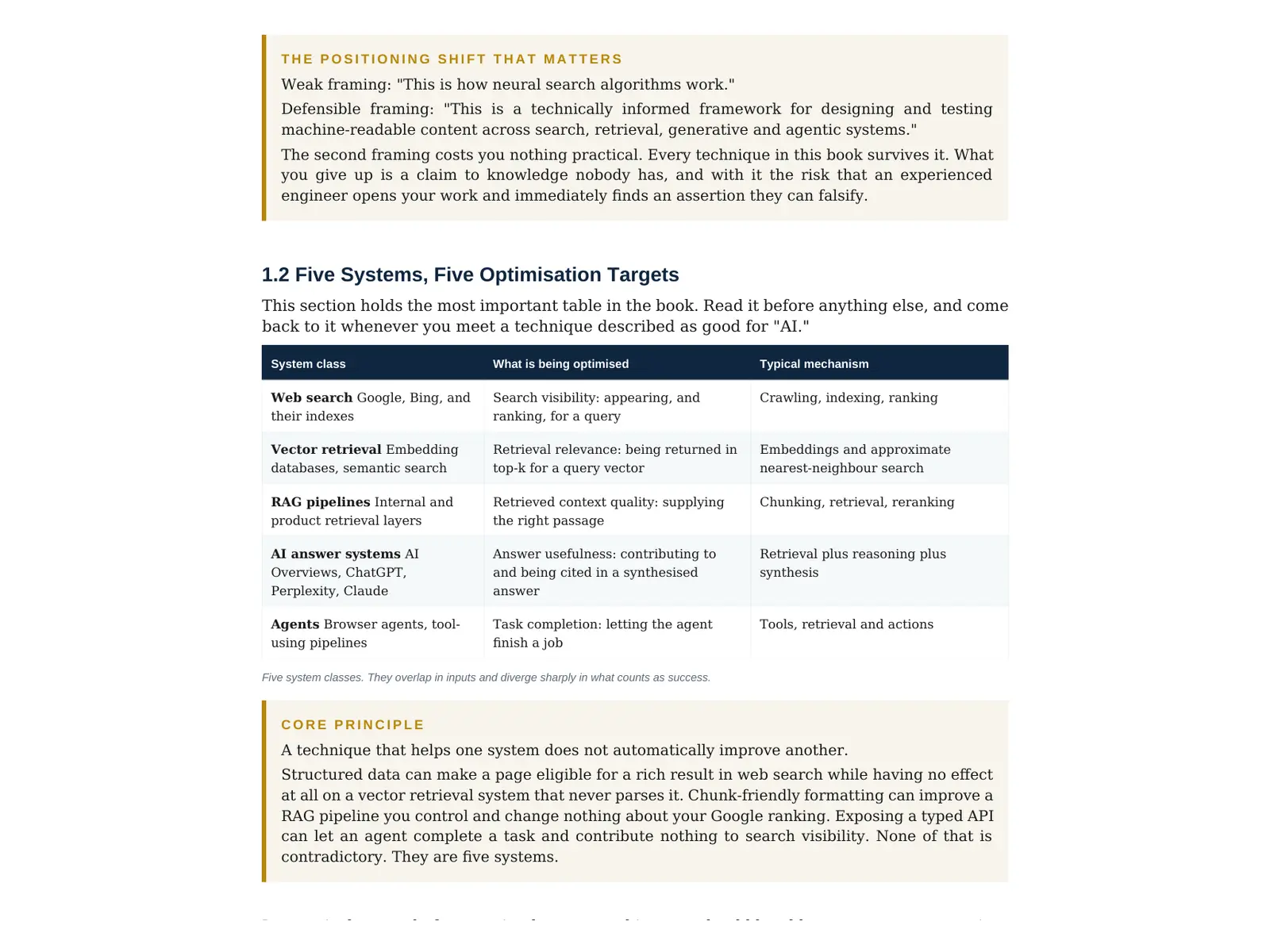
None of which makes the rest of the work unnecessary, because Google is one of five system classes. The practical method the book teaches runs roughly like this:
- Fix eligibility before anything else. Is the page indexed? Snippet-eligible? Reachable without JavaScript? Internally linked? A large share of “we never appear in AI answers” cases resolve right here, and no amount of restructuring fixes a page that was never eligible.
- Name the system you are optimizing for. If the answer is “AI,” you do not have a plan yet.
- Establish entity and relationship clarity in the prose itself, before touching markup.
Only then does implementation work start paying for itself:
- Make the structure honest — real headings, real tables, real lists, answer-first sections that stand alone when read cold.
- Add structured data that is true, not merely valid. A validator will happily pass a perfectly-formed lie.
- Decide crawler policy deliberately, then verify with server logs rather than assumptions.
- Baseline, change one thing, and write down in advance what result would make you conclude it did not work.
What the book will not do is promise you AI citations, Google AI Overview inclusion, or a ranking outcome. No search engine or AI platform has reviewed or endorsed this material, and no guarantee of ranking, citation or retrieval performance is made or implied.
AI Search Visibility: What Can Actually Be Measured?
Traditional analytics assumes users navigate to your site. When an AI system answers the question outright, your content may have been retrieved, read and used while your analytics record nothing. The value you delivered went up and the metric went down.
That is real and it deserves a measurement response — but it also gets exaggerated. Zero-click behaviour predates AI search by a decade, and Google reports traffic from AI features inside ordinary Search Console data rather than as a separate channel.
The book’s answer is to sort every number into one of three tiers, and to say which tier you are in whenever you report:
- Tier 1 — Platform-reported. Search Console impressions and clicks, coverage, URL inspection, server logs, your own analytics. This is measurement.
- Tier 2 — Sampled observation. You or a tool query AI systems across a fixed query set and record what appears. Real data, but sampled, unstable, and not a census.
- Tier 3 — Inference. “Adding schema improved our citations.” Usually unfalsifiable. Label it as a hypothesis.
Most AI Search Visibility reporting sold to clients dresses Tier 2 sampling in Tier 1 confidence and finishes with a Tier 3 causal claim. Keeping the tiers apart is more honest, and with sophisticated clients it turns out to be more persuasive.
On top of that model the book proposes five practitioner metrics — citation frequency, entity mention rate, attribution accuracy, referral traffic from AI surfaces, and competitive displacement — and is explicit that these are proposed measures rather than standardized industry KPIs. It also supplies the reporting discipline that makes them defensible: state the query set, the sample size and cadence, which systems were queried and on what dates, and that responses are non-deterministic. A citation-rate figure missing those things is an anecdote with a percentage sign attached.
Entity SEO and Content Architecture
Entity SEO is the most durable idea in the book, because it outlasts every architectural change underneath it. Whatever a system does internally, it still has to work out what your content is about — which makes entity work the load-bearing half of Semantic SEO rather than a specialism sitting beside it.
An entity is a uniquely identifiable thing — a person, place, organisation, concept, event, product or standard — with its own properties and relationships. What defines it is not existence but resolvability: a system can tell which specific thing you mean and connect it to a canonical identifier such as a Wikidata Q-number.
The chapters on entity architecture cover:
- Entity salience — plus a practical check: run your page through an entity-extraction service and see whether your intended primary entity comes back at the top. If it does not, the page is not about what you think it is.
- Disambiguation through context density — if your brand name doubles as a common word or another company, the fix is not more mentions of your name. It is more mentions of it alongside the entities that define your domain.
- Establishing a brand as an entity — the ordered signals practitioners find useful, each with its evidence status attached, and a blunt note that this is measured in years rather than campaigns.
Once the entities themselves are clear, the architecture question becomes which of them deserve a page of their own:
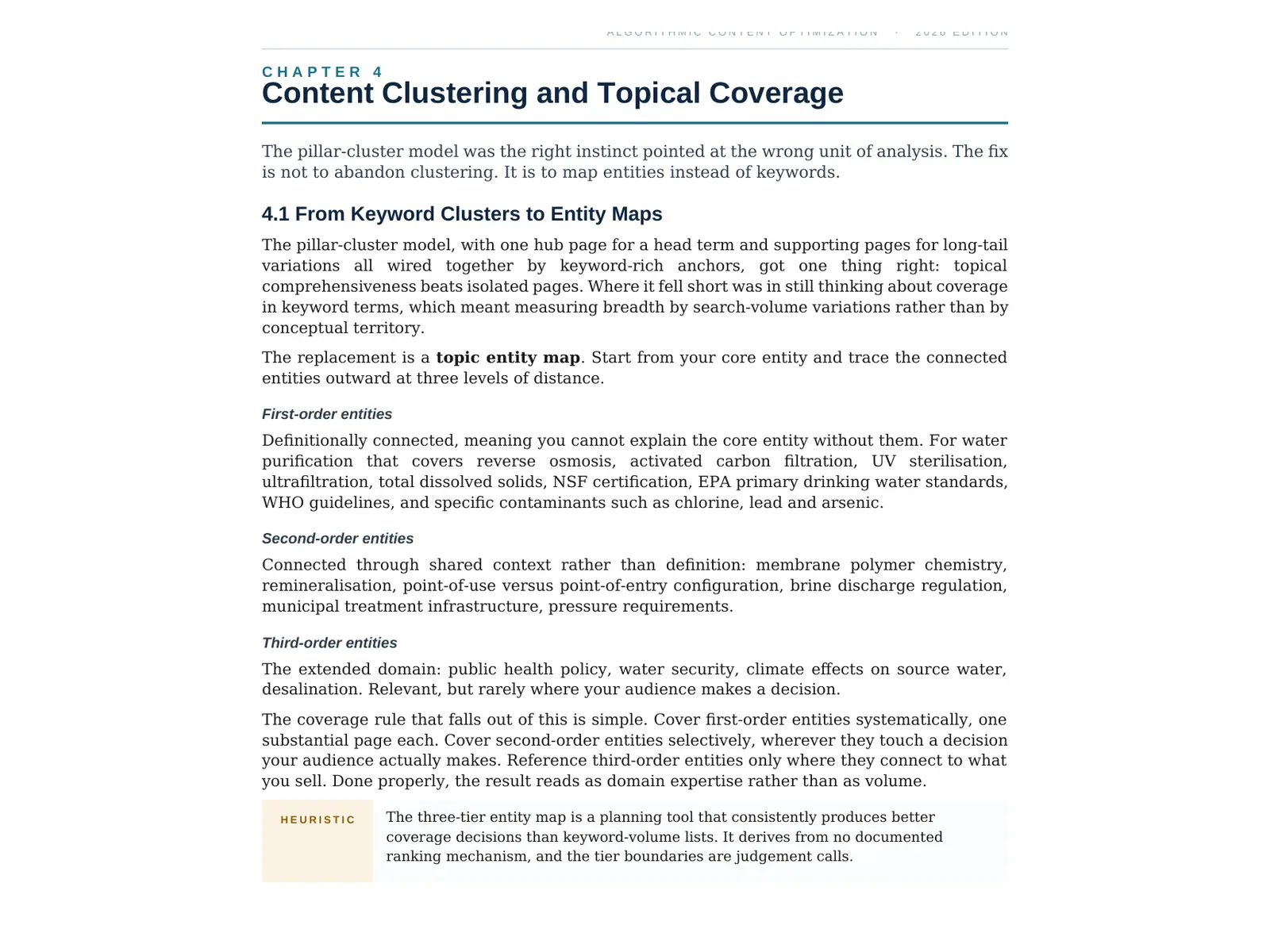
- The topic entity map — first-order, second-order and third-order entities, and a coverage rule that decides what gets a page and what gets a mention.
- Internal linking as relationship signalling — why a link inside a sentence that states the relationship beats a bare “learn more,” for readers and for anything extracting relationships.
Machine-Readable Content for Search and Retrieval
Machine-readable content means content whose subject, structure and relationships can be identified without inference — through semantic HTML, correct heading hierarchy, real tables with real header cells, real list markup, and structured data that accurately describes what visitors can see.
It is worth being precise about the claim being made here, because this is exactly where the field overreaches. Google’s structured data documentation says it helps Google understand a page and can make it eligible for rich results — eligibility, not entitlement. — For a practical WordPress implementation framework, see Schema Markup for WordPress: What to Add and What to Skip. And that accuracy- markup matching visible content- is the property that matters. It does not document “machine-readable content” as a ranking factor, and this book does not present it as one.
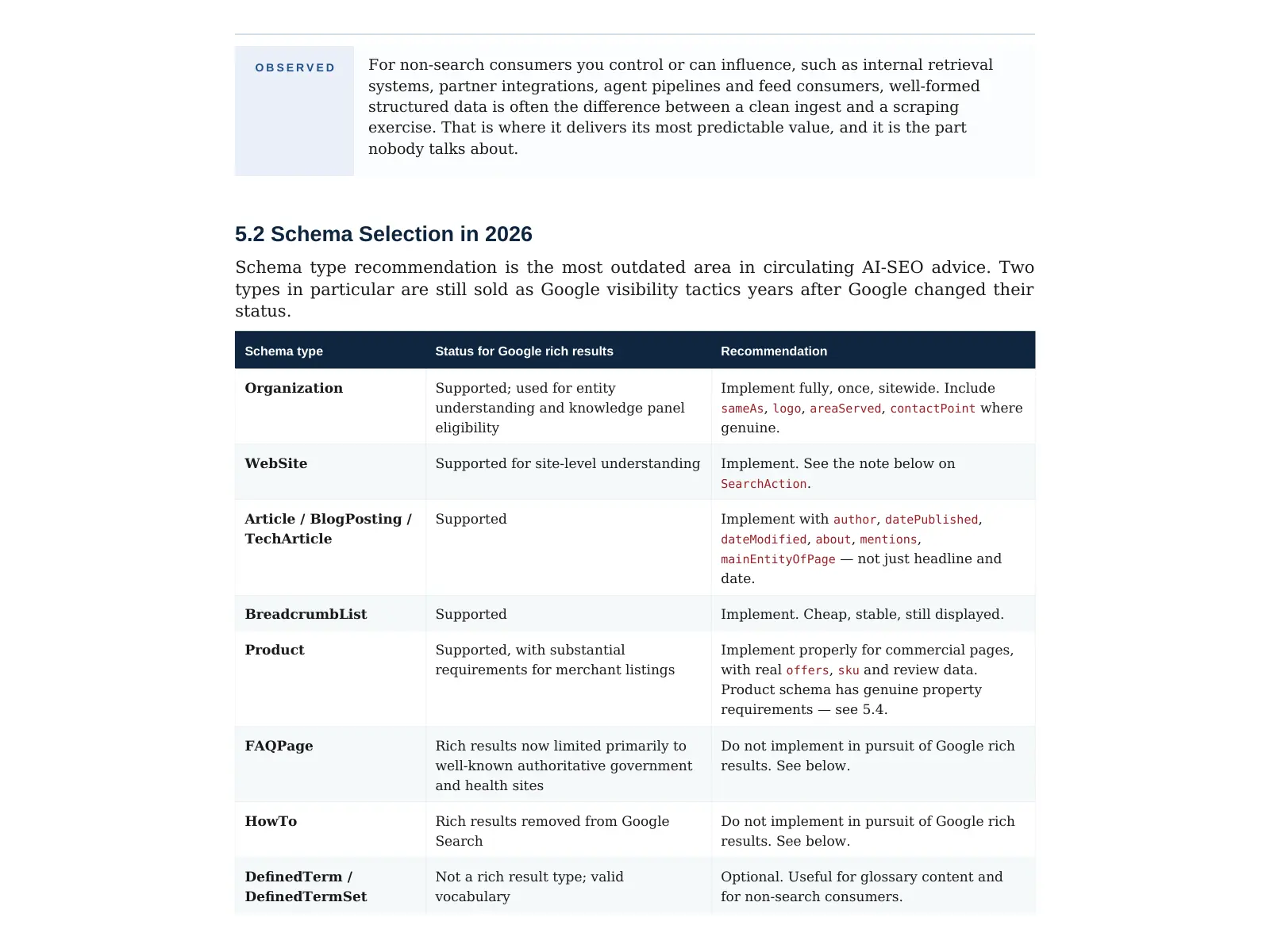
Where machine-readable delivery pays off most predictably is with the consumers you control or can influence: internal retrieval systems, partner integrations, agent pipelines, feed consumers. For those, well-formed structured output is often the difference between a clean ingest and a scraping exercise. That is the part almost nobody talks about, and it is the part that produces the clearest return.
WordPress Implementation
Part III is a complete reference implementation on WordPress, which powers a large share of the publishing web and is where most readers of this book actually work.
It opens by correcting a claim that appeared in the previous edition — that WordPress is “structurally hostile” to this kind of work. It is not. As the WordPress REST API Handbook documents, the API returns structured post objects, supports field selection through _fields, and exposes register_rest_field() and register_rest_route() for extension. Every type used in the book is checked against the Schema.org vocabulary rather than against what one search engine happens to display. The real gap is narrower: default implementations may not expose every content and entity field a particular retrieval workflow needs. That is worth closing, and the difference between “gap” and “hostile” determines what you build.
The WordPress structured data implementation is deliberately opinionated:
- Type-aware builders. Selecting Product produces Product properties, not Article properties with a relabelled
@type. Each builder returns nothing when it cannot honestly populate its type, and the dispatcher falls back to WebPage — which eliminates the entire class of defect where a site publishes hundreds of empty FAQPage or offerless Product declarations. - A single source of entity truth. Organization and Person declared once with stable
@idvalues and referenced by@ideverywhere else. - Validated input and graceful absence. URIs validated as URIs, free text sanitized, nonce and capability checks on every save, and a recursive prune so no blank properties are ever emitted.
Delivery and crawler policy are handled with the same restraint:
- Additive REST delivery. Custom fields registered with schema descriptions, a cached plain-text rendering, and a dedicated versioned endpoint with argument validation — plus the security test confirming draft content is not reachable through it.
- Explicit crawler policy emitted through the
robots_txtfilter, with undecided crawlers producing no output rather than a guess. - Semantic content also depends on a technically accessible site, so review your technical SEO and site architecture before implementing broader content changes.
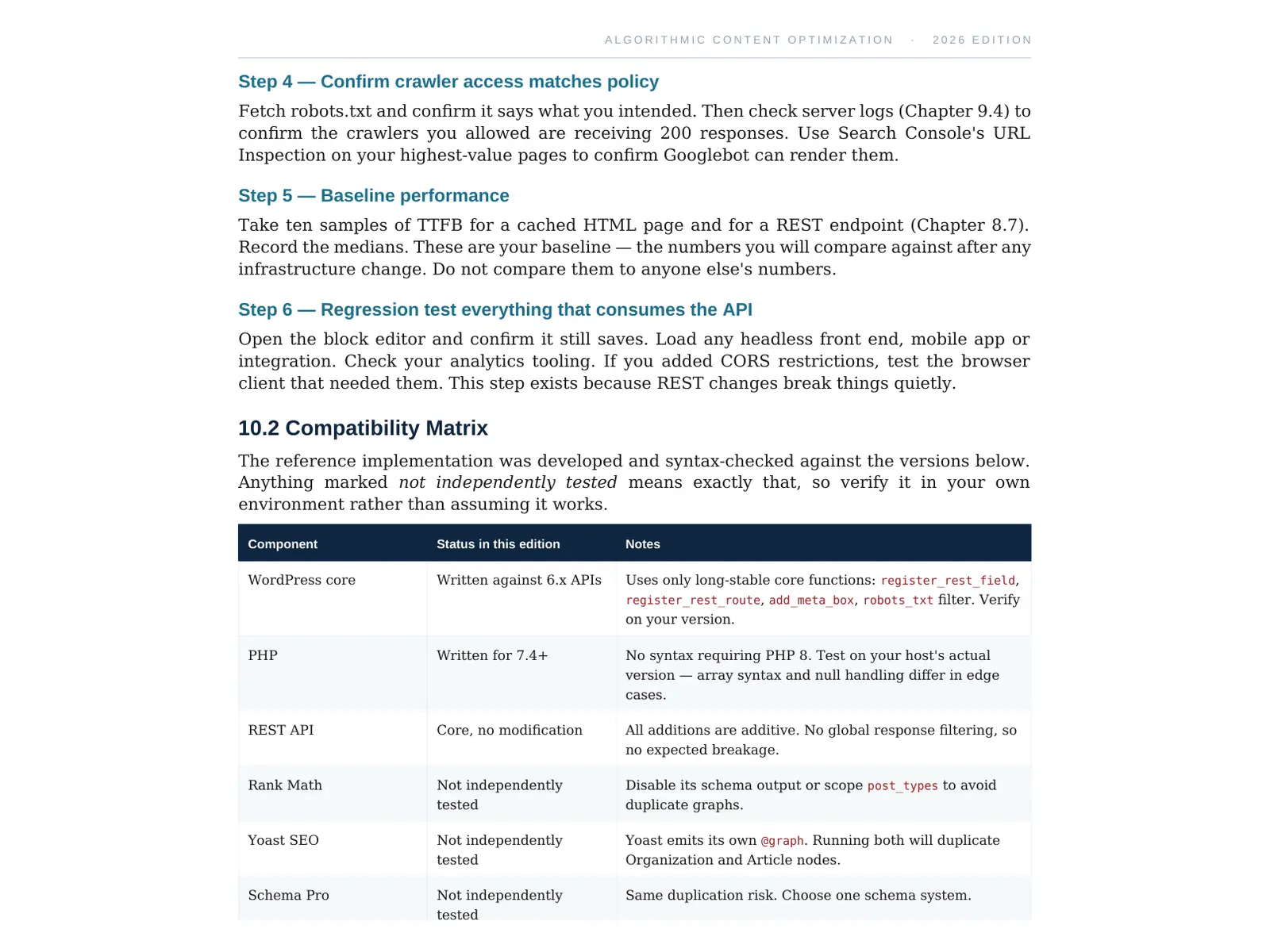
Every block of code is a reference implementation written to be read, not certified production code. Chapter 10 supplies the verification workflow and the compatibility matrix, including the duplicate-schema trap that is the most common real-world failure in this area: a plugin and a custom implementation both emitting Organization and Article nodes under different @id values. If you want that implemented for you rather than by you, that is what Market Latch’s WordPress development work exists for.
Who Is This Book For?
- Technical SEOs who need to separate documented behaviour from vendor narrative before advising a client.
- WordPress developers implementing structured data, REST delivery or agent-facing endpoints who want a design they can defend in review.
- Content strategists building topical coverage who want the entity-based reasoning without the false precision.
- Publishers deciding crawler policy — which AI systems may use their content, and on what terms.
- Agency owners who have to answer “does this actually work?” from a client who just read three contradictory articles.
It assumes you are comfortable with technical SEO concepts and can read PHP well enough to follow an implementation. It is not a beginner’s introduction to SEO, and it is not a first encounter with Semantic SEO — it is what you read once the introductions have stopped being useful. If you are starting from the beginning, the GEO Blueprint is written for that reader, and this book will make more sense afterwards.
What Makes This Book Different?
This edition exists because the first release was audited and found wanting — not because it was too technical, but because its technical claims were not precise enough. Appendix D lists 21 specific claims removed or corrected, each with the reason and the replacement, including:
- The “target cosine similarity above 0.75” threshold, which is meaningless outside a specified pipeline.
- “JSON-LD is parsed with 100% accuracy,” which is not defensible about any parsing system.
- FAQPage and HowTo recommended as high-priority tactics, after Google narrowed one and removed the other.
- SearchAction on the WebSite node, targeting a feature Google removed in November 2024.
- “AI crawlers abort requests above 800ms,” which has no published source behind it.
- “Agentic retrieval is 12–24 months from widespread deployment” — a forecast presented as fact that has already aged past its own window.
- llms.txt as “a low-effort, high-signal addition,” which independent adoption data does not support.
So what you are buying is not a promise of secret ranking factors. There are no ranking-factor lists here, no claimed knowledge of any search engine’s internal weighting, no guaranteed outcomes, and no thresholds presented as universal when they are properties of one pipeline. What you get instead is a coherent architecture, working reference code, an explicit test procedure, and an honest account of where the field’s knowledge runs out.
That is a harder book to write than certainty. It is also the only version of Semantic SEO writing that survives an experienced engineer reading it critically — or a client asking where the number came from.
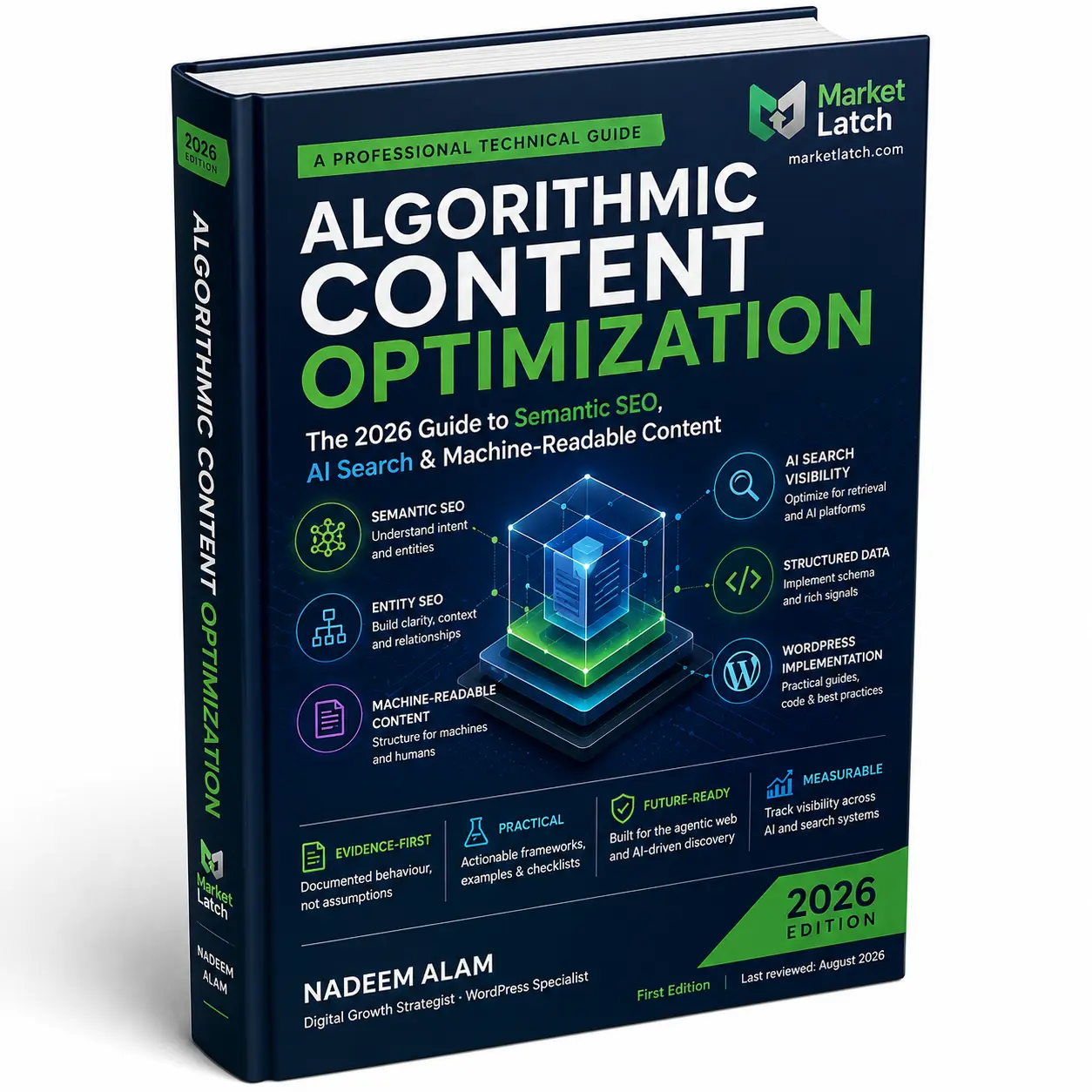
What You’ll Get
- Format: PDF — instant download, readable on any device
- Length: 90 pages, approximately 29,900 words
- Structure: 13 chapters across 4 parts, plus 4 appendices
- Reference code: PHP, JSON-LD and shell blocks throughout Part III, free to adapt in your own projects
- Appendix A: a 7-phase implementation checklist, ordered by dependency
- Appendix B: a troubleshooting table mapping symptoms to likely causes
- Appendix C: primary technical sources — platform documentation, specifications and published research, not secondary commentary
- Appendix D: the full changelog of corrected claims
- Edition: First Edition, 2026 · last technical review August 2026
Get the 2026 Edition →
Also available as part of the AI Search Authority Bundle, alongside the rest of the Market Latch AI search library.
Frequently Asked Questions
1. What is Semantic SEO, in this book’s definition?
Semantic SEO is the practice of optimizing for meaning rather than for character sequences — establishing unambiguously which entity your content is about, stating how concepts relate, and structuring the result so machines can identify all of it without guessing. The book treats it as the layer underneath web search, vector retrieval, RAG, answer engines and agents, since all five have to establish subject before they can do anything else.
2. Is this a beginner’s guide to SEO?
No. It assumes working familiarity with technical SEO and enough comfort with PHP to follow a WordPress implementation. Beginners are better served starting with the GEO Blueprint, which is written for that reader.
3. Does it cover AI search and generative engines?
Yes, and specifically it covers what is documented about them versus what is inferred. It quotes Google’s own stated position on AI Overviews and AI Mode, explains where non-Google answer systems differ, and separates AI answer synthesis from vector retrieval and RAG rather than treating them as one thing.
4. Does it cover Entity SEO?
Extensively. Entity resolvability, salience, disambiguation, brand entity establishment, the three-tier topic entity map, and internal linking as relationship signalling — each with its evidence status stated, including an honest note that no platform documents how much any specific system uses your sameAs declarations.
5. What does “machine-readable content” mean here?
Content whose subject, structure and relationships are identifiable without inference: semantic HTML, correct heading hierarchy, real tables and lists, and structured data that matches what visitors can see. The book explains where that pays off most predictably — with retrieval systems, partner integrations and agent pipelines — and does not present it as a documented Google ranking factor.
6. Does the book include WordPress code I can use?
Yes. Part III is a complete reference implementation: type-aware schema builders, a dispatcher, an editor meta box with full nonce and capability handling, additive REST fields, a dedicated endpoint, and a policy-first robots.txt filter. It is written to be read and adapted. It is explicitly not certified production code — Chapter 10 gives you the test procedure and compatibility matrix to run before anything touches a live site.
7. Does it explain structured data and schema markup?
Yes, including a current schema-selection table for 2026, the @graph pattern with stable @id references, the sameAs property, why type-specific properties are not interchangeable, and the corrected position on FAQPage, HowTo and SearchAction. It also explains why syntactic validity is not semantic correctness.
8. How does it approach AI Search Visibility measurement?
Through a three-tier model separating platform-reported data, sampled observation and inference — plus five proposed practitioner metrics and a monthly monitoring routine. The metrics are presented as proposed measures rather than standardized KPIs, because no platform certifies them.
9. Does it cover AI agents and the agentic web?
Yes. Current agent capability, the Model Context Protocol described accurately as an integration architecture rather than an SEO technique, WebMCP as an emerging browser standard with its actual adoption status, and why llms.txt does not function as a discovery signal. Forecasts are replaced with four labelled scenarios and no dates.
10. Does it guarantee AI citations or Google AI Overview inclusion?
No, and it says so on the copyright page. No guarantee of search ranking, AI citation, retrieval performance or commercial outcome is made or implied, and no search engine or AI platform has reviewed or endorsed the material. What it offers instead is an architecture you can test and a method for finding out whether it worked.
11. Is this different from the AEO and GEO books in the Market Latch library?
Yes. The AEO Guide is about earning citations inside synthesized answers. The GEO Blueprint is a beginner-friendly path into generative search. This book is the Semantic SEO layer underneath both: how these systems read content at a mechanical level, and how you prove a change made a difference. They complement each other, which is why the bundle exists.
12. What format is it delivered in, and how do I get support?
A downloadable PDF, formatted for on-screen reading and for reference use during implementation, with its tables, code blocks and evidence call-outs preserved. For questions after purchase, or to challenge a technical claim, email info@marketlatch.com or use the contact form. Substantive corrections go into the changelog and the next revision.
Why Buy From Market Latch
Market Latch is the agency practice of Nadeem Alam, a digital growth strategist and WordPress specialist with around fifteen years of hands-on work in technical SEO, entity-based content architecture and platform engineering for publishers, serving clients across the United States, United Kingdom, Canada, Australia, the UAE and Pakistan.
This book came out of client work rather than theory — specifically out of auditing site after site whose owners had implemented confident AI-SEO advice aimed at mechanisms that either never existed or had been retired by the platform years earlier. The Semantic SEO methods and WordPress structured data patterns in these pages are the ones that survived that auditing. The same thinking drives Market Latch’s GEO and AEO services and its technical SEO work. If you would rather see where your own site currently stands before reading 90 pages, start with a free SEO audit.
For the wider context on how AI systems find and cite websites, the ChatGPT SEO guide is free to read. The rest of the catalogue lives in the Market Latch digital library.
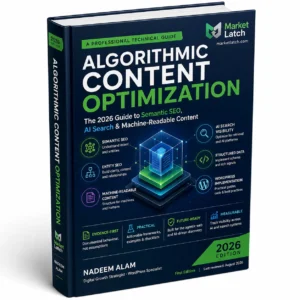
Get Algorithmic Content Optimization — 2026 Edition

Reviews
There are no reviews yet.