If you are deciding between Person Schema and Organization Schema, start with a question unrelated to rankings: What real-world entity does this website or page actually represent?
A site can represent a person, an organization, or both. That is common with founder-led businesses and professional brands. The founder is a real person; the business is a separate organization. Structured data can describe both, but only when the entities and their relationships are real and accurately represented.
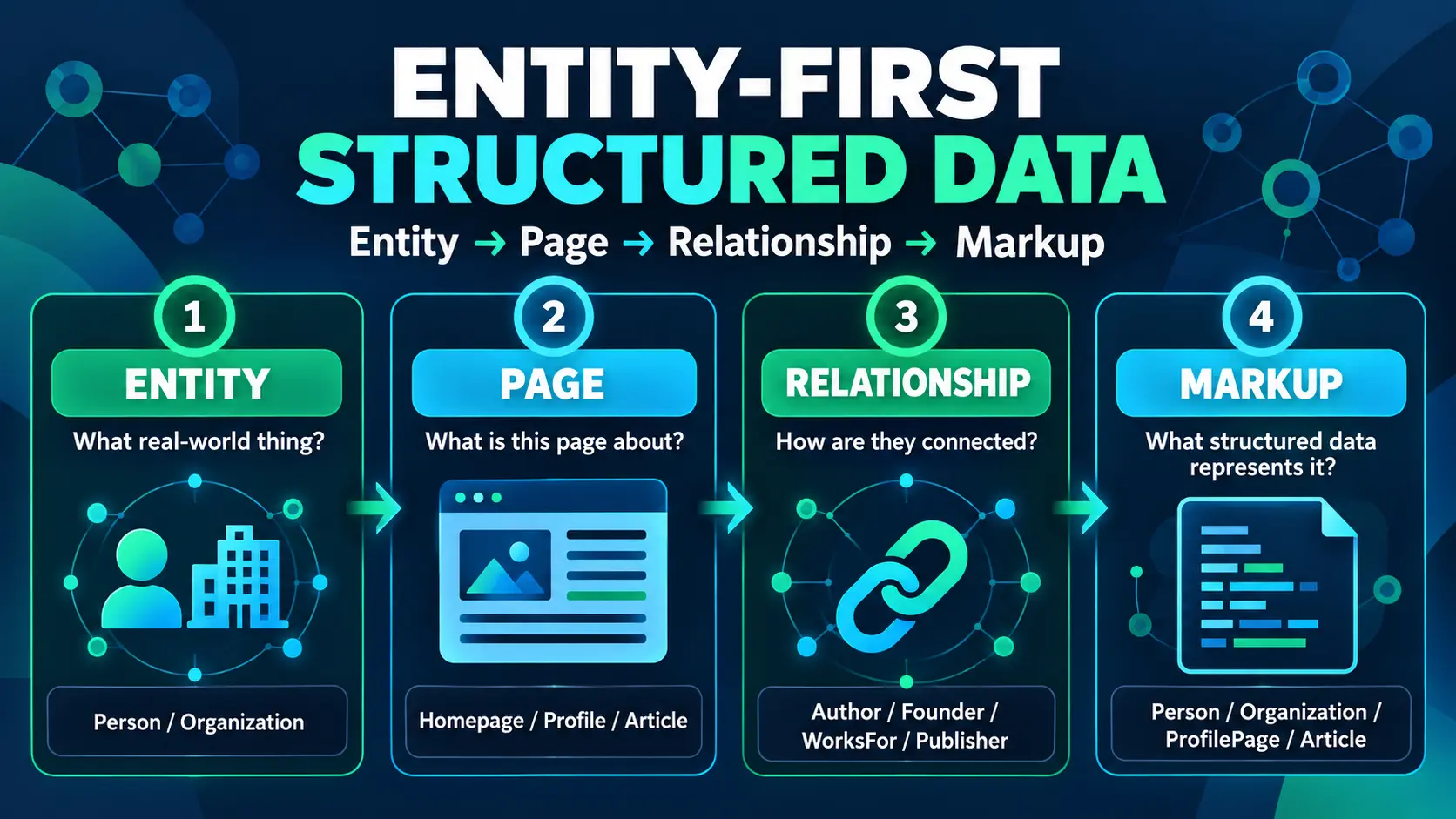
This article uses a simple framework: Entity → Page → Relationship → Markup. It helps you decide before touching WordPress, Rank Math, or custom JSON-LD.
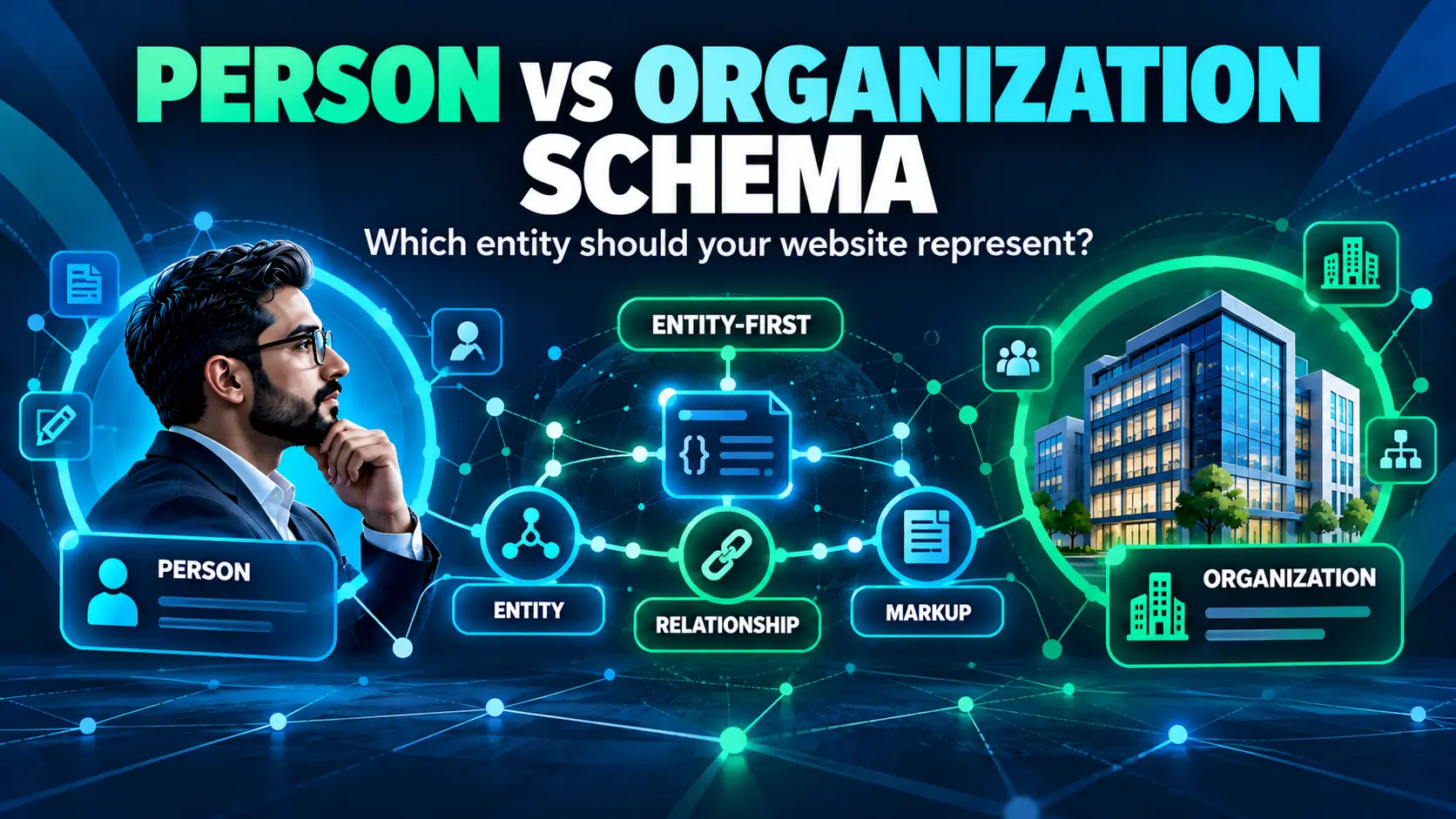
A useful mental model is to stop asking which schema “wins.” A Person and an Organization can describe different entities on the same site. What matters is whether each entity has a clear role and whether the relationships between them match reality.
Person Schema vs Organization Schema: What Each Actually Represents
Schema.org’s Person type describes an individual. It can carry details about that person and relationships to other entities, including worksFor when the relationship is true.
Google’s Organization structured data documentation says Organization markup can help Google understand an organization and disambiguate it in Search. The Schema.org Organization type provides the underlying vocabulary for describing an organization. Google also recommends putting organization information on the homepage or on a page that describes the organization when appropriate. Some properties can influence visual elements, but structured data does not guarantee a particular Search appearance.
So the choice is not a branding preference or an SEO trick. It starts with the entity that actually exists.
| Question | Person | Organization |
| What does it represent? | An individual person | An organization or business entity |
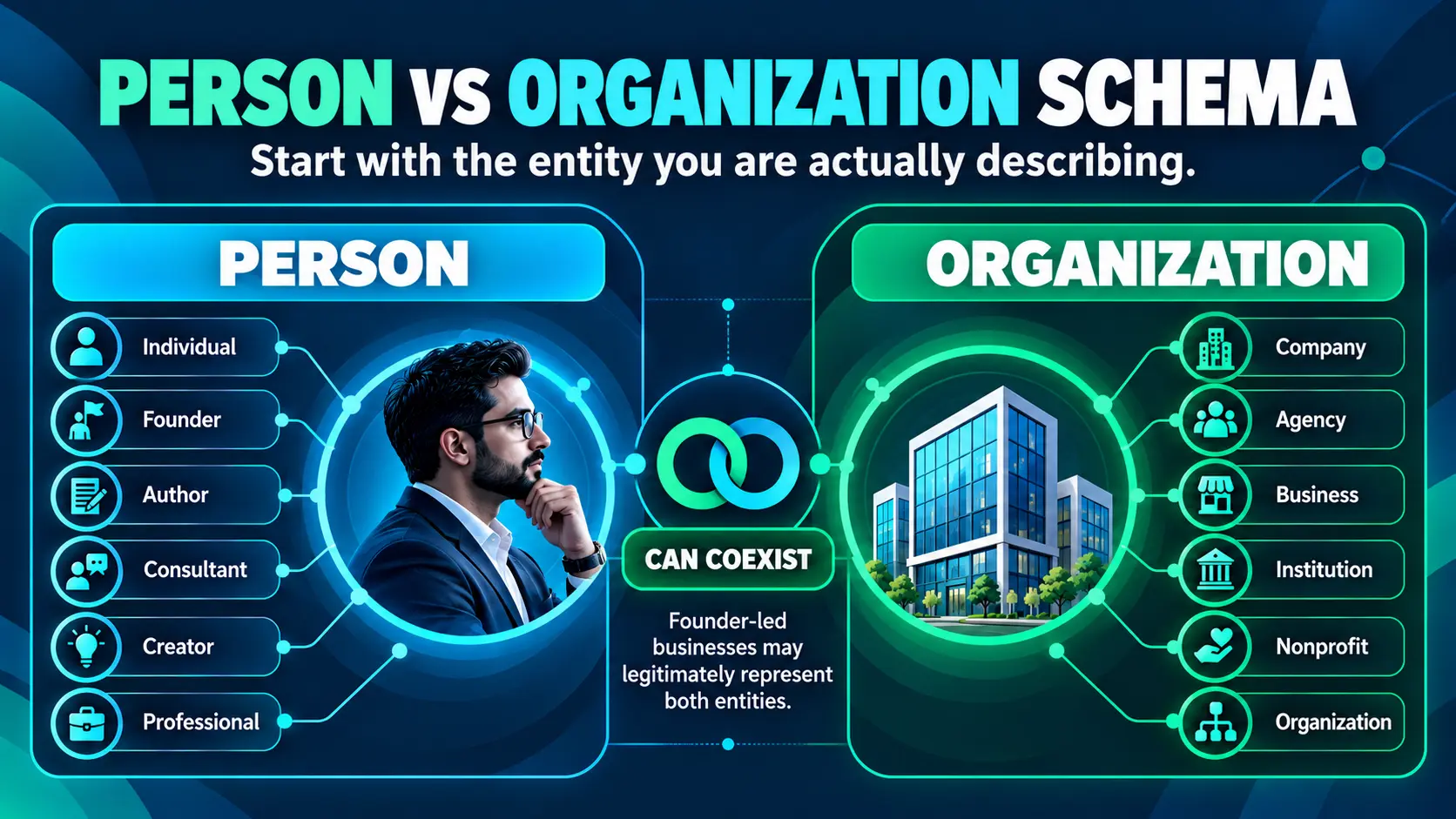
| Typical use | Author, creator, professional, founder | Business, brand, agency, company, institution |
| Can it coexist with the other? | Yes, when both entities genuinely exist | Yes, when both entities genuinely exist |
| Key relationship examples | worksFor, affiliation | founder, employee, publisher |
| Main rule | Describe the person accurately | Describe the organization accurately |
The Entity-First Framework: Entity → Page → Relationship → Markup
Separate four layers that are often bundled together. Google’s structured-data guidance emphasizes accurate, relevant markup. For supported Search features, check Google’s current search appearance documentation. This makes the schema decision much clearer.
- Entity — Who or what are you describing? This may be a Person or an Organization.
- Page — What kind of page is the visitor viewing? It may be an article, profile, about page, product page, or another page type.
- Relationship — How does the entity relate to the page or another entity? Examples include author, founder, worksFor, or publisher.
- Markup — Which structured-data types and properties accurately express those facts?
| MarketLatch rule: Don’t choose schema by guessing from your business model. First identify the entity, then the page type, then the relationship, and only then the markup. |
This also prevents a common implementation mistake: choosing a schema type because the page happens to be associated with that entity. A founder’s article is still an article. A company’s blog post is still an article. The entity and the page type can be connected without being the same thing.
When Should You Use Person Schema?
Use Person when the structured data is describing a real individual. That might be a professional, creator, consultant, founder, or author. The important part is that the individual is the entity being described—not simply the person who happened to write the page.
This distinction matters because an author’s identity and the page’s type are different pieces of information. An article can have a Person as its author without becoming a Person page itself.
- A profile or About page that is primarily about one individual can use that Person as its main entity.
- An article can identify its author as a Person while the article itself remains an Article or BlogPosting.
- A founder can be represented as a Person while the business is represented separately as an Organization.
- Use only properties that describe the real person and relationships that are actually true. More properties do not make the graph more useful if the underlying facts are wrong.
| Avoid this assumption Person Schema should not be presented as a guaranteed ranking boost, E-E-A-T boost, Knowledge Panel trigger, or special AI-search visibility switch. Those claims are not established by the sources used for this article. |
For a personal brand, this often means the person is important to the site’s identity, while the site may also represent a business or publication. That does not mean every page needs both entities. Add the entity where it has a real role, and connect it to the page or other entity only when the relationship is meaningful.
When Should You Use Organization Schema?
Use Organization when the real-world subject is an organization. Google’s Organization documentation says this markup can help Google understand an organization’s administrative details and distinguish it from other organizations in Search. Some properties can also influence visual elements, such as the logo shown in Search, but Google does not promise a particular appearance.
Google recommends placing organization information on the homepage or on a single page that describes the organization when appropriate. You do not need to repeat the same organization entity on every page simply because the site belongs to an organization.
- Use the most specific applicable Organization subtype when one genuinely fits.
- Keep names, URLs, logos, contact details, and other properties accurate.
- Use only properties that are relevant to the organization and the page.
- Before adding another Organization entity, inspect what your WordPress theme, SEO plugin, WooCommerce, or custom code already outputs.
The same principle applies to organizations. A business can be the publisher of an article without the article itself becoming an Organization page. Keeping those roles separate makes the graph easier to understand and reduces the temptation to mark up everything with everything.
Founder-Led Businesses: Why Person and Organization Can Coexist
Founder-led sites are where the simple either/or question often stops being useful. There may be a real person behind the business and a real organization operating the business. Both can belong in the same entity graph when the relationships are accurate.
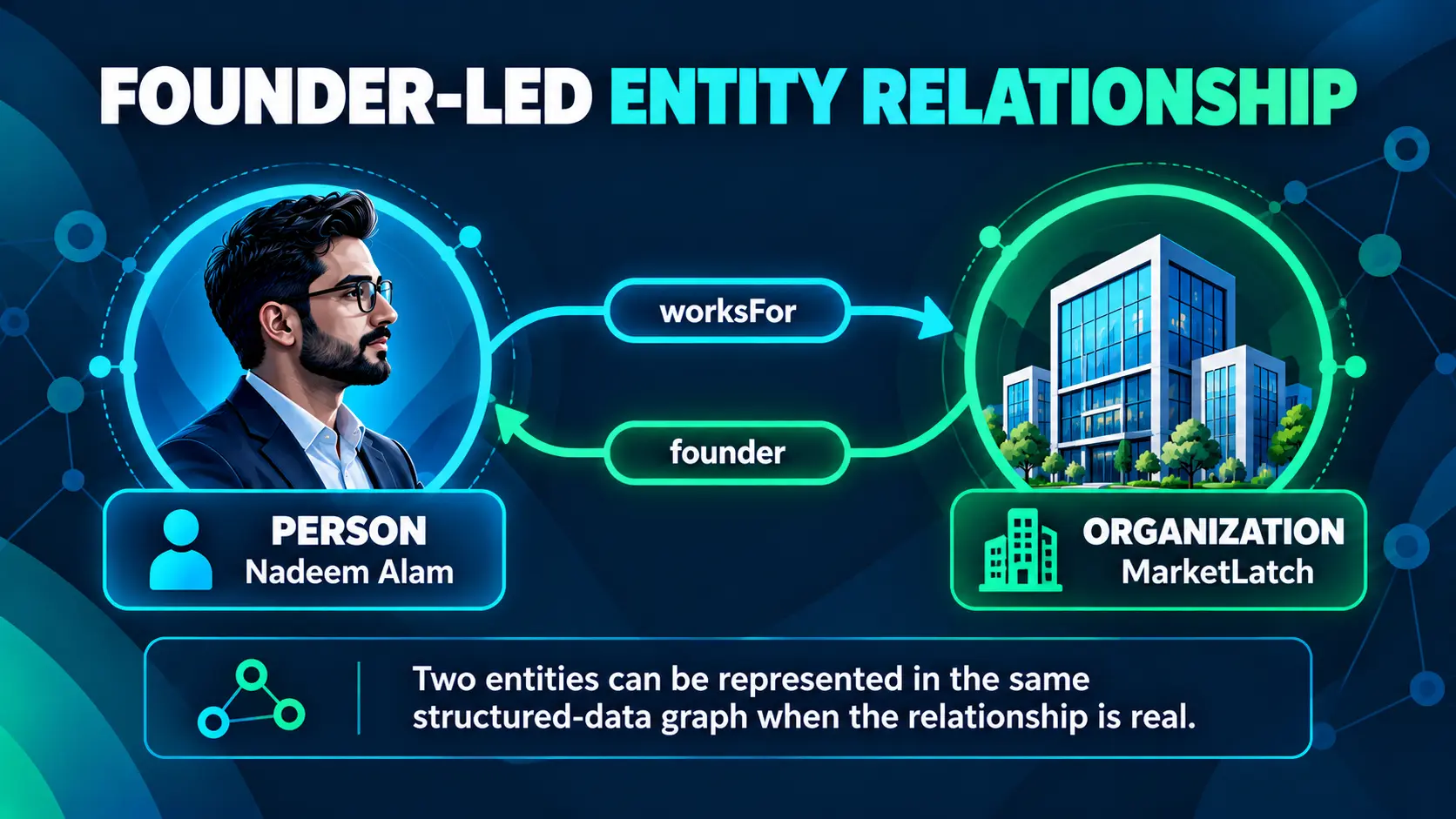
For example, a founder can be a Person and the business can be an Organization. Schema.org’s founder property describes who founded an organization, while worksFor describes an organization that a person works for.
The important word is accurate. Do not add a founder relationship because it sounds useful for SEO. Add it only if the person actually founded the organization. Likewise, use worksFor only when that relationship is true.
| Entity | Relationship | Entity |
| Person | founder | Organization |
| Person | worksFor | Organization |
| Article | author | Person |
| Article | publisher | Organization |
Person vs ProfilePage vs Article Author: Don’t Mix These Up
One of the most important distinctions in structured data is the difference between an entity type and a page type.
| Concept | What it describes | Example |
| Person | A real individual entity | A founder or author |
| Organization | A real organization entity | MarketLatch |
| ProfilePage | A page primarily focused on one Person or Organization | An author/about profile |
| Article / BlogPosting | The article page itself | This article |
| author | A relationship from the article to its author | Article → Person |
If you are unsure whether a page qualifies as a profile, look at the page itself. Is the main purpose to tell visitors who this person or organization is? If the answer is no, do not force ProfilePage markup onto it just because a Person or Organization is mentioned.
Google’s ProfilePage documentation says the primary focus of a ProfilePage should be a single person or organization affiliated with the overall website. Examples include an author page, an About Me page, and an employee page. That does not make every page written by that person a ProfilePage.
For an article, the page-level structured data should describe the article. Google’s Article documentation supports Article, NewsArticle, and BlogPosting, and an article author can be a Person or Organization.
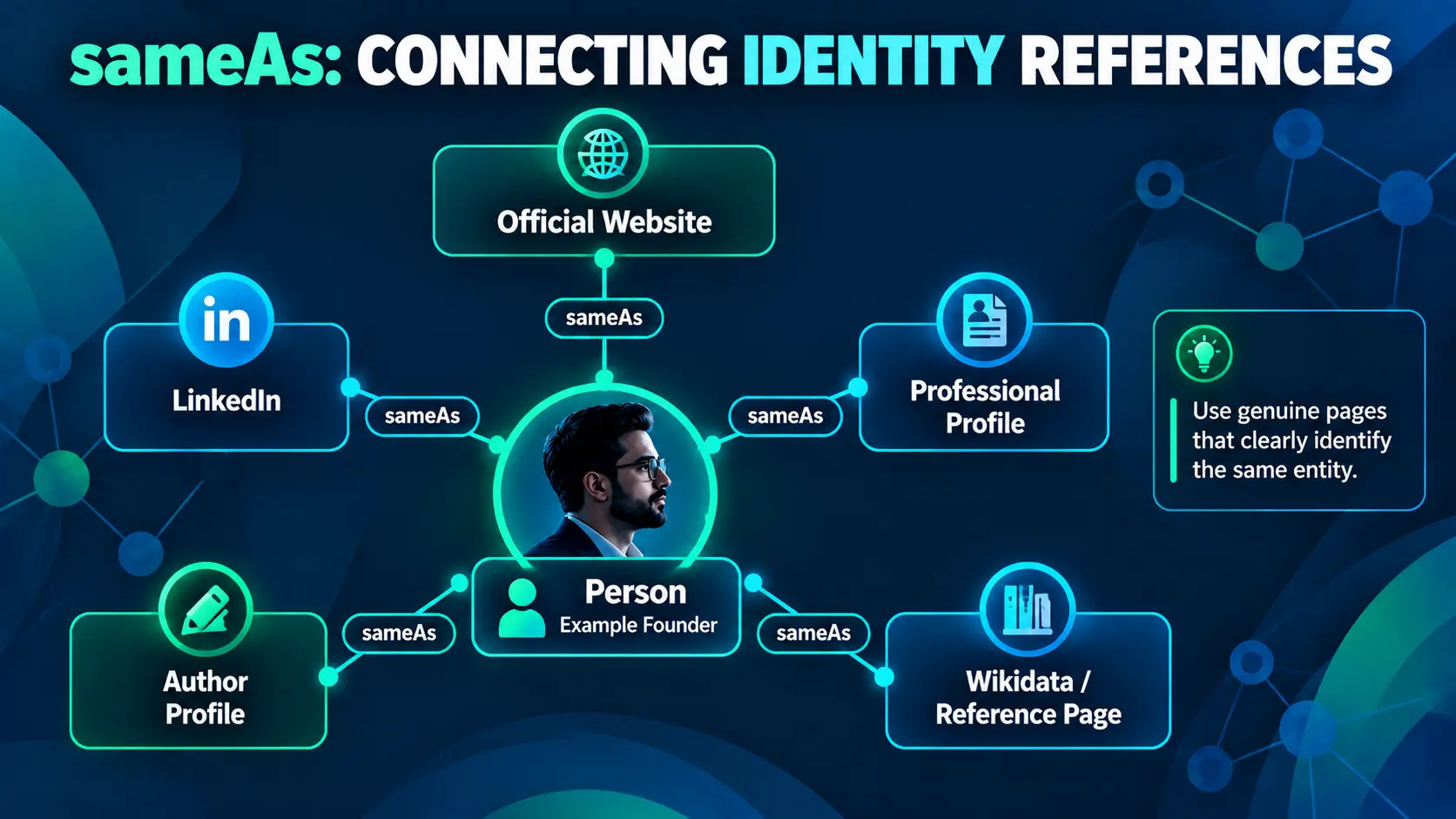
sameAs: Connect Identity Carefully
Schema.org’s sameAs property is a URL to a reference page that unambiguously indicates an item’s identity. Examples include an official website, Wikipedia page, or Wikidata entry.
Think of sameAs as an identity reference, not a switch that turns on a Knowledge Panel. The URL should genuinely identify the same person or organization represented by the entity.
- Use real identity references.
- Prefer stable, authoritative profiles or reference pages.
- Do not add random social profiles simply to increase the number of sameAs URLs.
- Do not claim that adding sameAs guarantees a Knowledge Panel or higher rankings.
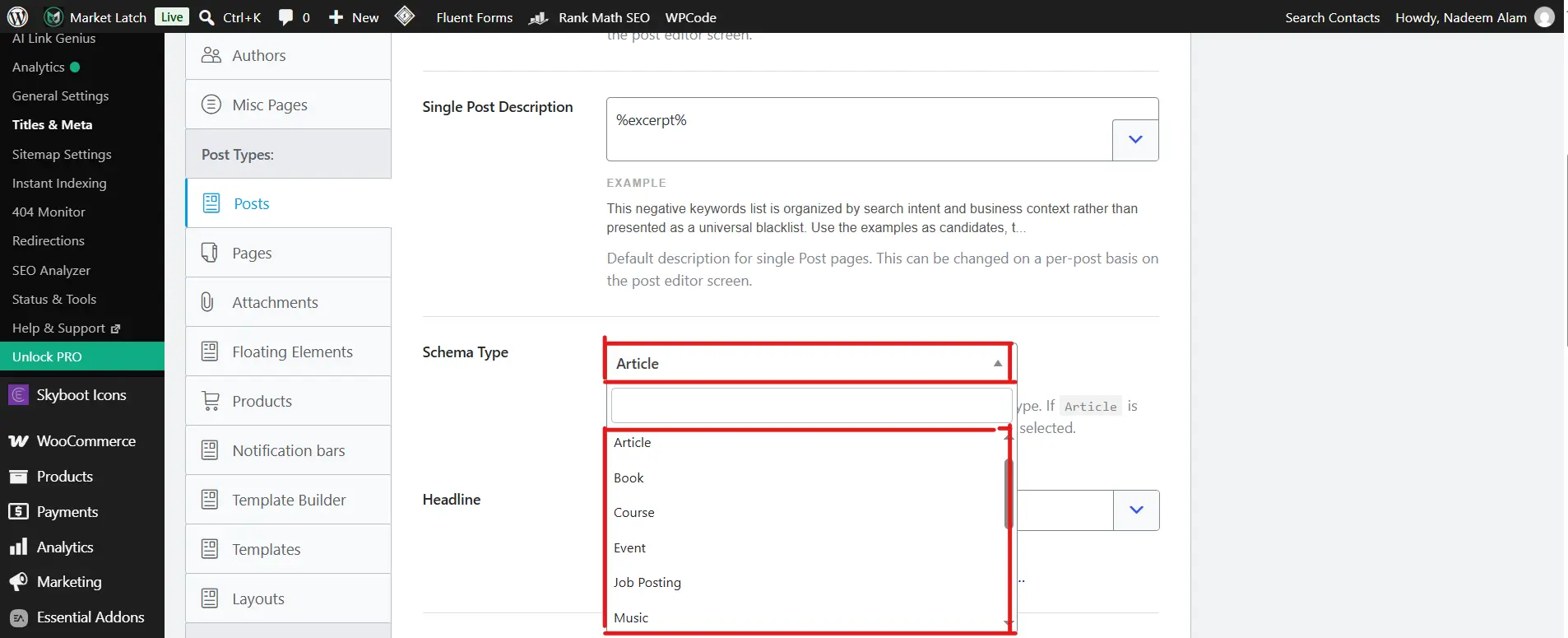
Before Changing Schema in WordPress, Audit What Already Exists
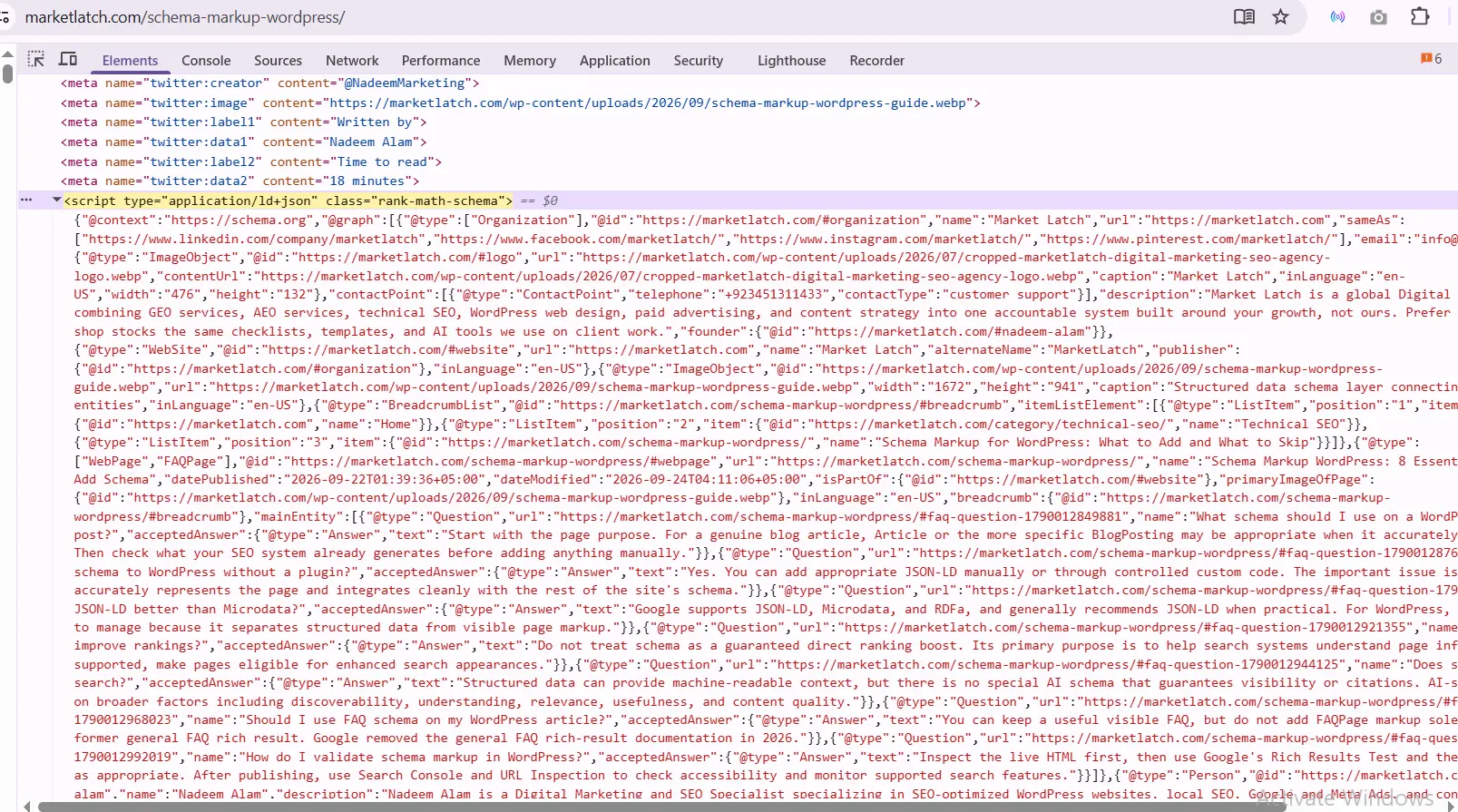
WordPress sites can produce structured data from several layers: the SEO plugin, theme, WooCommerce, custom code, or another plugin. MarketLatch’s broader WordPress schema audit guide uses the same audit-first principle: inspect what is already being generated before deciding what to keep, add, fix, or skip.
At MarketLatch, the practical approach is to inspect the published source before changing Rank Math settings. The editor screen tells you what is configured; the rendered output tells you what the site is actually publishing. That audit-first habit is especially useful when several plugins can generate schema. For the broader WordPress schema audit process, see Schema Markup for WordPress: What to Add and What to Skip.
- Identify the page — confirm exactly which page you are editing.
- Identify the primary entity — decide what the page is mainly about.
- Check existing schema — inspect the rendered page/source and structured-data output.
- Identify the generator — determine whether Rank Math, the theme, WooCommerce, custom code, or another plugin is producing it.
- Check entity connections — inspect author, publisher, founder, worksFor, sameAs, and related relationships where applicable.
- Check for duplicates — look for multiple versions of the same Person, Organization, Article, or WebPage entity.
- Compare with visible content — markup should accurately represent what users can see.
- Check the relevant Google feature or documentation — add markup because it has a legitimate, supported use case, not simply because the schema type exists.
- Choose an action — KEEP, ADD, FIX, or SKIP.
| The MarketLatch WordPress preflight Audit first. Decide second. Change third. Validate last. |
Annotated JSON-LD Example: A Founder-Led Entity Graph
The following is an illustrative example, not a universal copy-and-paste template. Adapt the entities, IDs, URLs, dates, image URLs, and relationships to the actual site. Never invent an author URL, sameAs URL, or entity ID just because the example contains one.
{
“@context”: “https://schema.org”,
“@graph”: [
{
“@type”: “Article”,
“@id”: “https://example.com/article/#article”,
“headline”: “Person Schema vs Organization Schema: Which One Should You Use?”,
“author”: {
“@id”: “https://example.com/author/example/#person”
},
“publisher”: {
“@id”: “https://example.com/#organization”
},
“mainEntityOfPage”: {
“@id”: “https://example.com/article/#webpage”
}
},
{
“@type”: “Person”,
“@id”: “https://example.com/author/example/#person”,
“name”: “Example Person”,
“worksFor”: {
“@id”: “https://example.com/#organization”
}
},
{
“@type”: “Organization”,
“@id”: “https://example.com/#organization”,
“name”: “Example Organization”,
“founder”: {
“@id”: “https://example.com/author/example/#person”
}
}
]
}
In this model, the Article is the page-level content; the Person is the author and the Organization is the publisher or business entity. Their relationships are included only when true.
The example deliberately does not turn the article into a Person or Organization page or add every available property. Accurate structure matters more than a large graph.
Common Person vs Organization Schema Mistakes
Most mistakes here come from assigning the wrong role to an entity, confusing an entity type with a page type, or adding markup before the existing WordPress output is understood.
- Treating Person and Organization as mutually exclusive when both real entities exist.
- Using Person or Organization as the page type for an article instead of describing the article itself.
- Adding ProfilePage markup to a page that is not primarily a profile.
- Adding sameAs URLs that do not clearly identify the same entity.
- Adding founder or worksFor relationships without verifying that they are factually true.
- Adding duplicate Organization or Person entities without connecting them to the existing entity graph.
- Assuming valid schema guarantees a rich result, Knowledge Panel, ranking improvement, or AI citation.
- Changing Rank Math settings before checking the structured data already generated by WordPress.
- Adding markup simply because it is available rather than because it accurately describes the page.
Frequently Asked Questions
Which schema should a founder-led business use: Person, Organization, or both?
For a founder-led business, both can be appropriate when both real entities exist. Represent the founder as a Person and the business as an Organization, then connect them only through relationships that are factually true.
Can Person Schema and Organization Schema exist together?
Yes. They describe different real-world entities, so they can coexist in the same entity graph. The important part is that each entity has a clear role and the relationships between them accurately reflect reality.
Is ProfilePage the same thing as Person Schema?
No. Person describes the individual entity; ProfilePage describes a page whose primary focus is that person or organization. A Person can be the mainEntity of a qualifying ProfilePage.
Does an article become Person Schema because it has an author?
No. The article remains an Article or BlogPosting. Google’s Article documentation supports a Person or Organization as the author. The page type and the author entity are different layers.
What does sameAs actually do?
sameAs identifies a reference page that unambiguously represents the same entity, such as an official profile or established reference page. It should be used only when the URL genuinely identifies that person or organization.
Does Person or Organization Schema improve rankings or guarantee a Knowledge Panel?
Do not treat either type as a guaranteed ranking boost or Knowledge Panel trigger. Google’s structured-data documentation explains that structured data can help Google understand page content, but Google does not guarantee that features using structured data will appear in Search.
So, Which One Should You Use?
If the real subject is an individual, Person may be appropriate. If the real subject is an organization, Organization may be appropriate. If both entities genuinely exist and have relevant relationships, both can coexist.
The practical question is therefore not simply “Person or Organization?” Ask three things: what entity is being described, what kind of page is this, and which relationships actually need to be expressed?
| Quick decision Person = the individual. Organization = the organization. ProfilePage = a page primarily about that entity. Article = the article page. author/founder/worksFor/publisher = relationships. sameAs = identity reference. |
MarketLatch Rule: Entity First, Markup Second
MarketLatch uses an entity-first process: identify the entity, page, relationship, and existing markup before changing anything.
Identify the real-world entity
- Identify the real-world entity
- Identify the page type.
- Identify the real relationship.
- Inspect the structured data already being generated.
- Add, keep, fix, or skip markup based on what the page actually represents.
- Validate the final output before and after publication.
Final Takeaway
Person Schema and Organization Schema are not competing SEO buttons. They describe different kinds of real-world entities.
For a personal brand, professional, or founder-led business, the implementation may involve a Person, an Organization, or both. The deciding factor is factual accuracy. For the broader WordPress process, see MarketLatch’s schema markup guide.
Before changing WordPress schema, inspect the published output. Then use the simplest accurate structure that represents the page and its entities. For the broader relationship between structured data and AI-search content, see MarketLatch’s ChatGPT SEO guide.
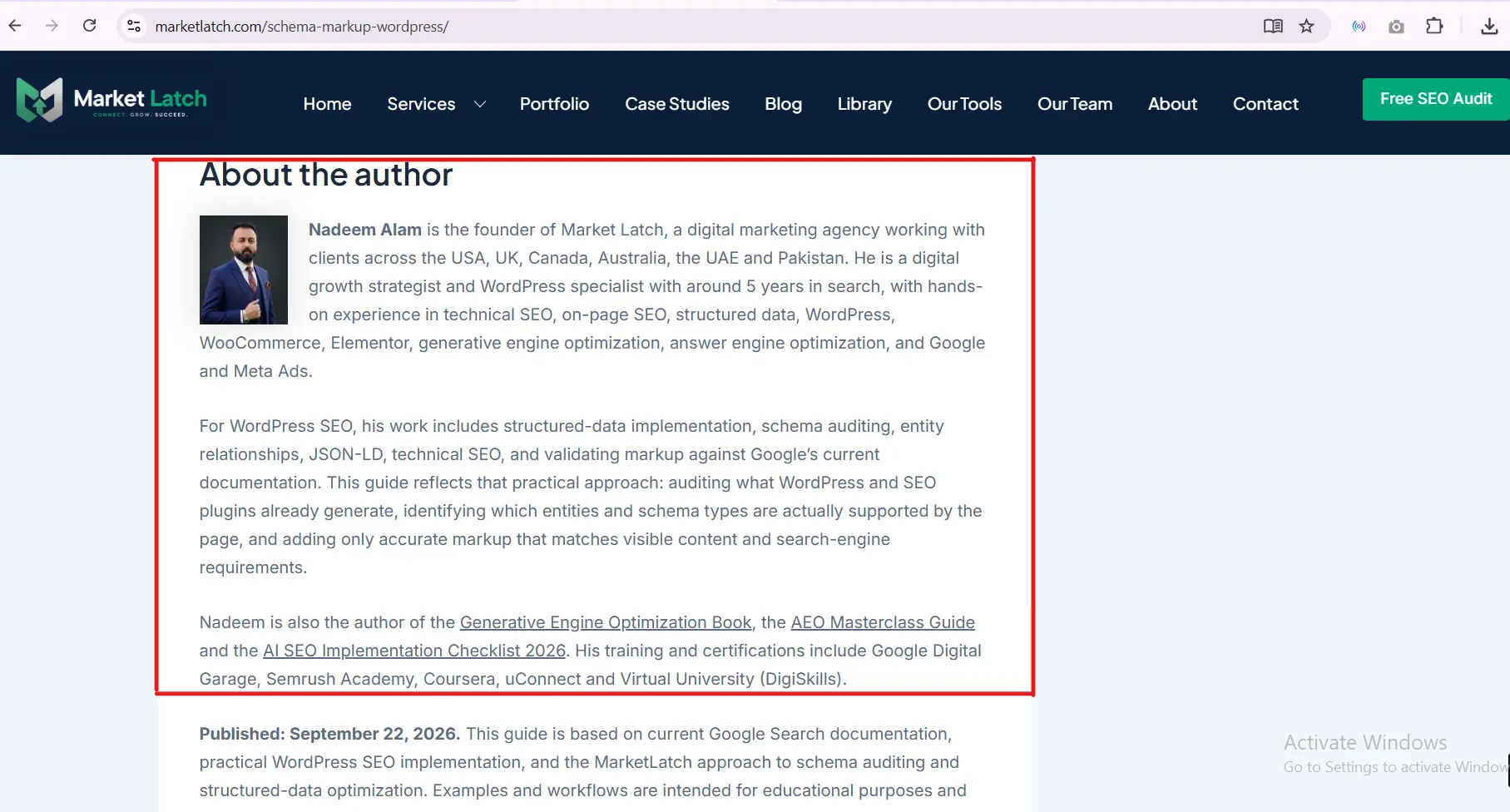
About the author

Nadeem Alam is the founder of MarketLatch, a digital marketing agency serving clients across the USA, UK, Canada, Australia, the UAE, and Pakistan. He is a digital growth strategist and WordPress specialist with about five years of experience in search, with hands-on experience in technical SEO, on-page SEO, structured data, WordPress, WooCommerce, Elementor, Generative Engine Optimization, Answer Engine Optimization, Google Ads, and Meta Ads.
For WordPress SEO, his work includes structured-data implementation, schema auditing, entity relationships, JSON-LD, technical SEO, and validating markup against Google’s documentation. This guide reflects that practical approach: auditing what WordPress and SEO plugins already generate, identifying which entities and schema types are actually supported by the page, and adding only accurate markup that matches visible content and search-engine requirements.
Nadeem is also the author of the Generative Engine Optimization Book, the AEO Masterclass Guide and the AI SEO Implementation Checklist 2026. His training and certifications include Google Digital Garage, Semrush Academy, Coursera, uConnect and Virtual University (DigiSkills).
Published: September 26, 2026. This guide is based on current Google Search documentation, practical WordPress SEO implementation, and the MarketLatch approach to schema auditing and structured-data optimization. Examples, recommendations, and workflows are provided for educational and informational purposes only and should be adapted to the specific requirements of each website. Search engine documentation, structured-data guidelines, and SEO best practices may change over time, so always verify current requirements before implementation. Examples and workflows do not disclose confidential client information, and no guarantee is made regarding search rankings, rich results, traffic, or other SEO outcomes.