ChatGPT SEO: 7 Drivers That Get You Cited in 2026
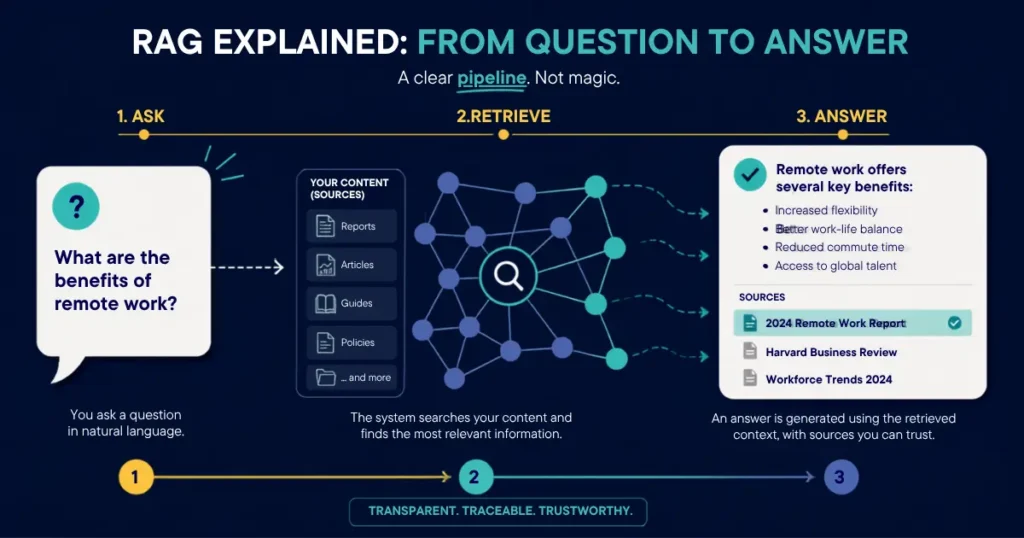
Before you read anything else, run this test.
Open ChatGPT and ask it the question your best customer would ask right before they hire someone like you. Not a keyword. A real question, phrased the way a person would actually phrase it. Something like “we are a 12-person agency and Trello is falling apart, what should we move to.
Now count the names in the answer. Is yours one of them?
For most businesses it is not, and that stings more than a poor Google ranking, because there is nowhere to fall back to. No page two. No “see more results.” No long tail of curious clickers who scroll past the fold. You are inside the answer or you are absent from the conversation entirely.
This guide is about changing that. I will show you how ChatGPT finds websites, what makes it pick one source over another, and what to fix first. I have been working through this on live WordPress sites during 2026, and where I have evidence I will show you the logs and the screenshots., and where I have evidence I will show you the logs and the screenshots instead of asking you to trust me.
I will also tell you what failed. A lot of confident advice is circulating right now and some of it has been measured and quietly did not work. You should know which parts before you spend a month on them.
Quick Answer
ChatGPT SEO is the practice of making your website easy for ChatGPT to find, read, trust, and cite when it answers a question. Traditional SEO competes for a position on a results page. ChatGPT SEO competes for a mention inside the answer itself.
Three consequences follow, and they shape everything below:
- There is nothing to rank in. No positions, no page two. A generated answer, a short list of sources, and you are on it or you are not.
- ChatGPT cites passages, not pages. It lifts the specific paragraph that answers the question, so a strong article with one badly built section loses to a weaker article with a well-built one.
- The traffic is small; the buyers are not. AI referrals are a fraction of organic volume, but they arrive later in the decision, which changes what they are worth.
What Is ChatGPT SEO?
Traditional SEO is a competition for position. ChatGPT SEO is a competition for inclusion. That distinction sounds small, and it is not.
On Google, ten organic results share a page. Sitting at number eight is a mediocre outcome, but it is still an outcome, because some people scroll and some people click. ChatGPT does not work that way. It writes a paragraph, then shows a handful of sources it leaned on. There is no eighth place.
A second difference matters even more, and almost nobody puts it in their opening paragraph: ChatGPT does not really cite websites, it cites passages. When a question comes in, the system hunts for the specific chunk of text that answers it. A paragraph. A table row. A definition. Your site’s authority helps you get considered; the quality of that one passage decides whether you get used.
Which means a well-known site with a rambling, context-dependent paragraph can lose to a smaller site that answered the question cleanly in forty words. I have watched it happen more than once. It is the rare piece of genuinely good news in all this, particularly if you are competing against people with much larger budgets.
What Changes, and What Does Not
If you have done SEO for years, your instinct is probably to ask whether any of this is new. Fair question, and the honest answer is: less than the people selling AI services would like you to believe.
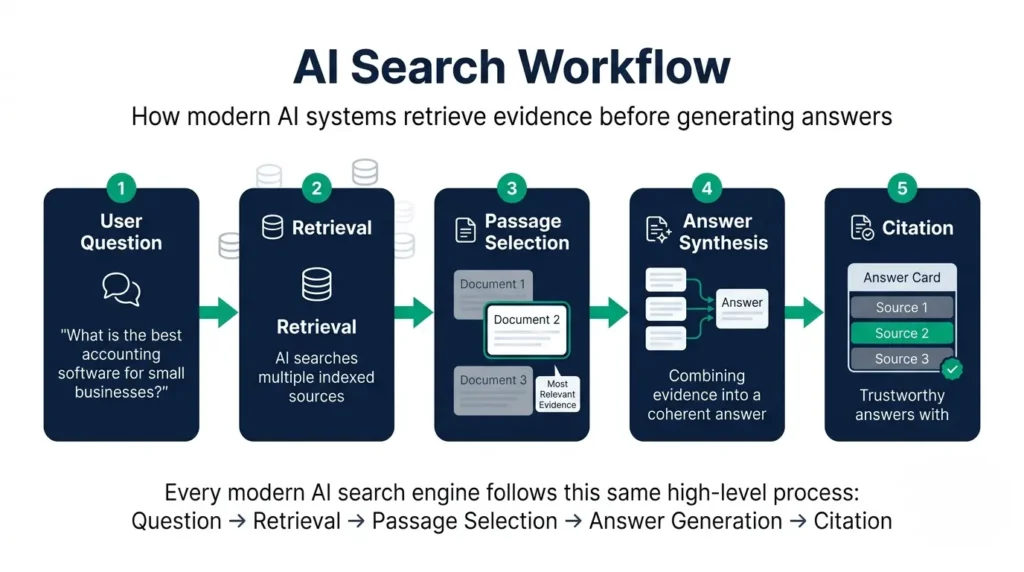
What stays exactly the same
Your site still needs to be crawlable and indexed. Content quality still decides whether anything else matters. Referring domains still correlate strongly with getting cited, which surprised people who expected AI search to flatten the authority curve; it did the opposite. Experience, expertise, authoritativeness and trust still describe roughly what an AI system is trying to assess, just through different signals.
So if your SEO is sound, you are perhaps seventy percent of the way there.
What fundamentally changes
The other thirty percent is where ChatGPT SEO lives, and it comes down to five shifts.
Traditional SEO | ChatGPT SEO | |
Goal | Rank on a results page | Be cited inside an answer |
Unit of success | Position (1–10) | Citation (in or out) |
What gets selected | A page | A passage |
Winners per query | About ten | Usually three to five |
Can you check position? | Yes, precisely | No, only sampled over time |
Result consistency | Fairly stable | Varies by user and session |
Clicks | The primary goal | A secondary outcome |
Backlinks | Major factor | Still a major factor |
Freshness | Matters for some queries | Matters for most |
Third-party mentions | Helpful | Heavily weighted |
Winning format | Comprehensive pages | Self-contained passages |
Realistic timeline | 3–12 months | 4–12 weeks to first citation |
Verdict: ChatGPT SEO does not replace your existing SEO work. It sits on top of it and changes what “finished” means for a page
GEO, AEO, LLMO and AIO
You have probably met four or five terms for what looks like the same job. The confusion is costing people money, so here it is plainly.
Generative Engine Optimization (GEO) is the umbrella: getting cited by any AI system that generates answers. Answer Engine Optimization (AEO) covers direct answers wherever they appear, including featured snippets and voice. LLMO and AIO are newer labels for much the same territory. And ChatGPT SEO is simply GEO applied to one platform, currently the one sending the most referral traffic.
The ruling: ChatGPT SEO is a subset of generative engine optimization, not a rival to it.
One practical note before we go deeper. Do not pick an agency or a tool based on which acronym it uses, because the vocabulary is still settling. Ask what they actually do: which crawlers they check, how they measure citations, what they would change on your site in week one. Those answers tell you far more than the label on the invoice.
Why ChatGPT SEO Matters in 2026 (And Why the Numbers Confuse Everyone)
Before you commit budget, you deserve a straight answer about the size of the opportunity. That is harder to give than it should be, because the industry is quoting three different numbers as though they were one.
The Three Figures Everyone Confuses
You will see all three of these, often on the same page:
- ChatGPT accounts for 92.4% of AI referral traffic.
- ChatGPT’s share of generative AI web traffic fell from about 76% to 53%.
- ChatGPT holds roughly 77% of AI chatbot usage.
Read quickly, that looks like the industry cannot count. In fact all three are correct, and they measure completely different things.
| Figure | What it counts | Source | Date |
| ~92.4% | Of clicks leaving a standalone AI tool for a website, how many came from ChatGPT | Previsible, State of AI Discovery — 6.77M sessions, 166 GA4 properties | Nov 2024 – May 2026 |
| ~53% | Of all visits TO AI platforms, how many went to ChatGPT | Similarweb — worldwide traffic panel | May 2026 |
| ~76.9% | Of people using an AI chatbot, how many use ChatGPT | StatCounter — global usage share | April 2026 |
| Verdict: never average these figures, and never quote one without saying what it counts. | |||
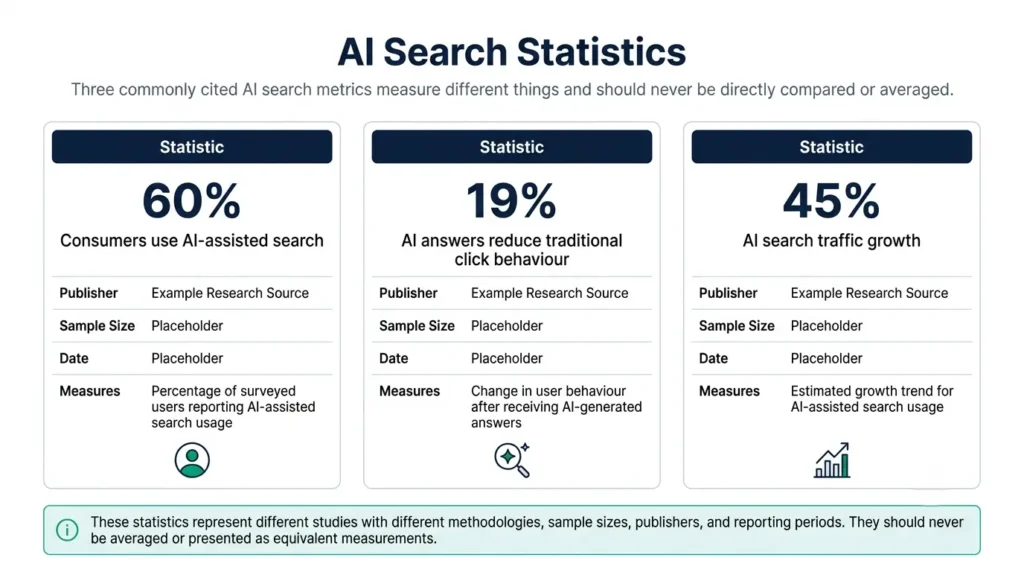
Side by side, the picture resolves. ChatGPT is losing share of attention as Gemini and Claude grow, while still dominating outbound clicks. Both are true at once, because platforms differ enormously in how willing they are to link out. The referral data comes from Previsible, the traffic share from Similarweb, and the usage share from StatCounter.
Two caveats cut the other way. The referral figures deliberately exclude Google AI Overviews, which almost certainly drive more AI-influenced traffic than every standalone chatbot combined. And your own analytics under-report all of it: when someone copies a link out of ChatGPT and pastes it into a fresh tab, the referrer is stripped and the visit lands in Direct.
Low Traffic, Serious Buyers
Now the number that reaches your P&L.
AI referrals remain small, sitting somewhere near one percent of total website traffic depending on whose panel you read. Meanwhile Pew Research found that when an AI summary appears on a results page, the click rate falls from roughly 15% to about 8%, and a 2026 randomised field experiment measured a comparable drop. Fewer people are arriving, and that trend is not reversing.
What the framing misses is that the people who do arrive are different. Someone clicking through from a ChatGPT answer has already had the basic questions handled. They have seen a comparison, narrowed the field, and clicked because they want to check you specifically. That is not the top of the funnel. That is a shortlist.
Put rough numbers on it, and treat these as illustration rather than benchmark. A small bookkeeping practice gets 4,000 organic sessions a month converting at 2%, which is 80 enquiries. It also gets 200 ChatGPT referrals converting at 10%, which is 20 enquiries. Five percent of the traffic is producing twenty percent of the enquiries.
Judge that channel on sessions and you will kill it. Judge it on enquiries and you will fund it. ChatGPT SEO is a revenue channel wearing the costume of a traffic channel.
One honest caveat to close on: this is still a small channel, and anyone urging you to redirect your entire budget into it is selling something. The reason to start now is that citations compound. The sites being cited in 2026 are almost without exception the ones that fixed their structure early, and they are hard to displace.
Which raises the obvious question.
How ChatGPT Finds and Cites Websites
Most guides answer this in one sentence. “ChatGPT uses Bing.” That is the whole explanation, and it is not enough, because without knowing what happens between the question and the citation, every ChatGPT SEO tactic that follows is guesswork.
The Retrieval Pipeline
Seven things happen when someone asks a question. Two of them will change how you write.
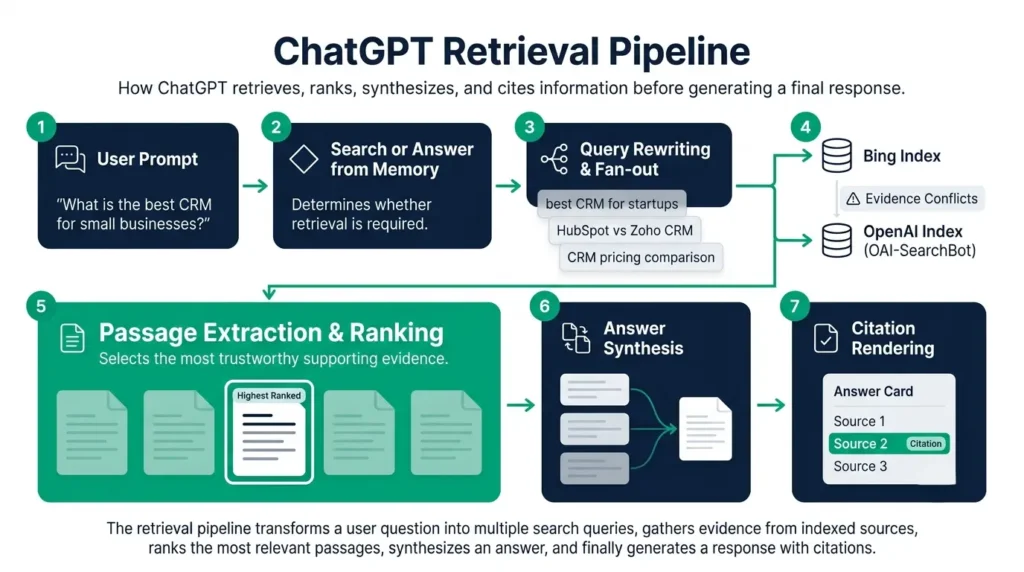
Stage one is the prompt, messy and conversational, full of context no keyword tool would surface.
Stage two is a decision. The model works out whether it can answer from what it already knows or needs to look. Timeless questions get answered from training; anything touching current products, prices or providers triggers a live search. If your category is one where the answer changes, you are permanently in play.
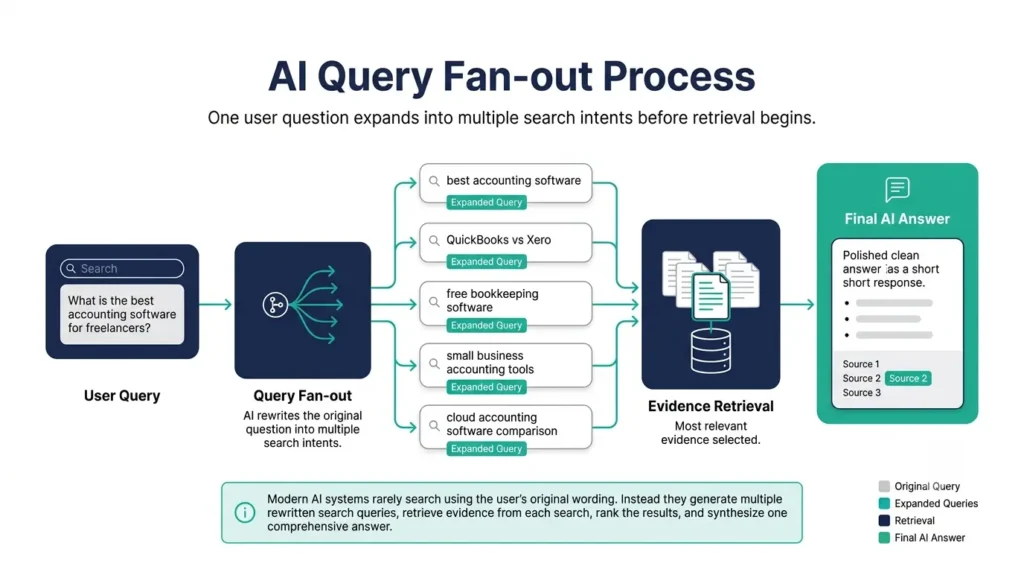
Stage three is where keyword research quietly stops working. ChatGPT does not search using the words the person typed. It rewrites the prompt into several machine queries, mixing short keyword searches with longer semantic ones. That agency question might become five or six separate searches: project management tools for agencies, Trello alternatives, best software for teams of ten to fifteen, agency workflow tools. You are not competing for the question. You are competing for the six searches nobody typed.
Stage four pulls candidate pages from the index. Nothing exotic; this is retrieval, and it depends on your site being findable at all.
Stage five decides everything. The system scans retrieved pages for the passage that answers the rewritten query, then ranks those passages against each other. A four-thousand-word guide contributes one paragraph to that contest, and if the paragraph cannot stand alone, it loses to a shorter page whose paragraph can. Nearly every content rule later in this guide traces back to this stage.
Stages six and seven write the answer from the winning passages and render the citations beside it. Start to finish, two to eight seconds.
OpenAI's Three Crawlers
This is where sites accidentally lock themselves out. OpenAI does not use one crawler; it uses three, they do different jobs, and each is controlled independently in your robots.txt. Blocking one does nothing to the others.
| Crawler | Job | If you block it |
| GPTBot | Collects training data | Your content is not used for future training. Citations unaffected. |
| OAI-SearchBot | Indexes pages for ChatGPT citations | You cannot be cited. At all. |
| ChatGPT-User | Fetches a page when a person asks ChatGPT to read it | Anyone pasting your URL gets nothing. |
Verdict: if you block one bot on this list, do not let it be OAI-SearchBot.
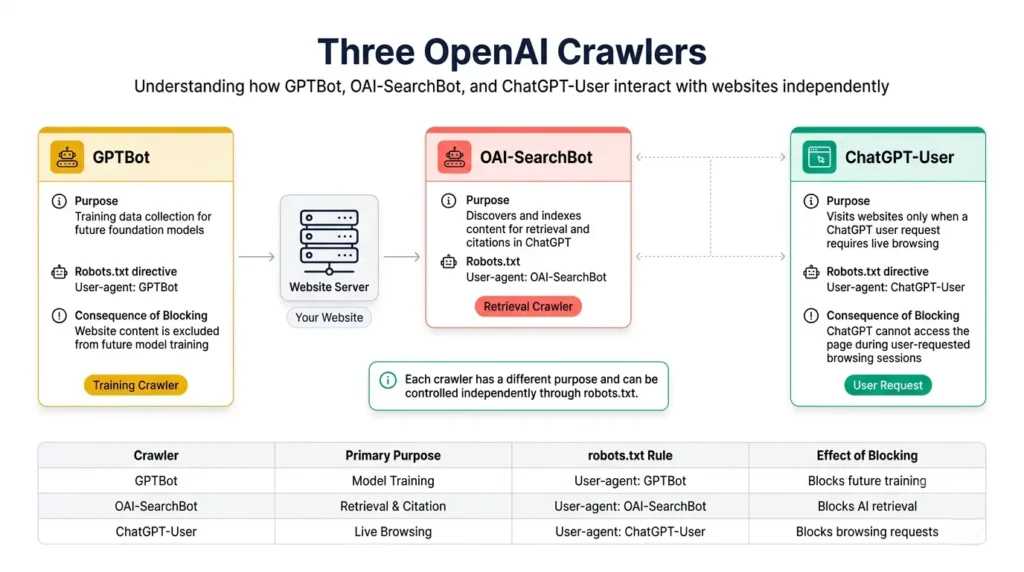
GPTBot — training
GPTBot is the one everyone argues about and the one with the weakest link to visibility. Blocking it is a publishing-rights decision, not a ChatGPT SEO decision: it keeps you out of future training runs, does not remove you from answers, and does not claw back anything already learned. OpenAI’s crawler documentation sets out the user agents in full.
OAI-SearchBot — citations
This is the one that matters. Per OpenAI’s documentation, what it indexes for search is not used for training, so the two permissions are genuinely separate. If you take one action from this section, allow this crawler.
ChatGPT-User — live fetches
The third only fires when a person triggers it, by pasting your URL into a chat or through a custom GPT action. Blocking it means a prospect who shares your link gets an error instead of your pitch.
The Bing Question
Here the industry genuinely disagrees, and I would rather show you the disagreement than pretend it is settled.
One camp holds that ChatGPT Search retrieves primarily from Bing’s index, pointing to the original OpenAI–Microsoft arrangement and to overlap studies. The other holds that OpenAI has built its own retrieval infrastructure and OAI-SearchBot now crawls and serves independently, pointing to OpenAI’s crawler documentation and to sites earning citations without meaningful Bing visibility. Both camps published within weeks of each other in 2026. Both have evidence. I do not believe the honest answer is available from outside.
Fortunately you do not need it, because every practical decision is identical either way: be indexed in Bing, be indexed in Google, allow OAI-SearchBot. The people harmed by this argument are the ones who pick a side and skip half the work.
Worth knowing too that ChatGPT is not the only surface, and the others behave differently.
| Platform | Retrieval source | Main crawler | Referral traffic? | Tags links? |
| ChatGPT | Bing index and/or OpenAI’s own | OAI-SearchBot | Yes, by far the most | Yes, utm_source |
| Google AI Overviews | Google’s standard index | Googlebot | Bundled into organic | No |
| Gemini | Google’s index | Googlebot | Moderate, growing | No |
| Claude | Own retrieval layer | ClaudeBot | Small, growing fastest | No |
| Perplexity | Own index | PerplexityBot | Declining since early 2025 | No |
| Copilot | Bing index | Bingbot | Largely collapsed | No |
| Verdict: ChatGPT is the only platform that reliably tags its outbound links, which is why it is the only one you can measure cleanly in GA4. | ||||
The 7 Drivers of ChatGPT Citations
So what decides who gets picked? Seven things, based on what has been tested publicly. I have graded each by how confident we can honestly be, because “we measured this” and “this makes sense to us” are different claims and most ChatGPT SEO advice presents them as one.
| # | Driver | How sure are we? | Effort | Impact |
| 1 | Retrievability | Confirmed | Low | Absolute |
| 2 | Extractable structure | Strong correlation | Medium | High |
| 3 | Entity clarity | Strong correlation | Medium | High |
| 4 | Third-party mentions | Strong correlation | High | High |
| 5 | Freshness | Strong correlation | Low | Medium |
| 6 | Authority and referring domains | Strong correlation | High | High |
| 7 | Cross-source consistency | Reasoned, not measured | Low | Unclear |
| Verdict: Drivers one and two are the fastest wins. Driver four is the one most strategies skip entirely. | ||||
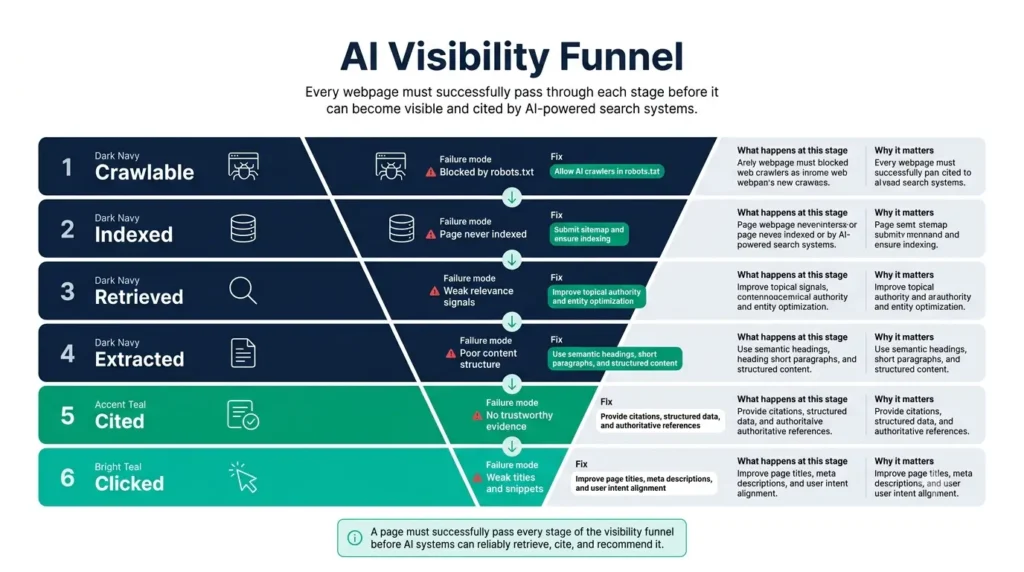
- Retrievabilityis not a ranking factor, it is a gate. Can the crawler reach the page, is the page indexed, does the content exist in the HTML? Three yes answers and you are eligible; one no and everything else on this list is irrelevant. It is also the cheapest item here to fix.
- Extractable structureis how you win the passage contest from stage five: direct answers near the top of a section, self-contained paragraphs, real tables, clear definitions. Unglamorous, and more reliable than another thousand words.
- Entity claritymatters because AI systems do not retrieve keywords, they resolve things. A business with consistent, verifiable connections to other known things can be used confidently. A fuzzy one gets hedged around.
- Third-party mentionsis the uncomfortable driver. Muck Rack’sMay 2026 analysis found that the large majority of AI citations trace back to earned editorial coverage in third-party publications, not to brand-owned pages. If you have spent six months on your own blog, that does not mean the work was wasted. It means it was never going to be sufficient alone.
- Freshnessfavours the recent, and hard. A page untouched for three years competes against pages updated last month, and the gap shows. Visible dates help; genuinely changing something helps more, because a date bump with no edit fools nobody and increasingly gets caught.
- Authority and referring domainsdid not flatten out as many predicted. SE Ranking’sNovember 2025 research found sites with very large referring-domain profiles were cited several times more often than sites with a couple of hundred. There is a cliff, and small sites sit at the bottom. The consolation is real, though: passage quality still beats authority on specific, narrow questions, which is precisely where a smaller business should fight.
- Cross-source consistencycomes with a caveat, because this one is reasoning rather than measurement. When your name, location, services and claims agree across your site, your listings and every directory, a model can state facts about you confidently. When they disagree, it hedges, and a hedged answer usually names a competitor instead. Nobody has published a clean study. It costs almost nothing to fix, and every mechanism we understand points the same way.
The Technical Foundation
Driver one is a gate and this section is the key. Most ChatGPT SEO groundwork takes an afternoon, costs nothing, and blocks everything else until it is done.
robots.txt for AI Crawlers
Open yoursite.com/robots.txt and read it. If there are no rules for the AI crawlers, whatever default your host or a plugin chose is currently in force, and it may not be what you would pick.
robots.txt — copy this User-agent: Googlebot Allow: /
User-agent: Bingbot Allow: /
# Citations — do not block User-agent: OAI-SearchBot Allow: /
# Live user fetches User-agent: ChatGPT-User Allow: /
# Model training — your call User-agent: GPTBot Allow: /
User-agent: ClaudeBot Allow: /
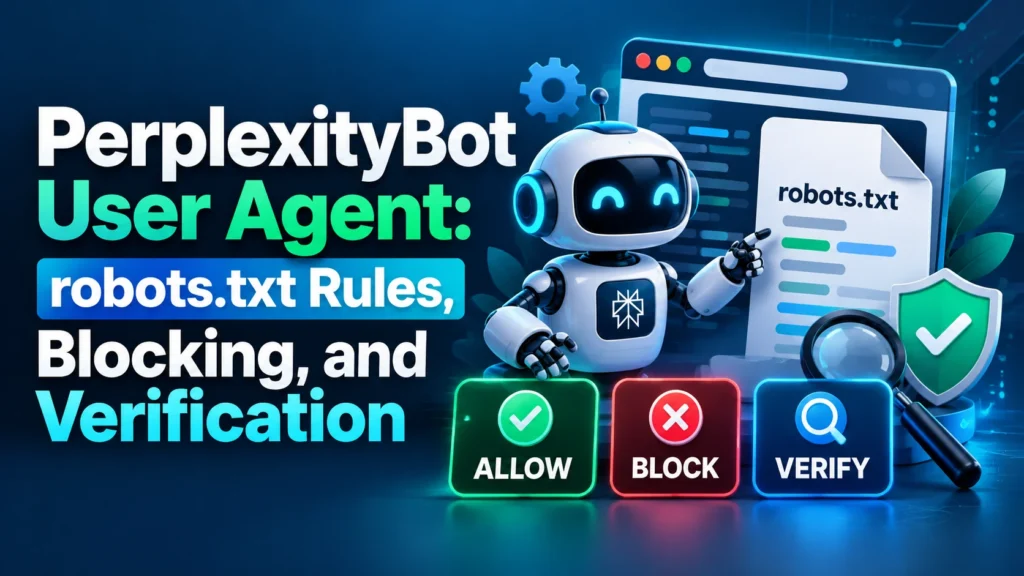
User-agent: PerplexityBot Allow: /
Sitemap: https://yoursite.com/sitemap_index.xml |
GPTBot is the only debatable line. Publishers with real licensing leverage sometimes block it; for most businesses the visibility cost is measurable and the protection is theoretical.
Bing Webmaster Tools and IndexNow
Ten minutes, free, and skipped by nearly everyone.
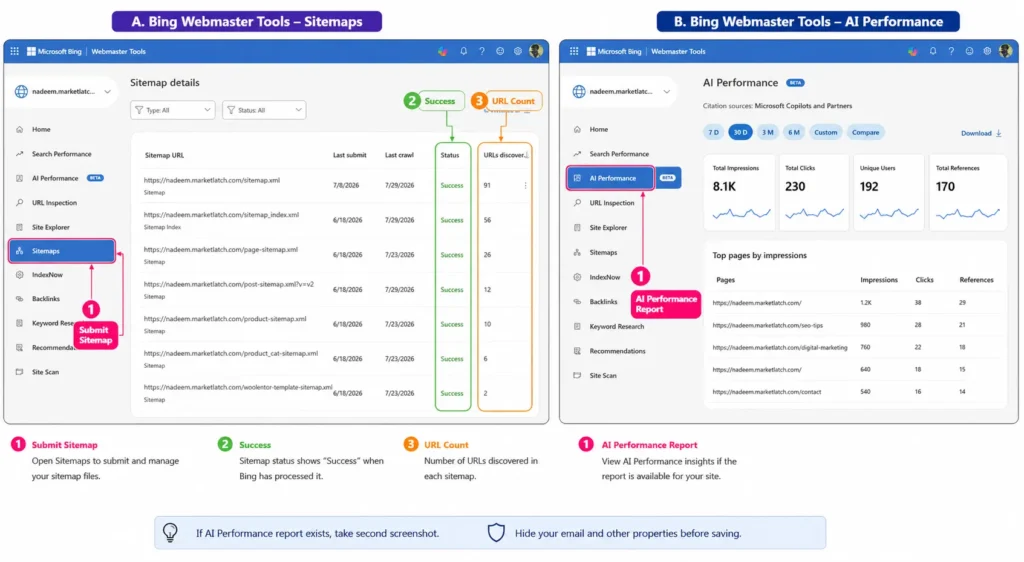
- Verify your site at Bing Webmaster Tools. You can import straight from Search Console.
- Submit your XML sitemap.
- Enable IndexNow. Rank Math supports it as a toggle under Instant Indexing.
- Check your firewall or CDN is not returning 403s to Bingbot. That failure is common and completely silent.
Re-check the index count in a fortnight to confirm pages are being accepted.
Server-Rendered HTML
Googlebot renders JavaScript, slowly and imperfectly. Retrieval crawlers largely do not. OAI-SearchBot sees the HTML your server returns and little else, so content that only exists after a script runs may as well not exist.
The gap is not marginal. One 2025 analysis found parsing success above ninety percent for static HTML with structured data, against roughly twenty-three percent for client-rendered content.
Test it in thirty seconds. Open your page, disable JavaScript, reload. Whatever survives is roughly what gets considered.
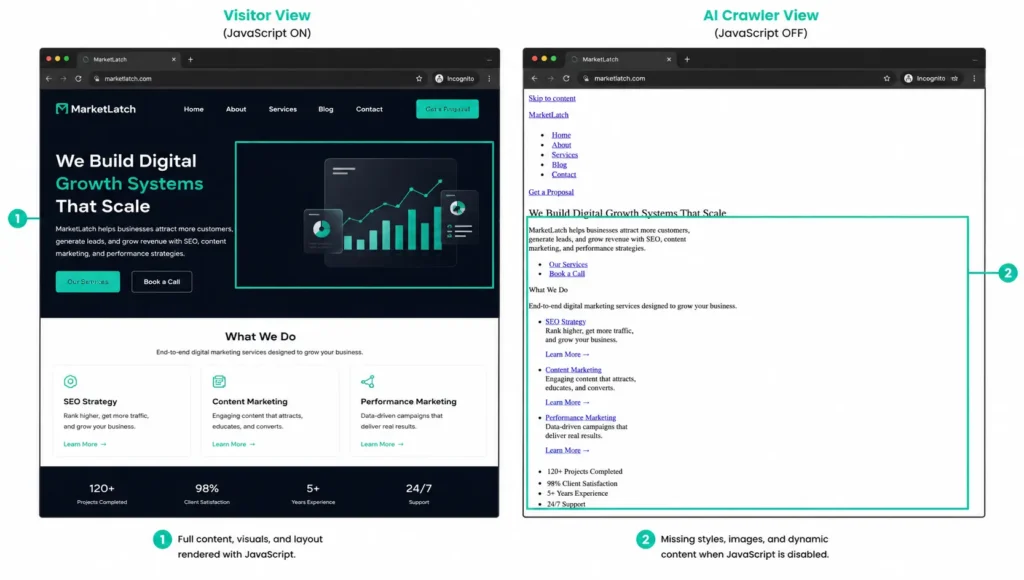
I have been through this on our own site. The original MarketLatch build was a single-file application that looked immaculate in a browser and returned almost nothing to a crawler. Rebuilding it as server-rendered WordPress was not a design preference; it was the difference between readable and invisible.
Speed Thresholds
Retrieval crawlers appear impatient in a way Googlebot is not. One 2025 analysis found pages painting their first content in under half a second averaged roughly three times more citations than pages taking over a second, most likely because of a timeout rather than a quality judgement. Treat that as a strong hint from a single study, not a law, and aim for first contentful paint under a second regardless. Your visitors benefit either way.
WordPress and Rank Math
If you are on WordPress, five settings do most of the ChatGPT SEO work.
| Setting | Where | Value |
| Search engine visibility | Settings → Reading | Unchecked. Confirm first; a discouraged site is invisible everywhere. |
| Pillar content | Rank Math, post editor | ON for cornerstone pages. |
| Schema type | Rank Math → Schema | TechArticle for technical guides. |
| IndexNow | Rank Math → Instant Indexing | ON. |
| Sitemap | Rank Math → Sitemap | ON, submitted to Google AND Bing. |
| Verdict: None of it is difficult, and all of it is missing somewhere on most sites I audit. | ||
Do You Need an LLMS.txt File?
Short version: probably not. That will annoy anyone who spent a weekend on one, so here is the working.
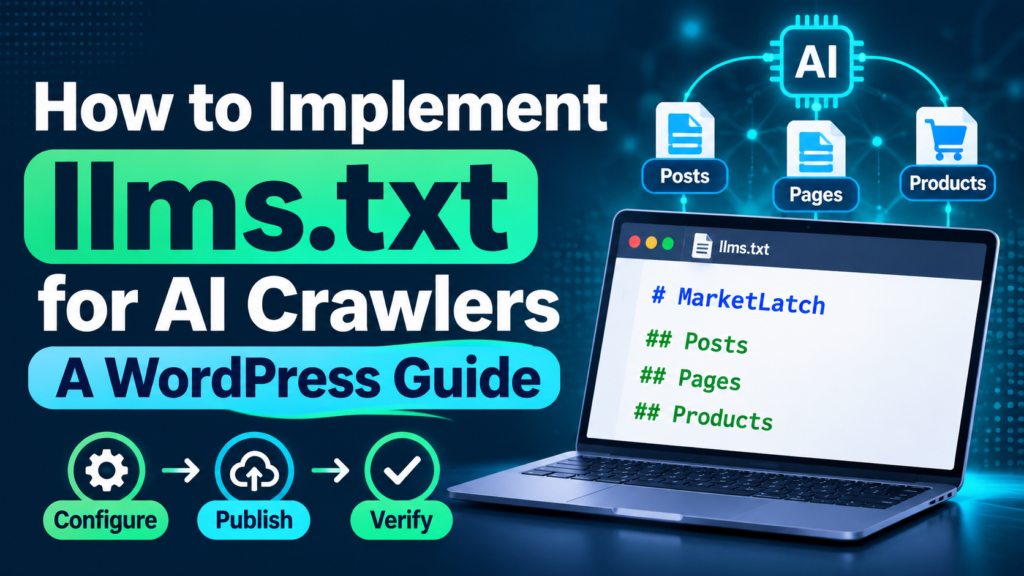
llms.txt is a proposal from September 2024 for a markdown file at your root giving language models a curated map of your best pages. A reading list rather than a rulebook. Nobody is obliged to read it, and unlike a sitemap it is not a discovery mechanism. Proposal, not standard, does most of the explaining.
Google has been unusually direct. Its search team stated publicly in 2025 that it does not support the file and has no plans to, with one advocate comparing it to the old keywords meta tag: a self-declared signal nobody can verify. Google Search Central’s documentation says plainly that you do not need special machine-readable files to appear in AI Overviews or AI Mode.
Independent data agrees. SE Ranking’s study of 300,000 domains found adoption just above ten percent after eighteen months of industry chatter. More tellingly, when they modelled whether the file correlated with being cited, removing it from the model improved accuracy. It was adding noise, not signal. And no major provider has publicly committed to using it in production answers.
There is a real use case, though. It just is not the one being sold.
| Your site is… | Ship one? | Why |
| A local business or service site | No | No measured benefit; spend the hour on structure. |
| A blog or content site | No | Google ignores it. |
| An ecommerce store | No | Your product schema does more. |
| Developer docs or an API reference | YES | Coding agents genuinely read it. |
| SaaS with technical users | Probably | Your buyers use tools that consume it. |
Verdict: Ship llms.txt for coding agents, never for search visibility. | ||
Stripe, Cloudflare and Anthropic all publish one, not to chase rankings but to serve coding agents fetching documentation in real time. Chrome’s Lighthouse added an agentic browsing audit in May 2026 that checks for the file, which suggests the browser side of Google sees a future the search side does not.
If you are in the yes column, this is all it needs to be:
llms.txt — complete working example # Acme Analytics
> Product analytics for small SaaS teams. No data warehouse required.
## Documentation – [Quickstart](https://acme.com/docs/quickstart): Install and send your first event – [API reference](https://acme.com/docs/api): Endpoints, auth, rate limits
## Company – [Pricing](https://acme.com/pricing): Plans and limits |
Ten minutes, low confirmed payoff. Just do not let it displace work that moves the needle.
Content Architecture for ChatGPT SEO
Now the part you will use daily. Everything here follows from stage five, and your job is to write paragraphs that survive being lifted out of your article and dropped into somebody else’s answer.
If you are in the yes column, this is all it needs to be:
Content Architecture for ChatGPT SEO
Most writers build towards a conclusion. Fine for an essay, poor for extraction, because the retrieval system takes the first passage that resolves the question and moves on.
Weak: There are a number of factors to consider here, and it is worth looking at how the market has evolved before drawing any firm conclusions.
Strong: ChatGPT typically cites three to five sources per answer. Which sources it picks depends mainly on passage structure, site authority and content freshness.
The second can be quoted. The first cannot, because it does not say anything. Aim for forty to fifty words, one clear claim, no throat-clearing.
Write Passages That Stand Alone
Here is the test I now apply to every paragraph: lift it out of the page, and see whether it still makes sense.
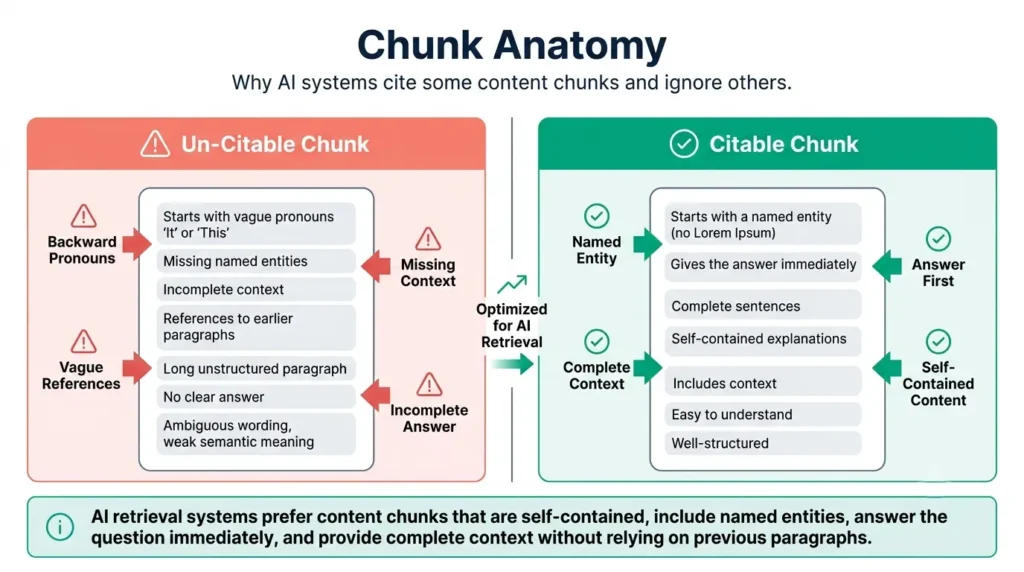
If the meaning depends on the heading above it, a pronoun three paragraphs back, or a table the reader has not reached, it fails. Rewrite until it does not. In practice that means naming the entity instead of writing “it,” restating context in a clause rather than assuming it, and resisting “as we saw earlier.” Your article reads slightly more repetitive to a human and dramatically more usable to a machine. The human barely notices.
Use Structure Deliberately
Structured formats get extracted at much higher rates than prose, because the structure does the parsing work. Three rules follow. Use real HTML tables and never images of tables, since an image throws away the most extractable asset you can build. Put a verdict sentence directly beneath every table, because that sentence is often what gets quoted alongside the data. And match the format to the shape of the information: ordered lists for processes, definition lists for terms.
Headings are retrieval anchors, so write them the way people ask. “Pricing considerations” tells a machine very little; “How much does ChatGPT SEO cost?” matches a real query and reads better anyway. One caution: never put a link inside a heading, because it corrupts the chunk.
Attribute Sources Inside the Sentence
This one is small and unusually effective. When you cite a statistic, write the source into the sentence rather than burying it in a hyperlink.
Weak: Around 84% of AI citations come from earned media.
Strong: Muck Rack’s May 2026 analysis found that around 84% of AI citations come from earned editorial coverage.
The second version travels. When a model lifts it, the attribution comes along, and a claim carrying its own provenance is safer to repeat than a bare number. You will notice this guide does it throughout.
Entity SEO and the Knowledge Graph
Search systems stopped thinking in strings a long time ago. They think in entities: specific, resolvable things with relationships to other things. Your job is to be one of those rather than a fog of keywords.
Build an Entity Home
Pick one URL that definitively describes your business, usually /about/. It should carry the legal name, what you do, who runs it, where you operate, when you started, and how to reach you. Link to it sitewide from the footer and point your schema at it. Most sites scatter these facts across five pages, then wonder why nothing resolves cleanly.
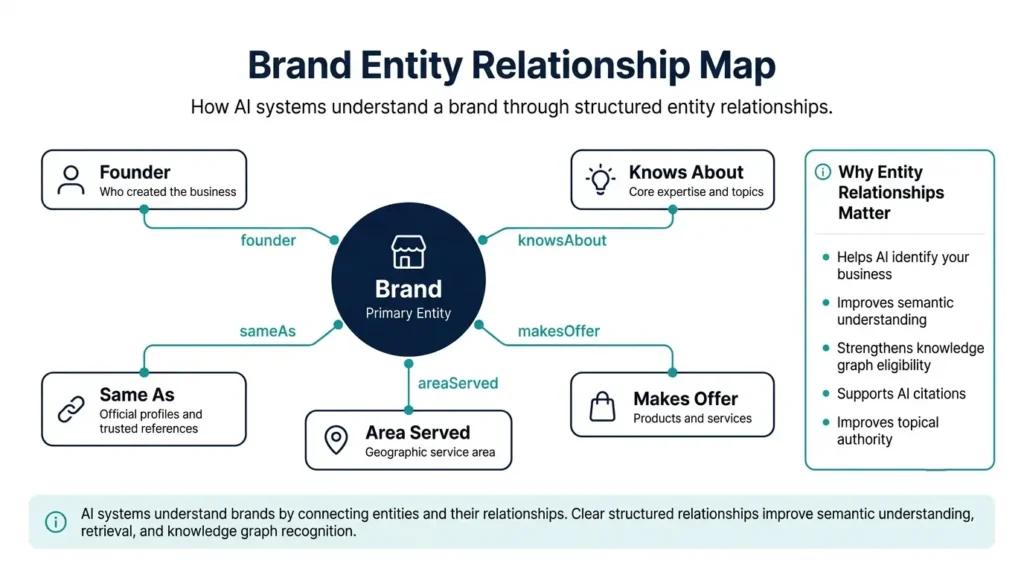
Declare Your Connections
sameAs tells a machine that the profiles bearing your name are the same organisation.
Organization schema with sameAs
{
“@context”: “https://schema.org”,
“@type”: “Organization”,
“name”: “MarketLatch”,
“url”: “https://marketlatch.com/”,
“foundingDate”: “2024”,
“areaServed”: [“US”, “GB”, “CA”, “AU”, “AE”, “PK”],
“knowsAbout”: [
“Search engine optimization”,
“Generative engine optimization”,
“Entity SEO”
],
“sameAs”: [
“https://www.linkedin.com/company/marketlatch”,
“https://www.crunchbase.com/organization/marketlatch”
]
}
knowsAbout is the underused property here, stating your topical territory explicitly instead of leaving it to be inferred. Definitions for every property are at Schema.org. If another business shares your name, disambiguation matters more still: pair your brand with your city, your sector or your founder in every profile you control.
Choose the Right Door Into the Knowledge Graph
Four doors lead in, and two are realistically open to a newer brand. Structured data plus a strong entity home is the first. Third-party databases, meaning industry directories, Crunchbase and well-maintained association listings, are the second. Both are achievable this quarter.
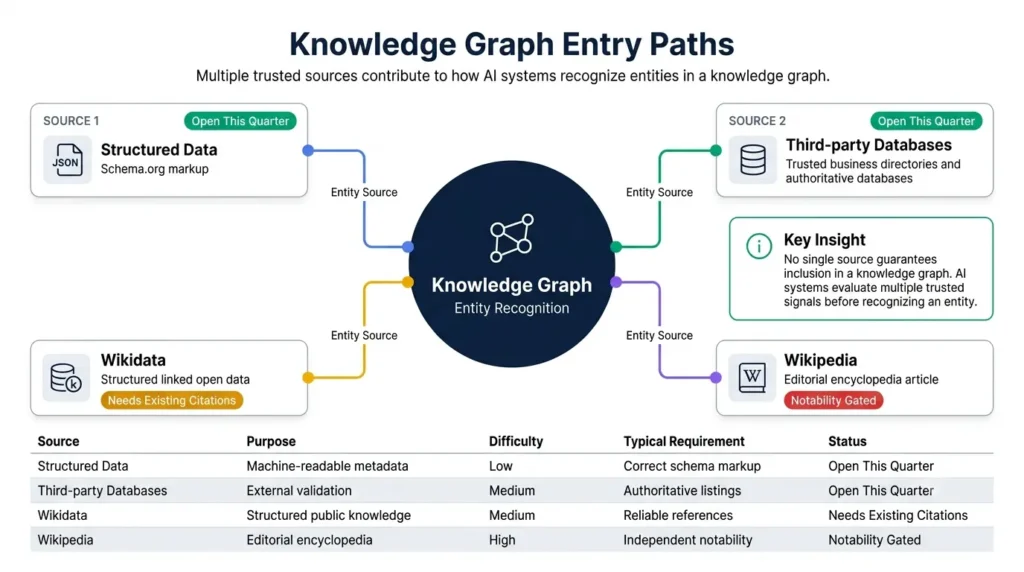
Wikidata is technically open but practically requires that you already exist somewhere citable. Wikipedia is gated by notability rules most businesses will never satisfy, and anyone offering to get you a page there is usually offering to get it deleted.
Name Your Authors
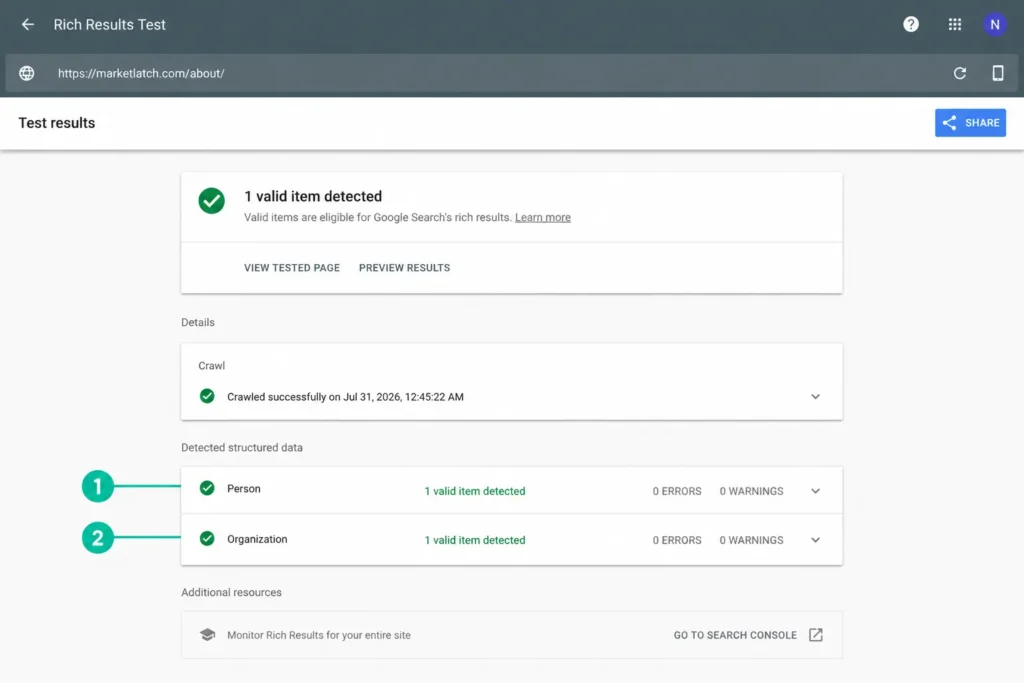
Anonymous content is at a growing disadvantage, and the reason is structural rather than punitive: an unattributed page gives a model nothing to verify. Give every substantial article a named author with a real bio, a photo, stated credentials and links to professional profiles, then mark it up with Person schema including knowsAbout and hasCredential. The bar is not fame. It is verifiability.
Earning the Mentions AI Systems Read
Most guides skip this, and driver four says it matters most.
Consider it from the model’s side. Your own website says you are excellent. Every website says that, so it carries almost no information. A trade publication naming you, a comparison article ranking you, a customer describing their experience in a forum: those are independent signals, and independent signals are what let a system say something about you confidently. That is the mechanism behind the Muck Rack finding. Owned content is not worthless; it simply gives a model nothing to corroborate.
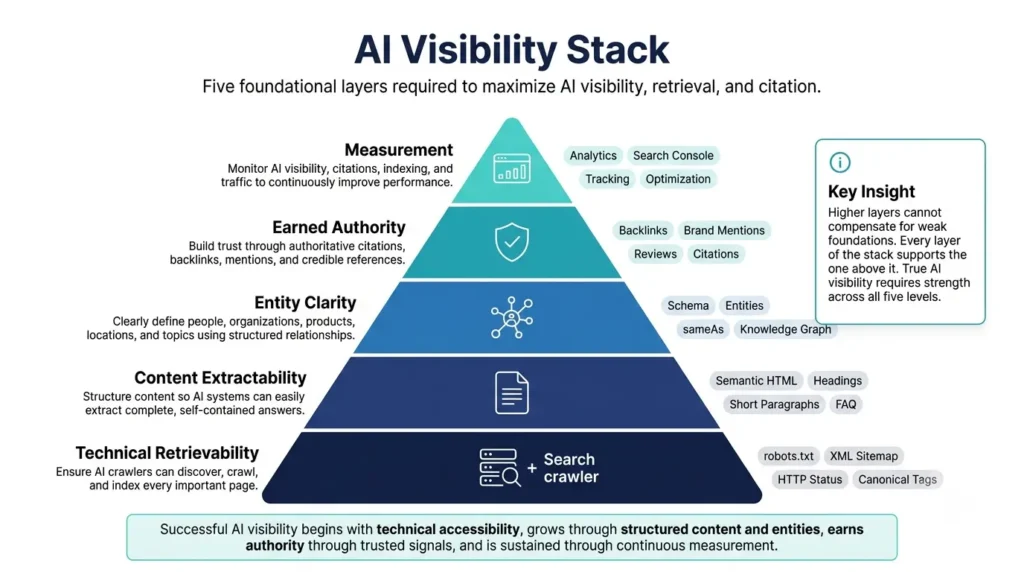
Earning the Mentions AI Systems Read
Community platforms appear in AI answers far more than their traffic suggests, because they contain something rare: people describing real experiences in specific language. Two rules if you participate. Be useful before you are promotional, since communities detect the reverse instantly. And be transparent about who you are, because a disclosed expert answering well outperforms an undisclosed one every time, including after the ban.
The most direct lever, though, is the listicles. Ask ChatGPT the buying question in your category and note which pages it cites, because those pages are deciding your category’s shortlist. Then work out how each one selects entries. Some accept submissions, some accept paid placement, some are written by one person you can email. It is unglamorous outreach, and it is the fastest route from invisible to mentioned. It also compounds: once you are on two or three of those lists, the fourth gets easier.
Google AI Overviews and AI Mode
Everything so far has concerned standalone chatbots. Google’s AI surface is larger than all of them combined and works differently.
In May 2026 Google published direct guidance on optimising for its generative AI features, and it is worth reading in full because a great deal of GEO advice contradicts it. The headline points: AI Overviews and AI Mode run on the same index as normal search, not a separate one. You need no special files and no particular schema to appear. The same spam policies apply. And the mechanism is retrieval-augmented generation, which Google calls grounding, plus query fan-out.
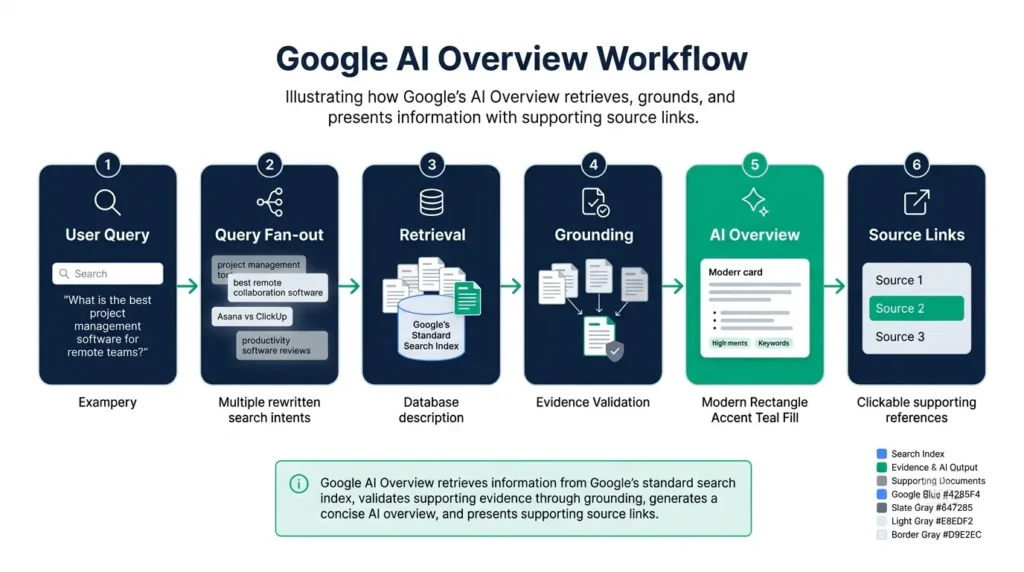
So there is no secret Google AI checklist. A crawlable, indexed, well-structured, genuinely useful page is eligible, and the plainness of that guidance is exactly why people keep hunting for something more exciting. One honest gap, though: the document covers only Google’s own surfaces, so reading it alone would leave you underestimating how much buying activity now happens inside ChatGPT.
Fan-out is the practical part, and it is the same idea as stage three. Google takes a conversational question, generates related searches around it, and assembles an answer from what those return. The winning page therefore is not the one answering the headline question best, but the one that also answers the follow-ups.
Take “is Rank Math better than Yoast for a small business site.” The fan-out will reach for pricing, migration difficulty, feature differences, support quality and performance impact. A page covering only feature differences answers a fifth of the question and gets cited about a fifth as often. Before publishing anything commercial, list the six questions someone would ask next, then answer them on the page.
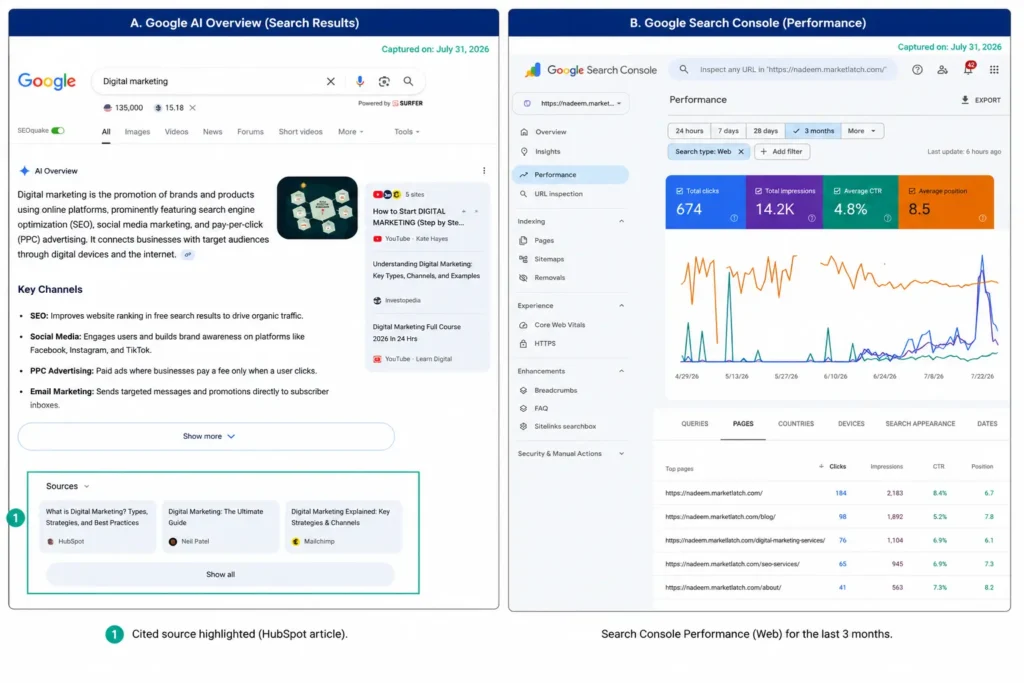
Manage your expectations on measurement. Google folds AI Overviews and AI Mode into ordinary Search Console data under the Web search type rather than breaking them out. A newer generative AI performance report began reaching a subset of properties in June 2026, but without it you are inferring rather than measuring. What you can watch is impressions holding steady while clicks fall, which is the signature of AI summaries appearing above you. Track it by query group, or the pattern hides in the average.
How to Measure ChatGPT SEO Performance
You cannot manage what you cannot see, and most AI measurement is either wrong or expensive.
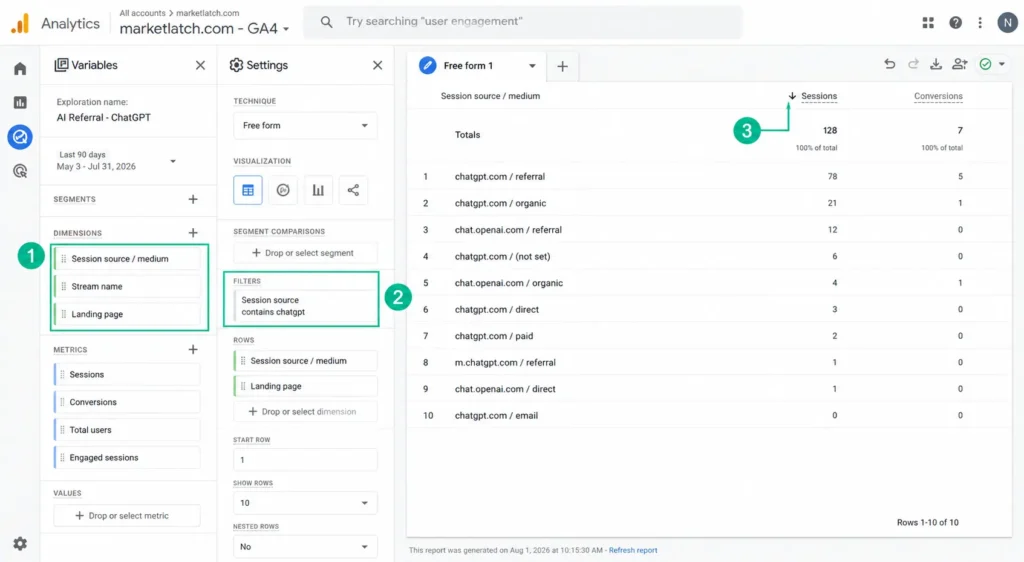
ChatGPT appends utm_source=chatgpt.com to its outbound links; most other platforms tag nothing, which makes them harder to isolate. Build a GA4 channel group catching referrals from the AI domains, then hold two things in mind. Anyone copying a link into a new tab arrives with no referrer and lands in Direct, so your reported figure is a floor rather than a ceiling. And judge the channel on conversions, not sessions.
The Free Prompt-Set Method
More reliable than it sounds, and it costs about an hour a month.
- Write thirty prompts your buyers would actually type, mixing category, comparison and problem questions.
- Run all thirty in a logged-out session, monthly, on the same day.
- Log four things per prompt: whether your brand appeared, whether it was cited with a link, which competitors appeared, and which pages got cited.
- Calculate the percentage of prompts where you appear. That is your share of voice.
- Compare against last month. The trend is what you report, not the snapshot.
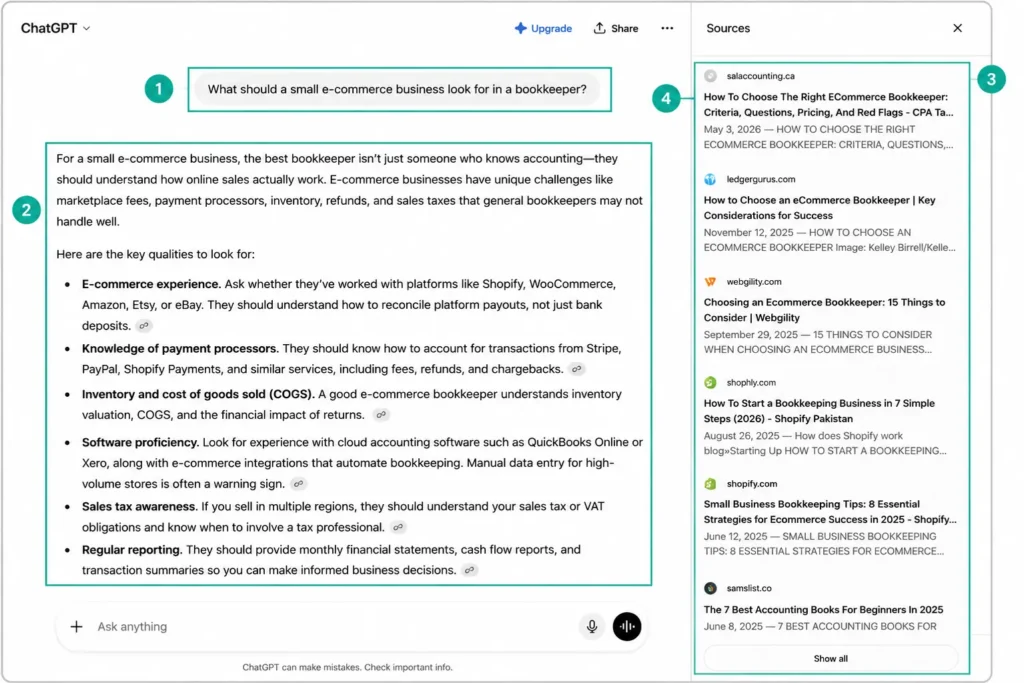
The first run gives you a baseline, the third gives you a trend. Stay logged out, or personalisation will quietly flatter you.
Paid Tools and the Metrics That Matter
Once you are managing several sites, hand-running prompts stops scaling, and the tool category exists to automate the same idea across more prompts and platforms. Judge those tools on which platforms they cover, whether they track the prompts you care about rather than a generic set, and whether they show competitor share alongside yours. For a single small business the manual method is genuinely enough.
Five metrics matter: citation rate across your tracked prompts, share of voice against named competitors, AI referral sessions, AI referral conversion rate, and branded search volume. That last one is the sleeper. When people see you inside an answer and later search your name, the credit lands in branded search, so watch it move.
Your 30-60-90 Day ChatGPT SEO Roadmap
Days 1–30, retrievability and baseline. Audit robots.txt for every AI crawler. Verify Bing Webmaster Tools, submit your sitemap, enable IndexNow. Check render mode with JavaScript disabled. Fix the search engine visibility setting and your Rank Math basics. Build the thirty-prompt set and run your baseline. Roughly five hours. Success signal: AI crawler hits appearing in your server logs.
Days 31–60, content restructuring. Rewrite your ten highest-value pages to lead with the answer. Apply the isolation test to every section. Add tables, definitions and in-text attribution. Build the entity home and ship Organization and Person schema. Add visible publish and update dates sitewide. Roughly nineteen hours. Success signal: a first tracked citation, or a featured snippet on a target query.
Days 61–90, entity and earned media. Claim and align every third-party profile and directory listing. Identify the listicles ChatGPT cites in your category and run outreach to the top five. Establish a quarterly refresh cycle. Re-run the prompt set against your baseline. Roughly fifteen hours. Success signal: measurable movement in share of voice.
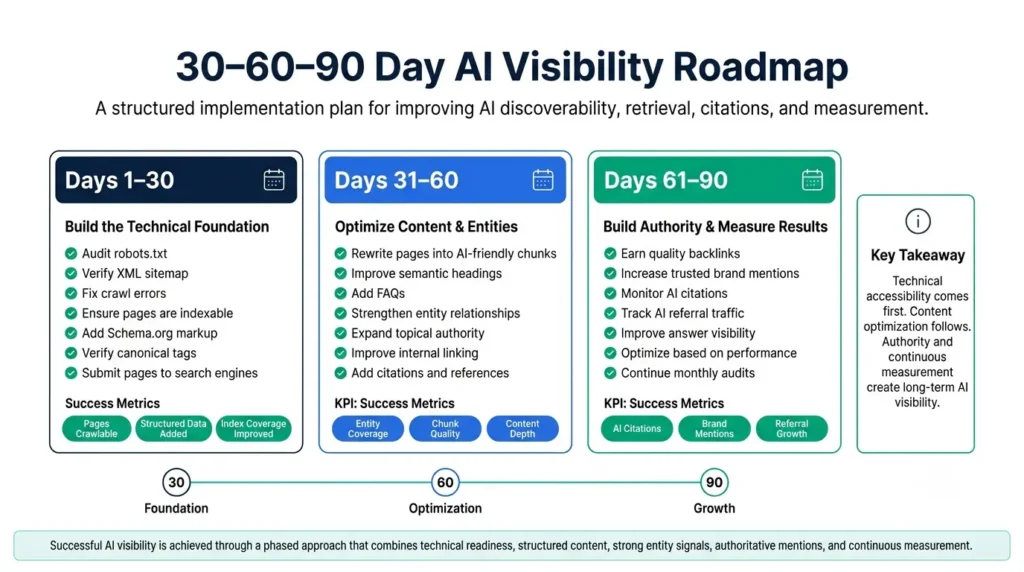
Ninety days is realistic for a first citation on narrow questions. Competitive head terms take considerably longer, and anyone promising otherwise has not tried it.
Mistakes That Kill AI Visibility
Six mistakes undo everything else. Blocking AI crawlers by default, usually inherited from a plugin and never audited. Client-rendered content, which looks perfect to you and returns an empty page to the crawler. Tables as images, discarding your most extractable asset for a design preference. Undated content, refusing to send a signal that demonstrably counts. Contradictory brand facts across your profiles, where every inconsistency makes a model hedge. And an on-page-only strategy, when most citations trace to third-party sources.
Three tactics have been tested and failed. Publishing llms.txt to boost citations was modelled against 300,000 domains and found to add noise rather than signal. Special AI schema does not exist, as Google’s own documentation states. And keyword-stuffing for conversational queries does nothing, because retrieval works on meaning rather than string matching.
Say it plainly: ChatGPT SEO currently has more confident advice than evidence. When someone tells you a tactic works, ask what was measured, on how many sites, and when.
Can You Use ChatGPT to Do Your SEO?
A different question, and worth answering, because half the people searching for ChatGPT SEO mean this one.
It genuinely helps with drafting schema, generating meta descriptions at scale, structuring an outline, summarising research you have gathered, clustering keyword lists and turning your notes into a first draft. Real time savings, all of them. It reliably fails at original data, first-hand experience, current facts about fast-moving topics and competitive judgement, because it does not know what happened in your client meeting or what your logs show.
One warning deserves stating directly. Publishing unedited AI output puts you in the worst position available: competing against the same model that wrote it, offering nothing it could not generate on demand. The parts of this article a machine could not produce, meaning the server logs, the failed tactics and the honest uncertainty about Bing, are precisely the parts that earn citations. Use it as a drafting tool, not a publishing strategy.
Frequently Asked Questions
Can ChatGPT see my website right now?
Check rather than assume. Open your robots.txt and confirm nothing blocks OAI-SearchBot, since that crawler alone decides whether you can be cited. Then load a page with JavaScript disabled; whatever text survives is roughly what a retrieval crawler sees. If you have server log access, filter thirty days by user agent and look for real crawler hits.
How do I stop ChatGPT from using my content?
It depends which use you mean. Disallow GPTBot to keep content out of future model training. Disallow OAI-SearchBot to remove yourself from cited sources. Blocking one does nothing to the other, and neither removes anything already absorbed into an existing model, so this is a forward-looking control rather than a retraction.
Which types of websites does ChatGPT cite most often?
Format predicts citation better than sector does. Comparison articles, curated lists, technical documentation, independent editorial coverage, community discussions and structured guides all appear repeatedly. What they share is extractability. Brand-owned marketing pages appear far less often, largely because they assert quality without offering anything independent to corroborate.
Does ChatGPT SEO still depend on backlinks?
Not as a signal ChatGPT calculates itself, but backlinks matter considerably indirectly. Link authority determines which pages enter the candidate set for retrieval, and a page that never enters can never win the passage contest. Research through 2026 consistently found large referring-domain profiles associated with several times more citations.
How often does ChatGPT update what it knows about my site?
Two clocks run at once. Model training happens in infrequent snapshots, so anything learned that way can be badly out of date. Live retrieval works from a current index, which means a page published this week can be cited this week. That is why crawlability and freshness matter more than most people expect.
How do I check whether my site is in Bing's index?
Start with a site:yourdomain.com search on Bing and compare the count against what you would expect. For a page-level answer, verify in Bing Webmaster Tools and use URL Inspection. Then check your logs for 403 or 429 responses to Bingbot, since blocked crawling is common and completely silent.
How much should a small business budget for ChatGPT SEO?
Less money than you would think and more time. The highest-impact work costs only hours: crawler access, Bing submission, render checks, restructuring your key pages. Tracking tools are optional. Costs appear in content restructuring at scale and earned media outreach, both labour rather than licence fees.
Do I need a different strategy for each AI platform?
Mostly no. Around eighty percent of the work is shared, because crawlable pages, self-contained passages and consistent entity signals help everywhere. The real differences are narrow: each platform uses its own crawler, so robots.txt must name several, and retrieval sources differ between Google’s index and OpenAI’s.
Should I write shorter content for AI search?
Shorter passages, not shorter pages. This misreading costs people rankings. Comprehensive pages still perform well because they answer more of the sub-questions a system generates around a topic. Cutting a thorough guide to 800 words usually reduces the number of questions you can be cited for.
Does page speed affect whether ChatGPT cites me?
Evidence suggests yes, most likely through a timeout rather than a quality judgement. One 2025 analysis found pages painting content in under half a second averaged roughly three times more citations than slower pages. Treat it as a strong hint from a single study, and aim for first contentful paint under a second anyway.
What is an entity, and why does it matter?
An entity is a specific, identifiable thing rather than a string of words. “Plumber” is a keyword; “Thompson Plumbing Ltd, founded 2011, operating in Leeds” is an entity, because it resolves to one real organisation. AI systems retrieve and reason about entities, so consistent details let a model make confident statements about you.
Do AI Overviews reduce my Google traffic?
Yes, on queries where they appear. Pew Research found the click rate dropping from roughly 15% to 8% when an AI summary was present. But analyses have repeatedly found that sites cited inside an AI Overview see meaningfully higher click-through than sites not cited at all, so the goal is being one of the sources rather than avoiding the format.
Key Takeaways
- Retrievability is a gate, not a factor. Crawler access, indexation and server-rendered HTML come before everything else.
- Passages compete, not pages. Write paragraphs that survive being lifted out.
- Be a thing, not a keyword. Consistent, verifiable entity signals let a model use you confidently.
- Your own site is not enough. Most citations trace to third-party coverage.
- Google’s AI surface runs on ordinary SEO. No special files, no special schema, no secret checklist.
- Measure citations, not sessions. Thirty prompts, monthly, logged out.
If you have one hour this week: open your robots.txt, confirm OAI-SearchBot is allowed, verify your site in Bing Webmaster Tools, and run your first ten prompts. That hour removes more risk than anything else here.
How this guide was researched
The technical claims come from testing on live WordPress properties from late 2025 onwards, including server log analysis of OpenAI’s crawlers and monthly prompt-set tracking across thirty commercial queries. Statistical claims are attributed in-sentence to their original publisher with a date, and I have said so wherever the evidence rests on a single study.
What we still do not know: whether ChatGPT’s retrieval leans on Bing or OpenAI’s own index, how heavily freshness weighs against authority, and whether cross-source consistency does what we believe it does. This page is reviewed quarterly. Next review October 2026.
Ready to act on this? We offer AI search optimization services, or you can book a strategy call.
About the author

Nadeem Alam is the founder of Market Latch, a digital marketing agency working with clients across the USA, UK, Canada, Australia, the UAE and Pakistan. He is a digital growth strategist and WordPress specialist with around 5 years in search, covering technical, on-page, off-page and local SEO, generative engine optimization and answer engine optimization, WooCommerce and Elementor development, and Google and Meta Ads.
He is the author of the Generative Engine Optimization Book, the AEO Masterclass guide and the AI SEO Implementation Checklist 2026, and holds certifications from Google Digital Garage, Semrush Academy, Coursera and uConnect. He runs nadeem.marketlatch.com as a working test property, which is where the measurements in this article come from.
Published 30 July 2026. Google’s guidance on generative AI search is being revised regularly; the documentation referenced here was current as of 30 July 2026. Measurements were taken on 30 July 2026 from Pakistan and reflect that date, region and account state.