ChatGPT for Marketing: A Practical Guide for Modern Marketers
Most marketers did not have an AI problem in 2026. They had a results-page problem, and an output problem, and the two arrived together.
The results page changed first. Impressions held steady while clicks fell, rankings stayed flat or improved, and nothing had been penalized. Then the second thing happened inside the teams themselves: producing a competent piece of content became almost free, and a great many content programs discovered that production capacity had never been the constraint. Having something to say that nobody else was saying was the constraint. Cheap production simply made that visible.
ChatGPT for Marketing is a 15-chapter practical guide written for that situation. It treats ChatGPT as a working system inside a marketing practice — context, prompts, verification, judgment, deployment — rather than as a chatbot you paste questions into. The argument running through every chapter is straightforward: when competent output stopped being expensive, value moved to the four things that did not get cheaper — proprietary input only you possess, distribution and brand, judgment about which of forty generated options is right for this client today, and documented systems that survive a staff change.
Everything in the book is an application of that idea to a specific discipline: search, content, technical SEO, AI search, digital PR, local and eCommerce, paid media, analytics and agency operations.
What Is This ChatGPT for Marketing Book?
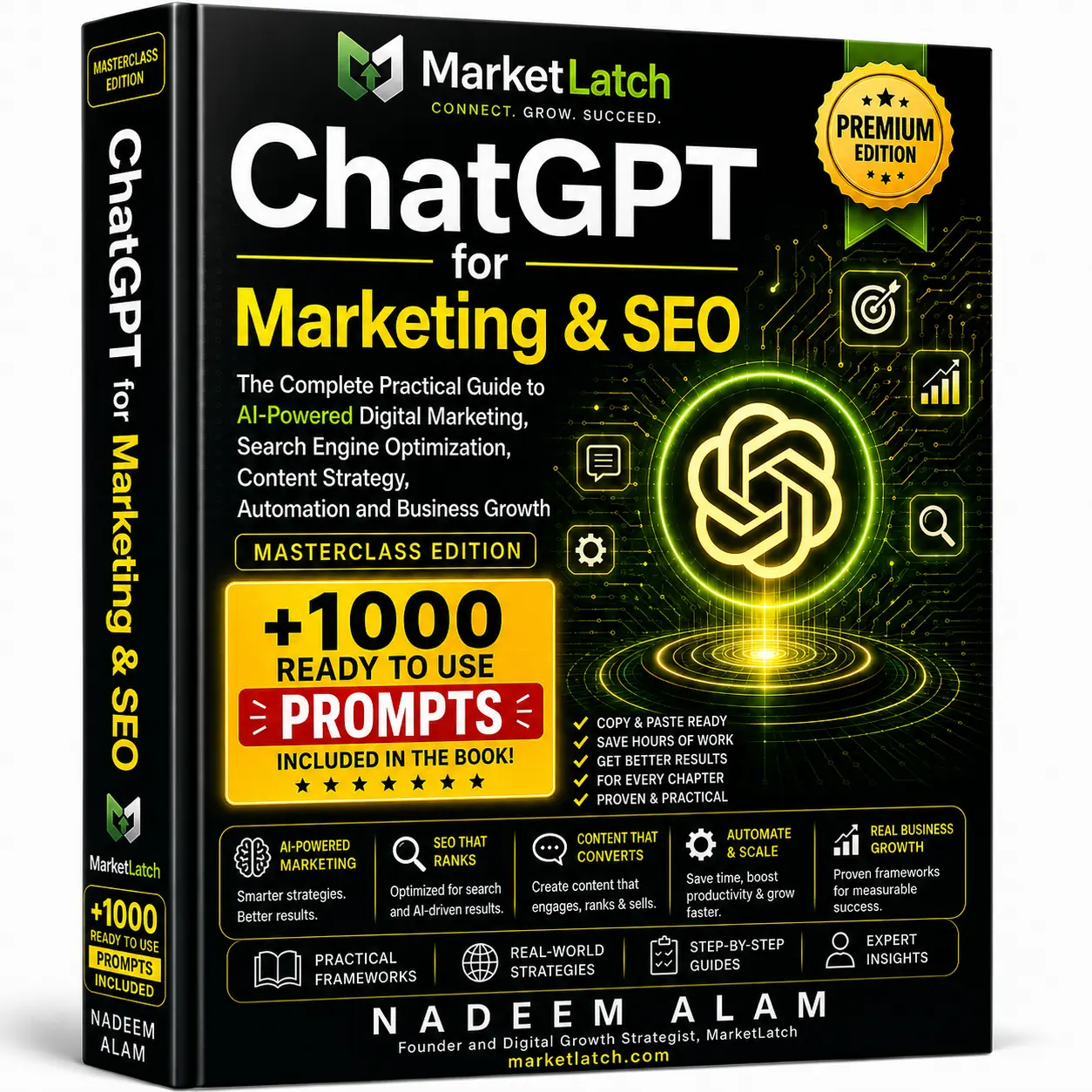
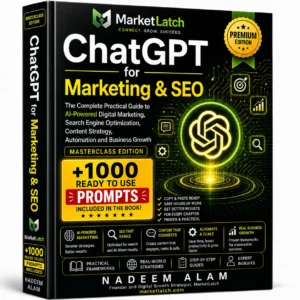
ChatGPT for Marketing & SEO: The Complete Practical Guide to AI-Powered Digital Marketing, Search Engine Optimization, Content Strategy, Automation and Business Growth is written by Nadeem Alam and published by Market Latch. This is Edition 1.0, published and content-reviewed in August 2026.
It is organized into four parts plus a reference section:
- Part 1 — Foundations (Chapters 1–5). How these systems actually work, where they help, where they fail, and how to direct them.
- Part 2 — Search (Chapters 6–9). SEO fundamentals in the AI era, technical SEO and site architecture, keyword research and content production, and on-page, semantic and entity optimization.
- Part 3 — AI Search and Authority (Chapters 10–12). AI answers and citation, the off-page work that makes claims believable, and three contexts where the rules differ: local, eCommerce and international.
- Part 4 — Growth and Operations (Chapters 13–14). Paid media, funnels and conversion, then the measurement, systems and ethics that decide whether any of it compounds.
- Reference (Chapter 15). The 1,000-prompt library — 1,000 prompts across 26 categories, in five volumes.
The book assumes you are intelligent and possibly new to the subject. Every technical term is defined the first time it appears, explained in terms of why it matters, illustrated with an example, and connected to how AI assistance applies to it. No knowledge of machine learning, statistics or code is assumed.
What You Will Learn
ChatGPT and AI Foundations
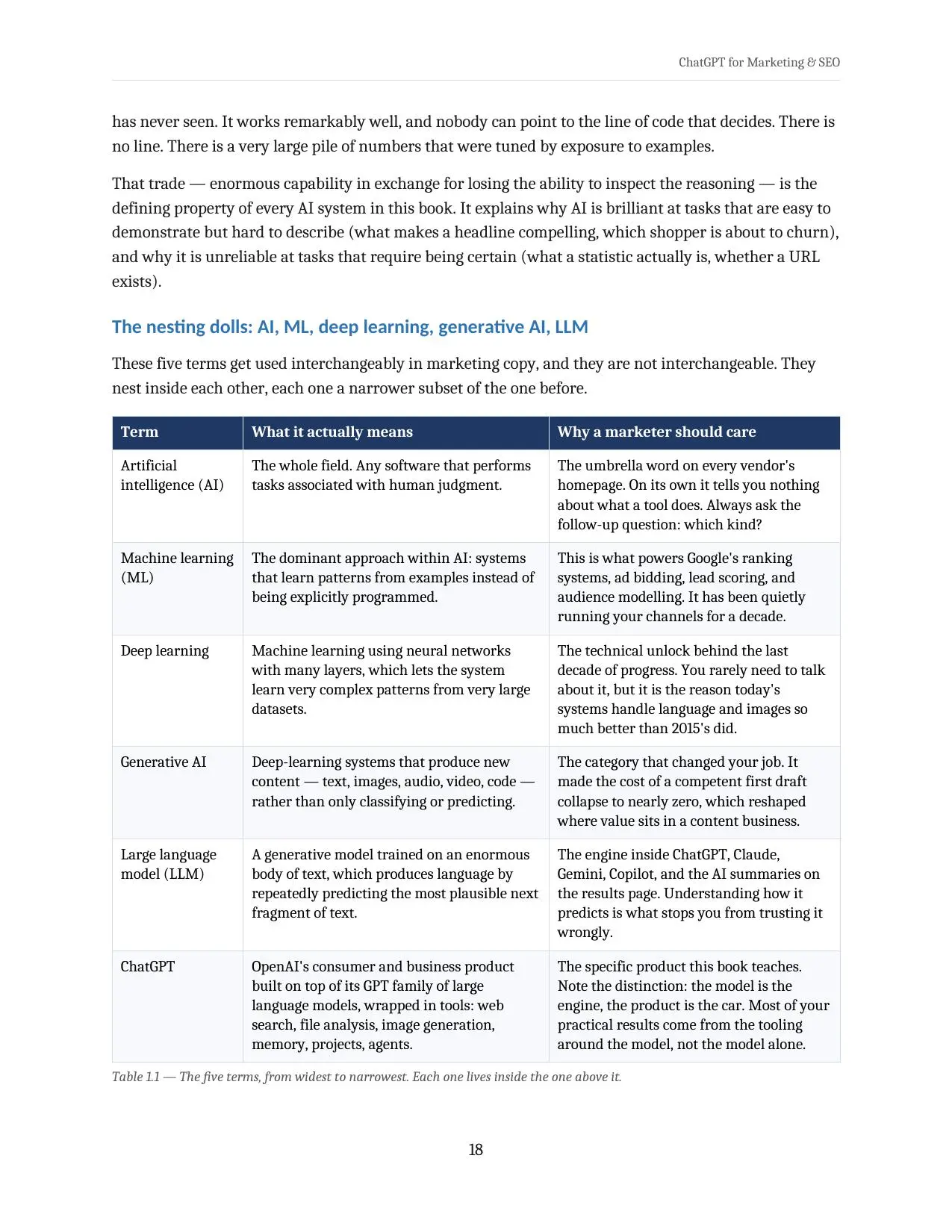
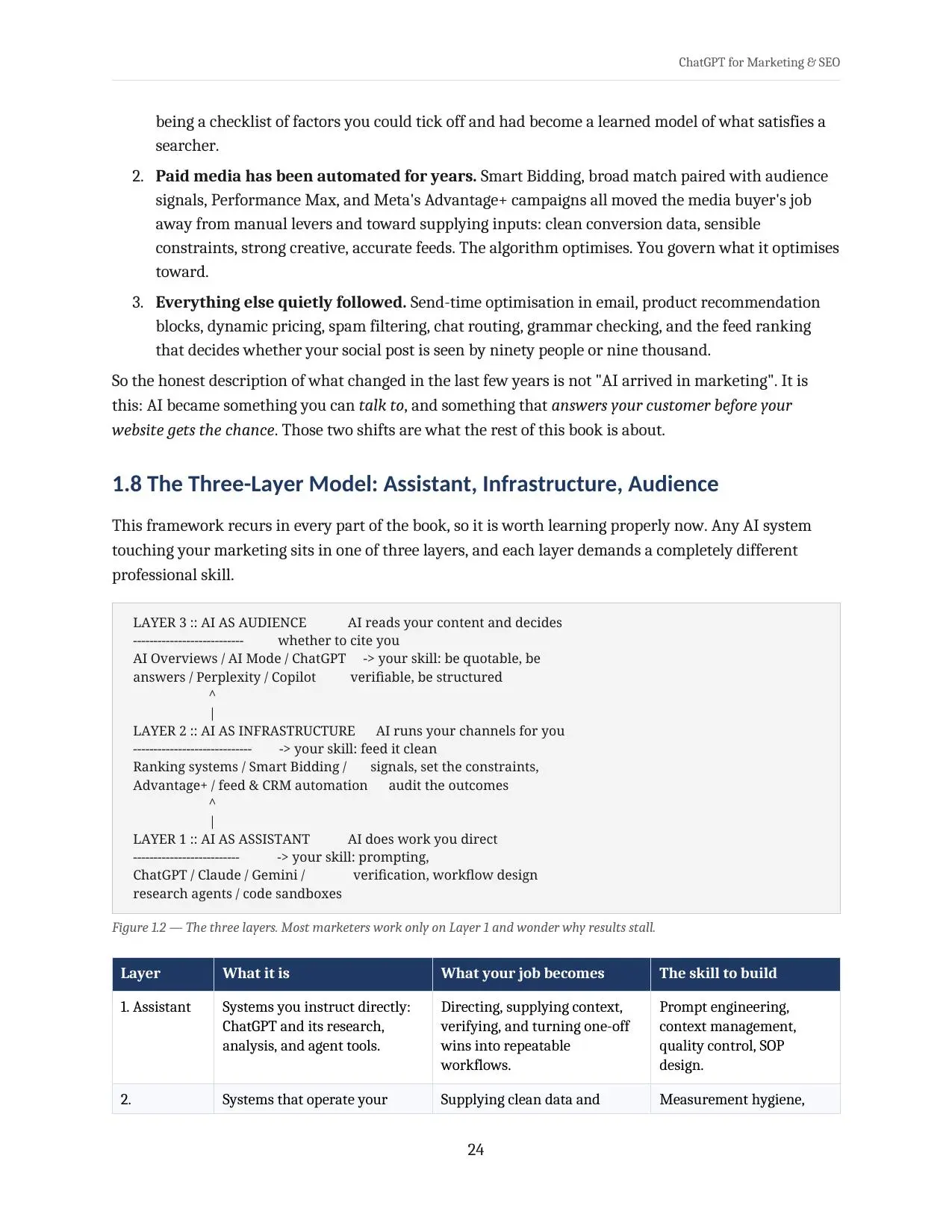
Chapters 1 to 3 build the mental model everything else depends on: what artificial intelligence actually is in plain English, the four kinds of AI you meet in a normal marketing week, why hallucination happens and how professionals handle it, what model training produces and what it cannot, and how to read a model launch without being sold to. You also get the three-layer model used throughout the book — AI as assistant, AI as infrastructure, and AI as audience.
Prompting, Context and Workflow Design
Chapter 2 covers the part most people skip: context windows, memory, session hygiene, and the four places an instruction can live. Chapter 5 covers professional prompting — prompt anatomy, what to supply and what to withhold, role prompting and what it does not do, constraints that actually hold, chains, evaluation before a human sees the work, and ten anti-patterns. The book’s position is blunt: a large share of disappointing AI output is a missing context pack rather than a weak prompt.
SEO Fundamentals and Technical Foundations
Chapter 6 covers crawling, indexing and ranking as three distinct stages, reading search intent from the results page, and a myths file for the folklore that AI models will happily repeat back to you. Chapter 7 covers the technical hierarchy — crawl access and budget, rendering, site architecture, structured data, the four situations that break sites, performance, and how to write findings developers will actually implement.
Keyword Research, Content Strategy and Production
Chapter 8 covers where demand actually lives, clustering to one page per intent, anchoring strategy to commercial outcomes rather than traffic potential, the brief, the production workflow, auditing an existing library, and measuring content properly.
On-Page, Semantic and Entity Optimization
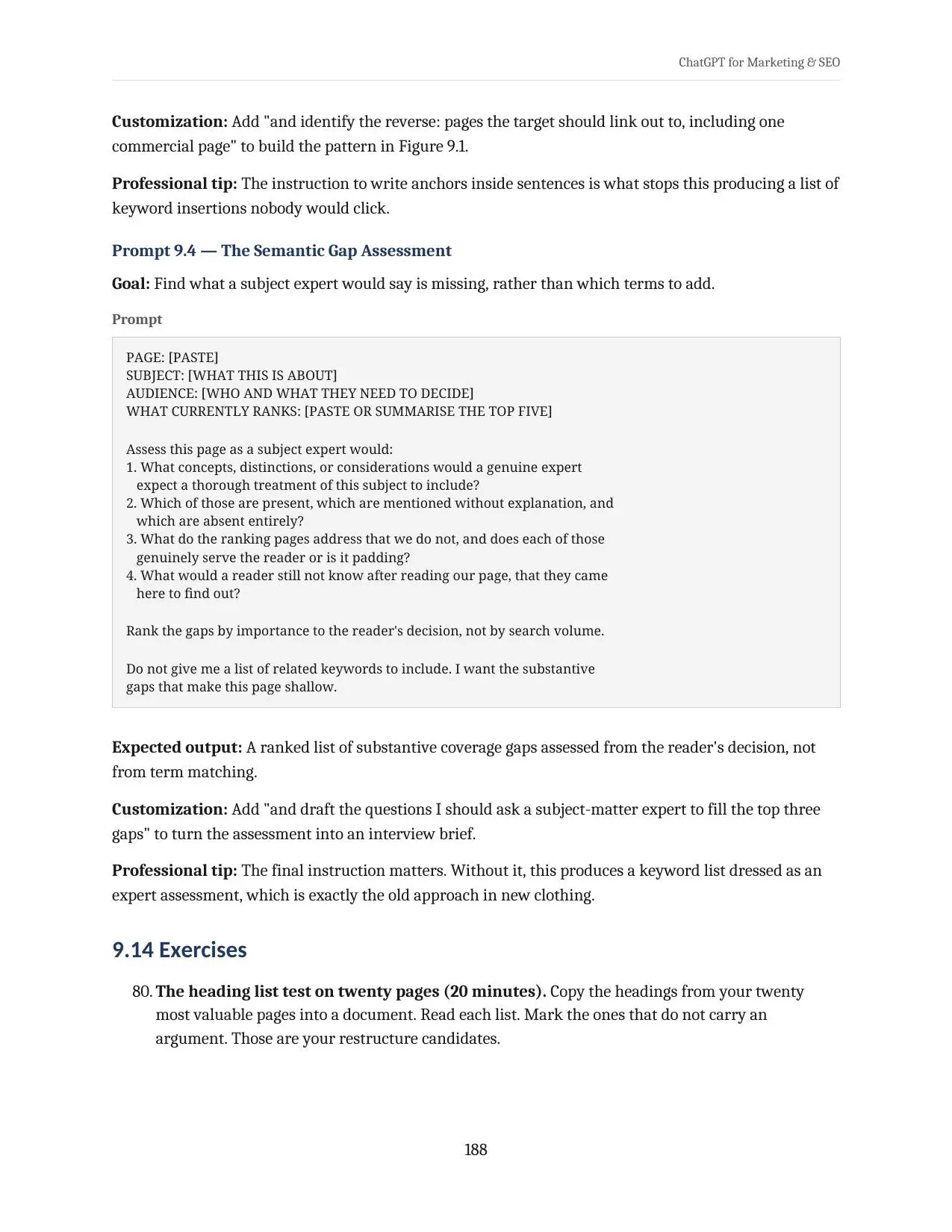
Chapter 9 treats the page as something written for two readers. Titles and descriptions, heading structure as argument, semantic depth without stuffing, entity clarity, internal linking as a system, and extractability — writing passages that can be lifted and quoted accurately.
AI Search, GEO and AEO
Chapter 10 covers what changed on the results page, the published evidence on clicks and its limitations, measuring visibility you cannot see in analytics, how answer engines choose sources, and a 90-day plan for an existing site. This pairs directly with the free ChatGPT SEO guide on this site if you want to see the approach before you buy.
Authority, Digital PR and Reputation
Chapter 11 covers what off-page work is actually for, the corroboration principle, auditing a link profile, the newsworthiness test, assets people link to, outreach that gets replies, entity building, and how to report slow work without losing the client.
Local, eCommerce and International Search
Chapter 12 covers what you can and cannot change in local search, why eCommerce is a data problem wearing a content costume, and why international failures are rarely technical.
Paid Media, Funnels and Conversion
Chapter 13 covers conversion tracking and value, account structure and bidding, creative and signals, diagnosing paid performance, funnels and landing pages, honest testing, and incrementality.
Analytics, Operations and Automation
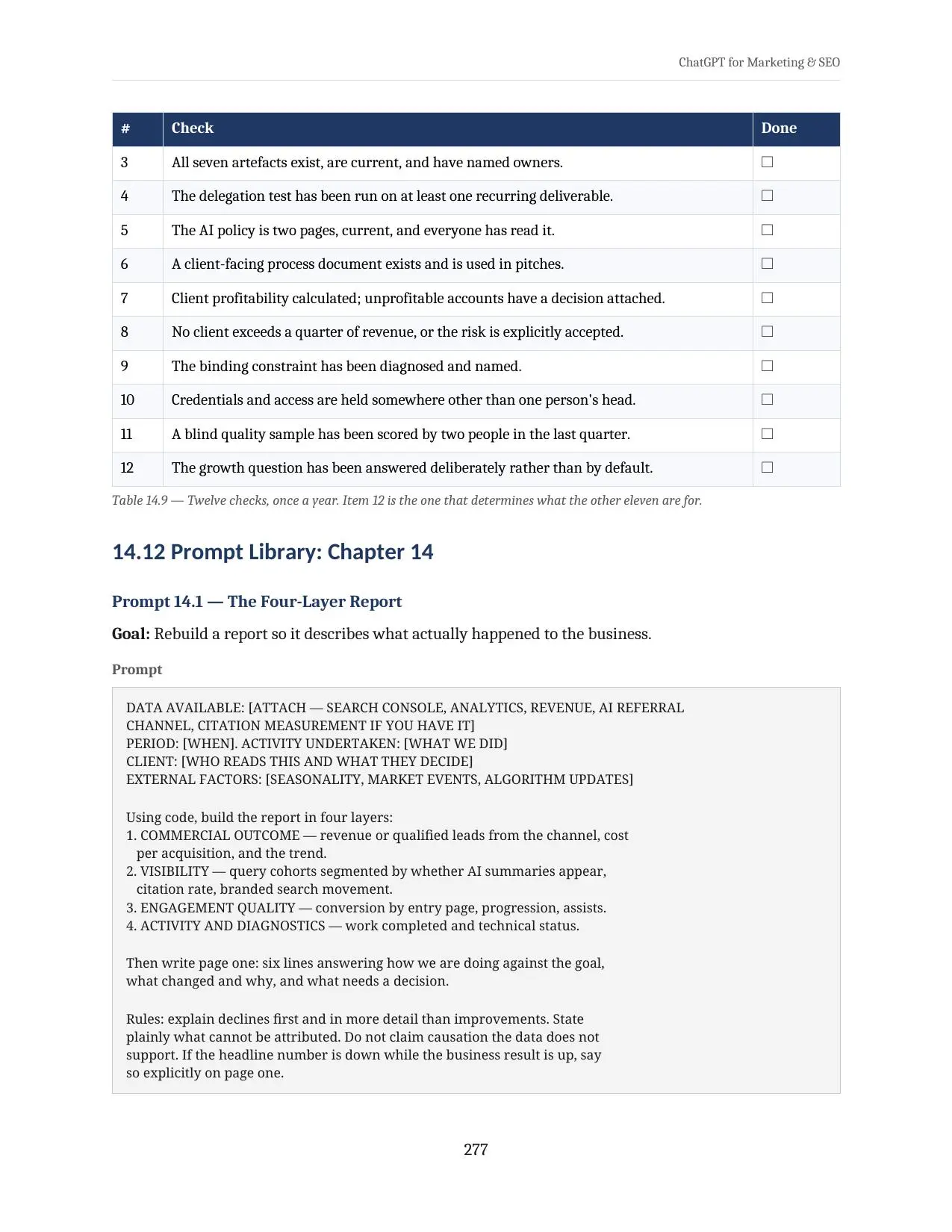
Chapter 14 covers rebuilding the client report so commercial outcomes come first, the analysis workflows, the seven artefacts a practice needs, AI policy and disclosure, client economics, and whether to scale at all.
1,000 ChatGPT Prompts for Marketing and SEO
Chapter 15 is a reference section, not a chapter. It contains 1,000 prompts organized into 26 categories across five volumes, written so you can paste them, replace the bracketed variables, and get a usable result on the first run.
Table 1 — The prompt library at a glance.
| Volume | Coverage | Prompts |
|---|---|---|
| Volume 1 | Search and Content | 001–200 |
| Volume 2 | Technical, Local, eCommerce and International | 201–400 |
| Volume 3 | Visibility, Authority and Reputation | 401–600 |
| Volume 4 | Paid Media, Email and Conversion | 601–800 |
| Volume 5 | Analytics, Operations and Growth | 801–1000 |
The 26 categories include keyword research, search intent and clustering, content strategy, content writing and optimization, on-page SEO, technical SEO, site architecture and internal linking, structured data and schema, local and multi-location SEO, eCommerce SEO, international and multilingual SEO, generative and answer engine optimization, digital PR, link building and outreach, entity building, reputation and reviews, Google Ads, Meta and LinkedIn advertising, email and lifecycle automation, funnels and landing pages, conversion optimization, analytics and reporting, proposals and pitching, onboarding, agency operations and SOPs, and AI workflow and career development.
Every prompt in the library sits at the first step of one chain, which the book repeats deliberately:
PROMPT → OUTPUT → VERIFICATION → JUDGMENT → DEPLOYMENT
Remove verification and the output is a plausible guess with your name on it. Remove judgment and you have published something nobody chose. These ChatGPT prompts for marketing are designed to chain — research, then clustering, then brief, then draft, then optimization — with each one consuming the previous output.
ChatGPT for Digital Marketing: Where It Helps and Where It Does Not
The book is deliberately even-handed about scope. Chapter 4 assesses the marketing value chain honestly, names the five workflows that pay back first, and — unusually for this category — names what not to automate.
Practical applications covered across the book include:
- Research: customer language, competitor gap analysis, market and audience research, and the questions a topic must answer.
- Content: briefs, drafts, editing passes, library audits, and consistency across multiple writers.
- SEO: intent classification, clustering, on-page review, internal link mapping, and technical findings written for developers.
- Campaign planning: offer construction, funnel mapping, landing page structure, and testing plans that are honest about sample size.
- Paid media workflows: account structure, creative variation, negative keyword logic, and performance diagnosis.
- Reporting and analysis: the four-layer report, anomaly explanation, and commentary that survives a client asking “so what?”
- Operations: SOPs, onboarding documents, proposals, and workflow documentation that keeps capability in the business.
The framing throughout is that AI assists professional judgment rather than replacing verification and expertise. Rule 1 of the book, introduced in Chapter 1 and repeated on purpose: never publish a number, name, date, quotation, statistic, law or link that you have not personally verified at its original source.
If you would rather have this run for you than run it yourself, that is what the SEO services and content marketing practices at Market Latch exist for.
SEO Prompts for ChatGPT: What You Can Actually Do With Them
Roughly half the library is search work. The SEO prompts for ChatGPT in Volumes 1 and 2 cover the tasks that consume most of a practitioner’s week:
- Keyword research (001–040). Seed expansion, long-tail generation, question harvesting, competitor gap finding, and commercial intent filtering. These assume you will validate volume and difficulty in a real tool afterwards — the book is explicit that you should never accept a search volume figure from a language model.
- Search intent and clustering (041–065). Intent classification, one-page-one-intent clustering, and cannibalization checks.
- Content strategy and briefs (066–100). Roadmaps anchored to commercial outcomes, and briefs a writer can work from.
- Content writing and optimization (101–150). Drafting, editing, tightening, and rewriting for extractability.
- On-page SEO (151–200). Titles, descriptions, heading structure, semantic depth, and page-level audits that produce a work list.
- Technical SEO, architecture and schema (201–310). Crawling and indexing diagnostics, internal linking systems, and structured data — checked against Google’s structured data documentation and the Schema.org vocabulary rather than invented from memory.
- Local, eCommerce and international SEO (311–400). Multi-location content, product data problems, and hreflang and market-entry work.
These ChatGPT SEO prompts are starting positions, not finished answers. A prompt you have adapted to your own workflow will outperform anything printed in the book, and the library says so on its first page. If you want a task-by-task implementation companion for the same work, the AI SEO Implementation Checklist pairs well with this volume.
AI Search, GEO and AEO — Handled Honestly
Part 3 covers generative engine optimization (GEO) and answer engine optimization (AEO) because they are the terms the industry has settled on and you will encounter them. The book attaches four clarifications to both, and repeats them:
- They are industry terms, not official systems. Google has not announced a “GEO algorithm,” and no search or AI company publishes a ranking system by that name. Google’s own guidance on AI features and your website and its AI optimization guidance are the primary sources the book points you back to.
- They are not a replacement for SEO. Answer engines draw heavily on pages that are already crawlable, indexed and ranking. Part 2 remains the foundation; Part 3 describes what changes on top of it.
- Multiple systems are involved and they differ. Google AI Overviews, Google AI Mode, ChatGPT, Gemini, Claude, Perplexity and Copilot use different retrieval approaches and cite different kinds of source. Crawler access is a separate decision from content quality, which is why the book sends you to OpenAI’s crawler documentation and Bing’s webmaster guidelines rather than to a blog post.
- Nobody can guarantee AI citations. Not this book, not any agency, not any tool. Results are non-deterministic — the same prompt can produce different sources on different days.
What the book says is within your control is narrower than the marketing around this subject suggests, and still substantial: publishing content accessible to crawlers and retrieval systems, answering real questions clearly enough to be quoted accurately, supporting claims with evidence a machine can find corroborated elsewhere, making your organization identifiable, and measuring citation systematically so you know whether any of it worked.
Readers who want a deeper single-topic treatment of this area can go further with the GEO Blueprint or the AEO Masterclass.
How the Book Handles Evidence
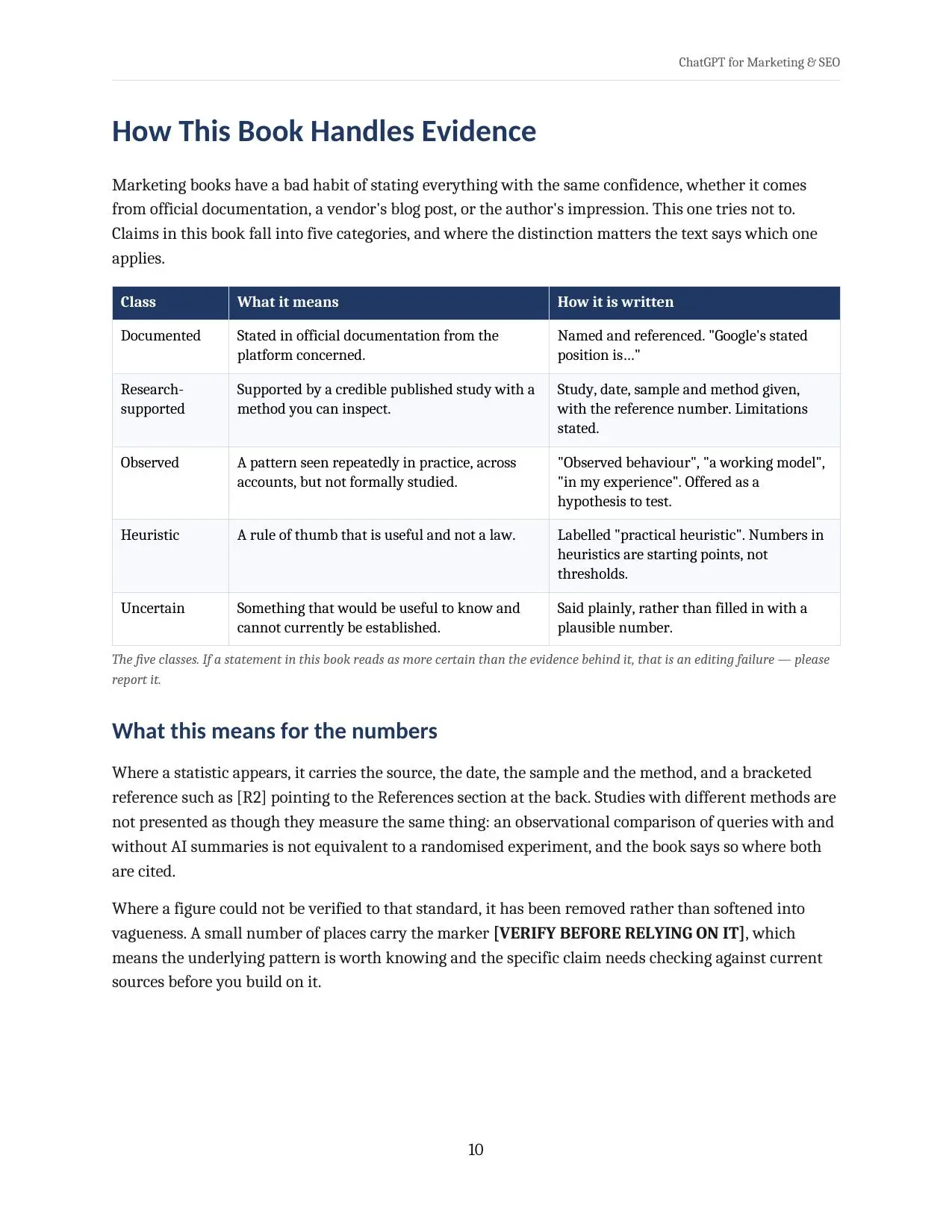
This is the part that most distinguishes the book, and it is worth knowing before you buy. Claims fall into five labelled classes, and where the distinction matters the text says which one applies:
- Documented — stated in official platform documentation, named and referenced.
- Research-supported — a credible published study, with date, sample, method and limitations stated.
- Observed — a pattern seen repeatedly in practice but not formally studied, offered as a hypothesis to test.
- Heuristic — a rule of thumb, with numbers treated as starting points rather than thresholds.
- Uncertain — said plainly, rather than filled in with a plausible number.
Where a figure could not be verified to that standard it was removed rather than softened into vagueness. A small number of places carry a [VERIFY BEFORE RELYING ON IT] marker. The case studies are composite practitioner scenarios drawn from patterns across multiple engagements; names and details are changed and figures are illustrative, not audited client results. The book states this up front rather than in the small print.
Who Should Read This Book?
- SEO professionals — Parts 2 and 3 in depth, plus roughly 600 search-related prompts covering technical, on-page, local, eCommerce, international and AI search work.
- Digital marketers — the full arc from research through content, paid media, conversion and reporting, with the workflow design to connect them.
- Freelancers — the prompt library as a production system, plus the proposal, pitching and client management categories in Volume 5.
- Agency owners — Chapter 14 on operations, client economics, AI policy and disclosure, the binding constraint on the practice, and whether to scale at all.
- Business owners doing their own marketing — plain-English foundations, checklists designed to be printed, and seven-day action plans. Chapter 14 can wait until you have staff.
- Content marketers and writers — briefs, drafting, editing, extractability, and consistency across multiple writers.
- eCommerce operators — Chapter 12 on product data, plus the eCommerce SEO prompt category. Also see eCommerce marketing at Market Latch.
- Marketing teams — the standardization argument: context packs, documented workflows, and the seven artefacts a team needs so capability stays when a person leaves.
- Beginners — every term is defined on first use, with an example and an application. Read Part 1 in order.
- Experienced practitioners — skim Part 1 for the framing, then use Chapter 15 as a reference and Chapter 14 as an operations review.
Why This Book Is Different
- It is a practitioner’s book, not a survey. Frameworks like context packs, the verification gate, the four-layer report and the frozen prompt set were built to answer client questions before they were written down.
- Evidence is classified, not asserted. Five labelled classes, sources dated, methods described, limitations stated.
- The coverage is unusually broad for one volume. Foundations, search, AI search, authority, local, eCommerce, international, paid media, conversion, analytics and operations.
- The SEO is deep, not decorative. Four chapters of search fundamentals before AI search is introduced at all.
- 1,000 prompts, structured. 26 categories, five volumes, bracketed variables, and tips attached to individual prompts.
- Verification is built into the method. Rule 1 applies to every prompt in every volume.
- Chapter furniture you can act on. Every chapter closes with case studies, common mistakes, professional tips, a printable checklist, exercises, an action plan, a summary and FAQs.
- It says what it does not know. The uncertainty class exists precisely so gaps are visible.
What You Get
- The complete book — 15 chapters across four parts, plus a reference section
- The 1,000-prompt library — 26 categories in five volumes
- Case studies in every chapter (composite practitioner scenarios)
- Common mistakes and professional tips sections in every chapter
- Printable checklists — AI readiness, client workspace setup, technical health, page-level review, AI search readiness, paid account review, annual practice review and more
- Exercises and seven-day, 30-day and 90-day action plans
- Chapter summaries and per-chapter FAQs
- A referenced sources section with dates, samples and methods
- Instant digital download after purchase
Get ChatGPT for Marketing & SEO — Edition 1.0 →
Also worth seeing: the rest of the Market Latch digital library, including the AI search titles that go deeper on single topics.
Who This Book Is Not For
Qualification matters more than persuasion here, so plainly — this is not:
- A programming book. No code is required and none is assumed.
- A theoretical AI textbook. There is no mathematics and no machine learning theory beyond what changes a marketing decision.
- A guaranteed ranking or citation system. The book states directly that no method — its own included — can guarantee rankings, AI citations, traffic levels or revenue.
- A replacement for expertise. The whole method assumes a professional making judgment calls and carrying accountability.
- A copy-paste prompt pack. Every prompt assumes a loaded context pack and a verification step. Used without either, the output will be generic and occasionally wrong.
- A permanent reference. Platform features, model names, plan limits and published statistics change quickly. The book describes principles and tells you where the vendor documentation lives.
Book at a Glance
| Title | ChatGPT for Marketing & SEO |
| Author | Nadeem Alam |
| Publisher | Market Latch |
| Edition | 1.0 — August 2026 |
| Structure | 15 chapters, 4 parts, 1 reference section |
| Prompt library | 1,000 prompts · 26 categories · 5 volumes |
| Level | Beginner to advanced practitioner |
| Format | Digital download |
Frequently Asked Questions
1. What is this ChatGPT for Marketing book about?
It is a practical guide to using ChatGPT inside a professional marketing and SEO practice. Fifteen chapters cover AI foundations, prompting and context design, SEO fundamentals, technical SEO, keyword research and content production, on-page and semantic optimization, AI search, digital PR and authority, local, eCommerce and international search, paid media and conversion, and analytics, operations and ethics — followed by a 1,000-prompt reference library.
2. Who is this book for?
SEO practitioners at any level, digital marketers, agency owners and freelancers, business owners doing their own marketing, content writers, eCommerce operators, and marketing teams deciding what to standardize.
3. Is it useful if I already work in SEO professionally?
Yes. Parts 2 and 3 are written at practitioner depth, and Chapter 14 addresses operations, client economics, disclosure policy and scaling decisions. Experienced readers typically skim Part 1 for the framing and use Chapter 15 as a working reference.
4. Does the book include ChatGPT prompts for marketing?
Yes — 1,000 of them, organized into 26 categories across five volumes, with bracketed variables to replace and usage tips attached to individual prompts.
5. How many prompts are included, and how are they organized?
Exactly 1,000. Volume 1 covers search and content (001–200), Volume 2 technical, local, eCommerce and international (201–400), Volume 3 visibility, authority and reputation (401–600), Volume 4 paid media, email and conversion (601–800), and Volume 5 analytics, operations and growth (801–1000).
6. Does it include SEO prompts for ChatGPT specifically?
Yes. Volumes 1 and 2 are search work end to end — keyword research, intent and clustering, content strategy, writing and optimization, on-page SEO, technical SEO, architecture and internal linking, structured data, local, eCommerce and international.
7. Does the book cover AI search and GEO?
Chapter 10 covers AI search, generative engine optimization and answer engine optimization, including how answer engines choose sources, measuring visibility you cannot see in analytics, and a 90-day plan for an existing site. The book is explicit that GEO and AEO are industry terms describing a practitioner discipline, not official algorithms announced by any search or AI company.
8. Does it cover AEO as well?
Yes, in the same chapter and in prompt category 15.12 (prompts 401–450), which covers generative and answer engine optimization together.
9. Does it cover technical SEO?
Chapter 7 covers crawl access and budget, rendering, site architecture, structured data, the four situations that break sites, performance, and how to write findings developers will implement. Prompts 201–310 support the same work.
10. Does it cover local and eCommerce SEO?
Chapter 12 covers local, eCommerce and international search in one place, with prompts 311–400 supporting all three. If you would rather have local search handled for you, see Google Business Profile optimization.
11. Does it cover paid media and email?
Chapter 13 covers paid media, funnels and conversion — tracking and value, structure and bidding, creative, diagnosis, landing pages, testing and incrementality. Email marketing is covered in the prompt library, in category 15.19 (prompts 686–725) on email and lifecycle automation, rather than as a standalone chapter.
12. Is this suitable for beginners?
Yes. Every technical term is defined the first time it appears, explained in terms of why it matters, and illustrated with an example. No knowledge of machine learning, statistics or code is assumed. Beginners should read Part 1 in order before jumping around.
13. Does the book guarantee SEO rankings or AI citations?
No, and it says so directly. Search and AI systems are non-deterministic; rankings, AI answers and citations vary by user, location, device, time and phrasing. The book states that no method described in it — and no method offered by anyone — can guarantee rankings, AI citations, traffic levels or revenue outcomes.
14. How does this compare to the other Market Latch books?
This is the broad one. The GEO Blueprint, the AEO Masterclass and Algorithmic Content Optimization each go deep on a single discipline. This book covers the whole marketing practice and adds the 1,000-prompt library.
Why Buy From Market Latch
Market Latch is a digital marketing practice working with clients across the United States, United Kingdom, Canada, Australia, the Gulf and Pakistan. The work is search-led — technical SEO, content strategy and AI-search visibility — alongside WordPress and WooCommerce implementation, paid search and paid social.
The frameworks in this book were built in client work before they were written down, which is also why the book is willing to say where the evidence runs out. If you want to see the approach before buying, read the ChatGPT SEO guide or request a free SEO audit. Questions about the book can go to info@marketlatch.com or through the contact form.
Get ChatGPT for Marketing & SEO + the 1,000-Prompt Library →
Prefer to start narrower? The AI SEO Implementation Checklist covers the same search work as a task list.


Reviews
There are no reviews yet.